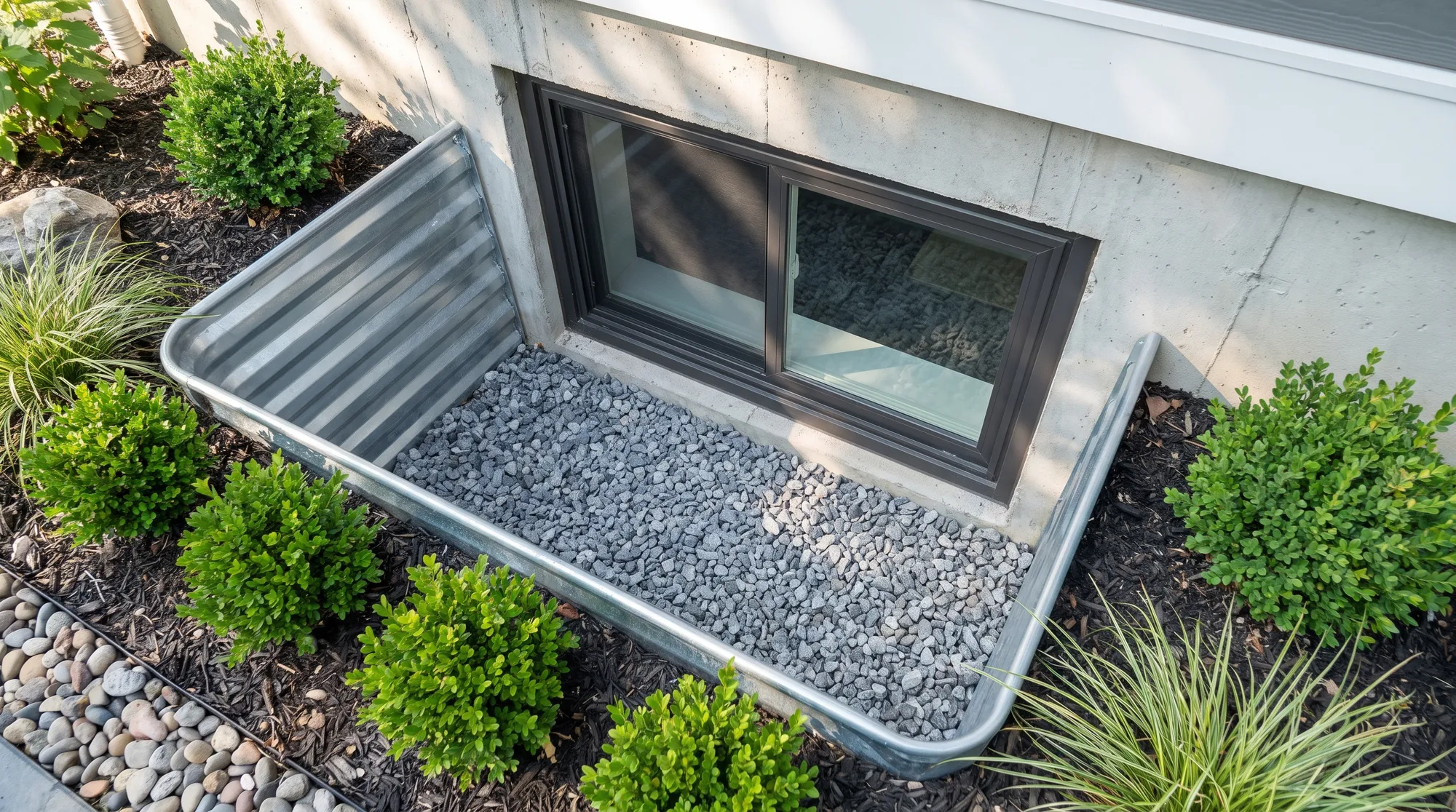
Almost every wet-basement call that starts with "water is coming in under the basement window" ends at the same place: a window well that stopped doing its job. The well is a small, unglamorous piece of the building envelope, but it is the only thing standing between your below-grade window and the soil around it. Here is how wells are supposed to be sized and drained, what an hour of fall maintenance prevents, and the egress rules you must respect when a bedroom window lives down there.
How a Window Well Keeps Water Out
A window well exists because part of your basement window sits below grade. The well — a galvanized steel, plastic or masonry surround — holds the soil back and creates an air space in front of the glass. Water that lands in that space is supposed to fall through a gravel base and reach the foundation's drainage system, never rising high enough to touch the window frame.
When it works, the well is invisible in your life. When it fails — clogged gravel, a blocked drain, soil that has slumped into the pit — rainwater ponds against the window like a small aquarium, and basement windows are not designed to hold back standing water. Even a well-installed unit will leak under hydrostatic pressure at the sill, and the leak announces itself during exactly the multi-day fall rains when the ground is already saturated.
The physics matter for diagnosis: water at a basement window is almost never a window defect. It is a drainage defect, and replacing the window without fixing the well simply schedules the next leak.
Sizing a Well Properly
A well needs to be larger than the window it protects. As working rules: it should extend roughly 200 mm (8 inches) beyond the window opening on each side, project at least 500 mm out from the foundation so the sash can open fully and the space can be maintained, and reach 200 mm below the bottom of the window frame so splashing water and accumulating debris stay below the sill.
Depth below the frame is the spec most often missed. Over the years, gravel silts up and leaves compost into soil, quietly raising the floor of the well until it sits level with the frame — at which point every rain delivers water directly against the assembly. If you can no longer see 150 to 200 mm of clean gravel below the window, the well has effectively shrunk.
The top edge matters too: the well rim should stand 50 mm or so above the surrounding grade, not flush with it, so surface runoff flows around the pit instead of into it. A well that has settled below grade is a funnel, and no amount of interior caulking will out-argue a funnel.
The Gravel Base and the Drain Below
Under the well sits its real working part: 150 to 300 mm of clean 20 mm (3/4-inch) crushed stone, ideally connected down to the foundation's French drain by a vertical gravel column or a rigid perforated pipe. Water entering the well percolates through the stone and exits through the weeping tile — as long as both remain open.
Both clog on predictable schedules. Fine sediment washes into the gravel with every storm; leaves and organic debris compost on top and seal the surface within a couple of neglected autumns. The test is simple: pour in a large bucket of water and watch. If it disappears within a minute or two, the path is open; if it ponds, you have found the problem before November does.
Restoration is honest shovel work: excavate the fouled gravel, check that any standpipe to the drain is clear, and refill with washed stone over a layer of geotextile fabric that slows the next silting cycle. On older Montreal-area homes where the French drain itself has failed — common on pre-1980 foundations — a camera inspection by an RBQ-licensed contractor tells you whether the well drain has anywhere to send its water at all, before you spend on cosmetic fixes.
The One-Hour Fall Cleaning That Prevents Most Leaks
Late August and September, before the long fall rains, is the moment. The routine is short and pays for itself many times over.
Do it again in late fall after the trees finish dropping, and once in spring after melt. Three short visits a year is the entire maintenance burden of a healthy well.
While you are down there, inspect the window itself: check the caulking joint between frame and foundation, confirm weep holes on the exterior frame are open, and look for rust at the well's fastening points into the concrete. Ten extra minutes catches the small failures while they are still caulk-gun problems instead of excavation problems.
- Remove leaves, litter and any soil slumped into the well
- Verify 150–200 mm of visible clean gravel below the frame — dig out and top up if silted
- Run the bucket test: water should drain away within a minute or two
- Confirm the rim stands proud of the surrounding grade
- Re-seat or replace the cover before the fall rains
- Check frame caulking, weep holes and well anchors
Covers: Cheap Insurance, With One Rule
A clear polycarbonate cover is the highest-value accessory a well can have. It keeps out the leaves that clog gravel, the snow that melts against the glass in March, and the occasional unlucky squirrel, while still passing daylight into the basement. Sloped and bubble profiles shed water toward the surrounding grade instead of collecting it. Expect $60 to $200 for quality units at Quebec building centres, or more for custom-fabricated covers on oversized wells.
The one non-negotiable rule: on a well serving a bedroom egress window, the cover must be removable or openable from the inside without tools, keys or special knowledge. A screwed-down cover over an emergency exit is a code violation and a life-safety hazard — in a fire, nobody is coming out through a panel fastened with deck screws.
In winter, brush heavy snow off covers after major storms. A cover carrying half a metre of snow both blocks the egress route and can crack under the load during a thaw-freeze cycle.
Grading and Gutters: Solving the Problem Upstream
Most drowned wells are murdered upstream. If the lawn slopes toward the foundation, or a downspout discharges beside the well, the pit receives many times the water its drain was sized for. The ground should fall away from the foundation — a slope in the range of 10 cm over the first 1.5 to 2 metres is the standard target — and downspouts should discharge at least 1.5 to 2 metres from the wall, never into or beside a well.
Fall is the season to check this, because summer landscaping is the usual culprit: new garden beds, edging and mulch quietly reverse the grade over a few seasons. Sight along the foundation after a rain and watch where the water actually goes; puddles that linger against the wall are next spring's leak, filing its paperwork early.
If regrading is not practical — tight lot lines in older Montreal boroughs often leave no room — a well extension that raises the rim, plus a sloped cover, achieves most of the same protection by refusing the surface water entry in the first place.
Egress Rules: When the Well Is an Emergency Exit
If a basement bedroom relies on its window as the emergency exit, the construction code sets hard requirements. The window must provide an unobstructed opening of at least 0.35 m² with no dimension smaller than 380 mm, and it must be openable from inside without tools or special knowledge. When a well fronts that window, the well must leave a clearance of at least 760 mm in front of the fully opened sash so an occupant can actually climb out — a person has to fit and move in that space, not just the window hardware.
Window style interacts with the well here. A casement that swings into the pit can eat the required clearance, which is one reason horizontal sliders are so common below grade: a single-slider window opens within its own plane, consuming none of the well's depth while still providing a compliant opening when sized correctly. Deep wells, for their part, should include a step or fixed ladder once they exceed roughly a metre in depth.
These rules are commonly triggered during basement bedroom conversions, and inspectors check them. If you are legalizing a basement bedroom, have the window supplier confirm the clear-opening dimensions in writing and size the well to match — retrofitting a too-small well in frozen November ground is nobody's favourite project.
When to Call a Professional
Call in help when the bucket test fails after you have cleaned and re-gravelled the well — that points to a blocked standpipe or a failed French drain, which is excavation or drain-camera territory. Same if you see white efflorescence or damp arcs on the foundation wall around the window frame, which suggest water is moving through the concrete, not past the window.
Persistent leaking at the window itself despite a dry, functioning well usually means the original installation was never properly flashed and sealed to the foundation. That is a replace-and-do-it-right situation, and in Quebec the contractor performing it must hold an RBQ licence — ask for the number and check it, because below-grade window installation punishes shortcuts more brutally than any other opening in the house.
Budget-wise: a DIY clean and re-gravel costs $30 to $80 in materials; a new well liner installed runs $300 to $800; connecting a well drain to the weeping tile, or excavating to repair the drain itself, climbs from $1,000 into five figures depending on depth and access. The one-hour fall cleaning is what keeps you at the bottom of that ladder.
Frequently Asked Questions
Why does water come in at my basement window during heavy rain?
Almost always because the well is holding water instead of draining it — clogged gravel, a blocked drain connection, or surface runoff pouring in from bad grading or a nearby downspout. The window is rarely the root cause; it is simply the weakest point once water ponds against it. Fix the drainage first, then assess the window.
How deep should the gravel be in a window well?
Keep 150 to 300 mm of clean 20 mm crushed stone below the window frame, sitting over a drainage path to the foundation's French drain. If you can no longer see clean gravel 150 mm below the frame, silt and debris have raised the floor of the well and it is due for excavation and fresh stone.
Do window well covers cause moisture problems?
No — quality polycarbonate covers shed precipitation away from the well while ventilation gaps at their edges prevent condensation buildup. The one strict rule concerns egress: over a bedroom emergency-exit window, the cover must be openable from inside without tools, or it becomes both a code violation and a genuine hazard.
What are the egress requirements for a basement bedroom window in Quebec?
The window must offer an unobstructed opening of at least 0.35 m² with no dimension under 380 mm, openable from inside without tools. A well in front of that window must leave at least 760 mm of clearance in front of the fully opened sash, and any cover must be removable from inside. Confirm dimensions in writing when converting a basement bedroom.
When should I clean my window wells?
Three times a year: late summer before the fall rains, late fall once the leaves are down, and spring after the melt. Each visit is fifteen minutes to an hour — remove debris, verify the gravel drains with a bucket test, and check the cover. The late-summer visit matters most, because saturated fall ground gives drainage failures nowhere to hide.
How much does it cost to fix a window well that will not drain?
A DIY clean-out with fresh washed stone runs $30 to $80. A contractor-installed new well liner costs roughly $300 to $800. If the blockage is deeper — a failed standpipe or a collapsed section of French drain — excavation work starts around $1,000 and rises with depth and access, which is exactly why the cheap annual maintenance is worth doing.