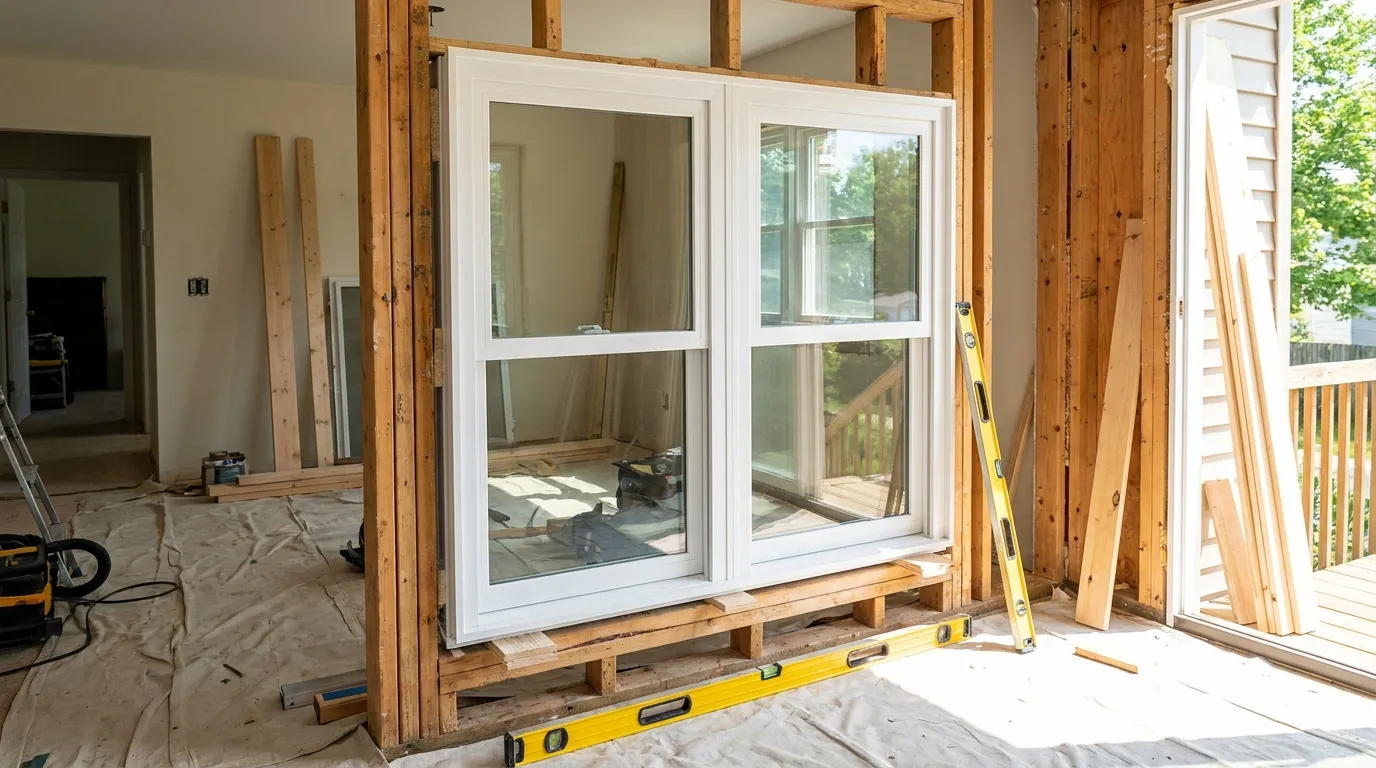
Ask ten Montreal homeowners when windows should be installed and nine will say summer, full stop. The truth is more interesting: professional crews replace windows twelve months a year in Quebec, and each season comes with real advantages and real trade-offs. Understanding both sides is how you get the best installation, the best price, and the shortest wait.
Why the season question matters more in Quebec
Quebec runs one of the widest temperature ranges of any populated region on the planet: a Montreal window can face 33 C with high humidity in July and -28 C with wind chill in January. That swing affects everything about an installation, from how sealants cure to how long your living room sits open to the outdoors while the old unit comes out.
It also drives a fiercely seasonal industry. Roughly speaking, demand for window replacement in greater Montreal peaks from May through September, and manufacturers' order books fill accordingly. When you choose your season, you are not just choosing weather, you are choosing your position in that queue, and that has consequences for price and lead time.
The good news is that there is no wrong answer. Modern materials, ENERGY STAR Zone D certified units, and proper cold-weather technique mean a January installation can perform exactly as well as a June one over the life of the window. What changes is the experience, the schedule, and sometimes the invoice.
The case for summer: curing, comfort, and daylight
Summer is the textbook season for a reason. Most caulking and low-expansion foams have an ideal application range of roughly 5 to 30 C, and in July they cure quickly and fully without any special handling. Crews can work long daylight hours, remove several windows at once without chilling the house, and take their time on exterior finishing details like aluminum capping and brickmould caulking.
Comfort is the other obvious win. With an opening exposed for 30 to 60 minutes per window, a summer changeout means at worst a warm breeze through the house, not a heat-loss emergency. If your project involves many openings, or structural work like enlarging a rough opening, the forgiving weather removes a lot of scheduling pressure.
The trade-off is that everyone else has the same idea. Peak-season lead times at Quebec manufacturers commonly stretch to 8 to 12 weeks from signature to installation, and the best crews are booked solid. Quoting discounts are rarer, and a rainy week can still bump your date because exterior sealing should not be done on soaked surfaces.
- Ideal curing conditions: caulking and foam perform at their best between 5 and 30 C.
- No heat-loss stress: multiple openings can be worked at once without freezing the house.
- Long days: more installation hours per visit, fewer return trips.
- The catch: peak demand means longer lead times and firmer pricing.
Winter installation: how professionals make it work
A qualified crew treats a winter changeout as a controlled, one-opening-at-a-time operation. The room is isolated with plastic dust and thermal barriers, the new window is staged and prepped indoors, and the actual exposure of the opening is compressed to roughly 20 to 40 minutes. Your furnace barely notices, and the rest of the house never drops more than a degree or two.
Materials are the second half of the answer. Installers switch to cold-weather sealants rated for application down to around -29 C and to winter-formula low-expansion foams that cure properly in the cold. Exterior caulking joints are tooled immediately, and any finishing that genuinely needs warmth can be scheduled for a short spring follow-up, though with modern products that is the exception rather than the rule.
There is even a diagnostic bonus: in winter, an installer can feel drafts and see frost patterns that reveal exactly where your old windows were failing, and can verify on the spot that the new unit and its insulation have eliminated them. A blower-door-minded installer will tell you January is the most honest month for judging an installation.
Price and lead time: where the seasons really diverge
Window pricing in Quebec is not officially seasonal, but capacity economics are. From roughly November through March, manufacturers want to keep production lines running and crews want to keep working, so promotional pricing, negotiation room, and bundled extras are noticeably more common. Savings of 5 to 15 percent on a mid-winter contract versus the identical June project are a realistic expectation, which on a $15,000 whole-home project is real money.
Lead times follow the same curve in reverse. An order signed in January might be manufactured and installed within 3 to 6 weeks; the same order signed in May can sit at 8 to 12 weeks, pushing your installation into the fall anyway. Many savvy homeowners split the difference: sign and lock pricing in winter, then choose an early-spring installation date before the rush.
One caution: a deep discount from a contractor you have never vetted is not a bargain. Whatever the season, confirm the installer holds a valid RBQ licence, carries liability insurance, and offers a written workmanship warranty. Our guide to professional window installation walks through exactly what a proper installation includes, step by step.
Caulking, foam, and cold: the technical fine print
The performance of an installation lives and dies in its seals, and temperature is the variable that matters most. Standard polyurethane and hybrid sealants applied below their rated temperature can skin poorly, adhere weakly to frosted surfaces, and crack during their first freeze-thaw cycles. This is the legitimate root of winter-installation skepticism, and it is why product selection matters more in January than in July.
Professionals solve it with chemistry and preparation rather than by refusing the work. Surfaces are cleaned dry and frost-free, sometimes warmed; cartridges are kept at room temperature until the moment of use; and only sealants explicitly rated for low-temperature application go on the gun. The same logic applies to the polyurethane foam insulating the gap between frame and rough opening, where winter formulations cure by moisture at temperatures regular foam cannot handle.
For the homeowner, the takeaway is a single question to ask any winter bidder: which sealant and foam do you use below zero, and what is its rated application temperature? A professional answers in ten seconds. Hesitation is your cue to keep shopping.
A booking strategy for Quebec homeowners
If your windows are merely tired, not failing, the highest-value play is counter-seasonal: get quotes in late fall, sign in winter when pricing is softest, and install in late winter or early spring. You skip the queue, capture off-season pricing, and your new ENERGY STAR Zone D windows are in place before the next cooling season, with a target U-factor of 1.4 W/m2K or better doing its job by summer.
If a window has actively failed, a fogged sealed unit, a rotten frame, a sash that will not lock, do not wait for a season. A failed window costs you every single day in heating or cooling losses, comfort, and sometimes water damage, and any competent installer can replace it safely in any month. The math almost never favours delay.
Finally, fold the paperwork into your timing. The Rénoclimat program offers around $150 per window opening replaced with an eligible model after pre- and post-work energy evaluations, and federal support through Canada Greener Homes, including its interest-free loan of up to $40,000 and grants of up to $5,000 when intake is open, requires you to start the process before the work begins. Booking off-season gives you the calendar slack to get those evaluations done without delaying your installation.
- Best value: quote in fall, sign in winter, install in early spring.
- Failed window: replace immediately, whatever the month.
- Grants: start Rénoclimat and Greener Homes steps before signing, not after.
- Verify: RBQ licence, insurance, written warranty, cold-rated materials in winter.
Frequently Asked Questions
Can windows really be installed at -20 C in Quebec?
Yes. Professional crews install year-round using a one-room-at-a-time method, thermal barriers, and sealants and foams rated for low-temperature application, keeping each opening exposed for only 20 to 40 minutes. The finished performance is equal to a summer installation when the materials and technique are right.
Is it cheaper to install windows in winter?
Often, yes. From roughly November to March, Quebec manufacturers and installers have spare capacity, so discounts, negotiation room, and bundled extras are more common, with savings of 5 to 15 percent being realistic. Lead times also shrink from 8-12 weeks to as little as 3-6 weeks.
Will my house get cold during a winter installation?
Barely. Installers isolate the work area with plastic barriers, prep the new window indoors, and swap one opening at a time, so the rest of the house typically stays within a degree or two of normal. Your heating system easily absorbs the brief, localized loss.
What is the best month to order windows in Quebec?
January and February are the sweet spot: pricing is at its softest, manufacturing queues are short, and you can lock an early-spring installation date before the May-to-September rush. Ordering in late spring usually means peak pricing and the longest wait of the year.
Does caulking cure properly in cold weather?
Standard sealants do not, which is why professionals switch to cold-weather formulations rated for application down to around -29 C, applied to clean, dry, frost-free surfaces. Ask any winter bidder which product they use below zero; a qualified installer will name it immediately.
Should I wait for summer if my window has failed?
No. A fogged, rotten, or non-locking window is costing you money and comfort every day and can invite water damage, and it can be replaced safely in any season. Grants like Rénoclimat (about $150 per eligible opening) apply year-round, so there is no financial reason to wait.