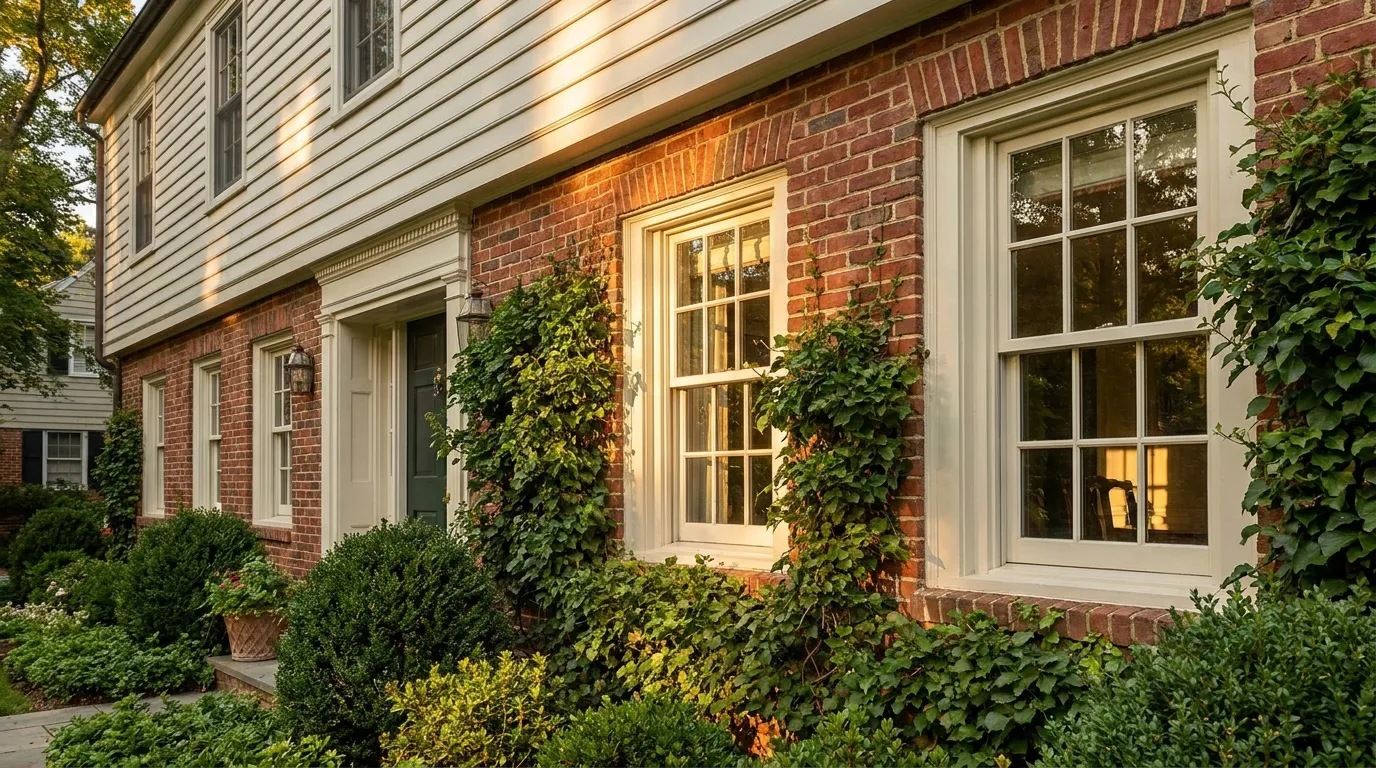
Grilles are the small bars that divide a window into panes, and they do more design work than almost any other detail on a home's facade. The right pattern can make a new build read as a heritage cottage or give a colonial the crispness it was missing. Getting them right means matching the style to your architecture, then choosing a construction that keeps the look without making the window a chore to clean.
Grilles, muntins and why the terms matter
Historically, a muntin was the real wooden bar that held several small panes of glass together, back when large sheets of glass were expensive or impossible to make. Today most windows use a single insulated glass unit, and the bars that divide it are called grilles, whether they are structural or purely decorative. The terms get used interchangeably, but the distinction between decorative and true is worth understanding before you buy.
The pattern those bars create is what gives a window its character. A tall six-over-six grid reads as classic and formal, a single horizontal bar near the top reads as prairie and modern, and a simple perimeter frame reads as farmhouse. The bars themselves are usually 5/8 to 1 inch wide, and that width changes how bold or delicate the window looks from the street.
Because grilles are one of the few window details visible from the curb, they carry a lot of the home's exterior identity. Choosing a pattern that fits the architecture is what separates a window that looks original from one that looks bolted on.
The main grille styles and where they fit
Colonial is the most recognizable pattern, a symmetrical grid of equal rectangular panes, described by the count per sash: six-over-six, eight-over-eight and so on. It suits traditional, heritage and formal homes and is the safe classic choice across much of Quebec's older housing stock. Georgian is a close cousin, typically a refined multi-pane grid with slightly heavier proportions, at home on stately, symmetrical brick facades.
Prairie style frames the glass with a border of panes around a large clear centre, echoing the horizontal lines of early-twentieth-century architecture. It gives a modern, architectural feel while still dividing the glass, and it works beautifully on transitional and Craftsman homes. Farmhouse, sometimes called modern farmhouse, uses a simpler two-over-two or a clean perimeter grille, spare and contemporary against black-framed windows and white siding.
The pattern should also relate to the window's shape and the rest of the house. Tall, narrow windows carry vertical grids well; wide windows suit a prairie border or a horizontal division. Mixing too many patterns on one facade rarely works, so pick one grille language and repeat it across the elevation for a cohesive result.
- Colonial: symmetrical equal-pane grid (six-over-six), for traditional and heritage homes.
- Georgian: refined multi-pane grid with heavier proportions, for stately brick facades.
- Prairie: border of panes around a clear centre, for Craftsman and transitional homes.
- Farmhouse: simple two-over-two or perimeter grille, for modern farmhouse and contemporary looks.
GBG, applied and true divided lites
Grilles-between-the-glass (GBG) are aluminum bars sealed inside the sealed glass unit, between the two panes. They are the most popular choice today for one overwhelming reason: the glass surface stays flat and uninterrupted, so cleaning is as easy as wiping a single pane. They are also the most affordable option and never need painting, though the flat bars read as slightly less dimensional than surface grilles up close.
Applied grilles, sometimes called simulated divided lites, are bars adhered to the exterior and interior glass surfaces, often with a matching internal spacer. They give a far more authentic, three-dimensional shadow line that closely mimics true muntins from the street, which is why they are preferred on heritage-sensitive and higher-end homes. The trade-off is that you clean around each bar rather than across a flat pane.
True divided lites (TDL) are the real thing: individual small panes of glass separated by structural muntins, exactly as historic windows were built. They deliver the most authentic look and are sometimes required in protected heritage zones, but each little pane is its own insulated unit, which raises cost and slightly reduces overall energy efficiency compared with a single large sealed unit.
- GBG: bars sealed inside the glass, easiest to clean, most affordable, flat appearance.
- Applied / SDL: bars on the glass surfaces, authentic shadow lines, clean around each bar.
- True divided lites: real separate panes and muntins, most authentic, highest cost.
Cleaning and maintenance in practical terms
For most homeowners, cleaning is the deciding factor. With grilles-between-the-glass there is nothing on the glass surface to work around, so an entire window wipes down in seconds and the bars, sealed inside the unit, never collect dust or need repainting. In a family home with a lot of windows, that convenience adds up over the years.
Applied grilles ask a little more. Because the bars sit on the glass, you clean into the corners of each simulated pane, and the adhesive bond should be inspected occasionally over the very long term. On quality windows this is minor, and many owners happily accept it for the authentic depth applied grilles provide. True divided lites are the most work, since you are cleaning many small panes and maintaining the muntins themselves.
There is a durability point too. GBG bars are completely protected from weather, UV and handling, so they will not chip, fade or warp the way an exposed wooden muntin eventually can. For a low-maintenance window that still looks divided, GBG is hard to beat, and it is why it dominates new residential installations in Quebec.
Do grilles affect energy performance?
Grilles-between-the-glass have a negligible effect on energy performance because the sealed unit itself is unchanged; the aluminum bars simply sit in the airspace or gas fill between the panes. On some units the bars can very slightly reduce the effective gas fill area, but the impact on the window's U-factor is minor and rarely a deciding factor.
Applied grilles have essentially no energy penalty, since they sit on the outside of an otherwise standard sealed unit. Your U-factor and ENERGY STAR rating come from the glass package, the low-emissivity coatings, the gas fill and the frame, not from surface bars. This is one reason applied grilles are popular: heritage look, no efficiency cost.
True divided lites are the only grille type with a real efficiency trade-off. Dividing one large sealed unit into many tiny ones multiplies the amount of edge-of-glass and spacer, which are the least insulating parts of any window, so a TDL window is typically less efficient overall than the same window with GBG or applied grilles. For an ENERGY STAR Zone D target, that matters, and it is worth confirming the whole-window U-factor before committing to true divided lites.
What grilles cost
Grilles-between-the-glass are the most economical, often adding only a modest amount per window over a clear-glass unit, which is a large part of why they are the default choice. For a home full of windows, that keeps the grille upgrade affordable while still transforming the exterior look.
Applied grilles cost more than GBG because of the extra material and labour to bond bars to both glass surfaces and align an internal spacer, but they remain far more affordable than true divided lites. Many homeowners see them as the sweet spot: most of the authentic look for a fraction of the TDL premium.
True divided lites are the most expensive by a wide margin, since each pane is a separate insulated unit set into a structural muntin grid, which is labour-intensive to build and glaze. They are generally reserved for heritage restorations, protected zones or high-end custom homes where authenticity justifies the cost. Our team can price all three across your window schedule so the pattern you love fits the budget.
- GBG: most economical, small upgrade over clear glass.
- Applied / SDL: mid-range, authentic look for a fraction of TDL cost.
- True divided lites: most expensive, reserved for heritage and high-end custom work.
Matching grilles to your home
Start with your home's architecture and era. A traditional or heritage home almost always wants a colonial or Georgian grid, while a Craftsman or transitional home suits prairie, and a contemporary or modern-farmhouse build looks best with a simple two-over-two or no grille at all. When in doubt, look at what similar well-designed homes on your street are doing.
Then consider consistency and colour. Grilles should usually match across the whole facade and coordinate with the window frame colour, black grilles on black frames for a modern look, white on white for classic. Interior and exterior grille colours can differ, letting you keep white inside while the street sees a bold black grid.
Finally, weigh look against upkeep and energy. For most Quebec homes, GBG or applied grilles in a pattern true to the architecture give the best balance of authentic appearance, easy maintenance and ENERGY STAR performance. Browse styles and options on our windows page, and we will help you match the right grille to your home.
Frequently Asked Questions
What is the difference between a grille and a muntin?
Historically a muntin was the structural wooden bar holding separate small panes of glass together. Today's windows use one insulated unit and the dividing bars are called grilles, whether decorative or structural; the terms are now used interchangeably in most conversations.
Are grilles-between-the-glass easy to clean?
Yes, they are the easiest option by far. Because the bars are sealed inside the glass unit, the glass surface stays flat and wipes down in seconds with nothing to clean around, and the bars never collect dust or need repainting.
Do window grilles reduce energy efficiency?
Grilles-between-the-glass and applied grilles have a negligible effect on your U-factor and ENERGY STAR rating. Only true divided lites carry a real penalty, because splitting one sealed unit into many small panes multiplies the less-insulating edge-of-glass area.
Which grille style suits a traditional Quebec home?
A colonial grid, such as six-over-six or eight-over-eight, is the classic match for traditional and heritage homes, and Georgian works on stately brick facades. Prairie and simple two-over-two patterns suit Craftsman, transitional and modern-farmhouse styles instead.
Can I have different grille colours inside and out?
Yes, on most quality windows the interior and exterior grille colours can differ. A common choice is a bold black grille on the exterior to match dark frames while keeping a clean white grille inside to match interior trim.
Are true divided lites worth the extra cost?
For heritage restorations, protected zones or high-end custom homes where authenticity matters, they can be. For most homeowners, applied grilles deliver nearly the same three-dimensional look at a fraction of the cost and with better energy performance.