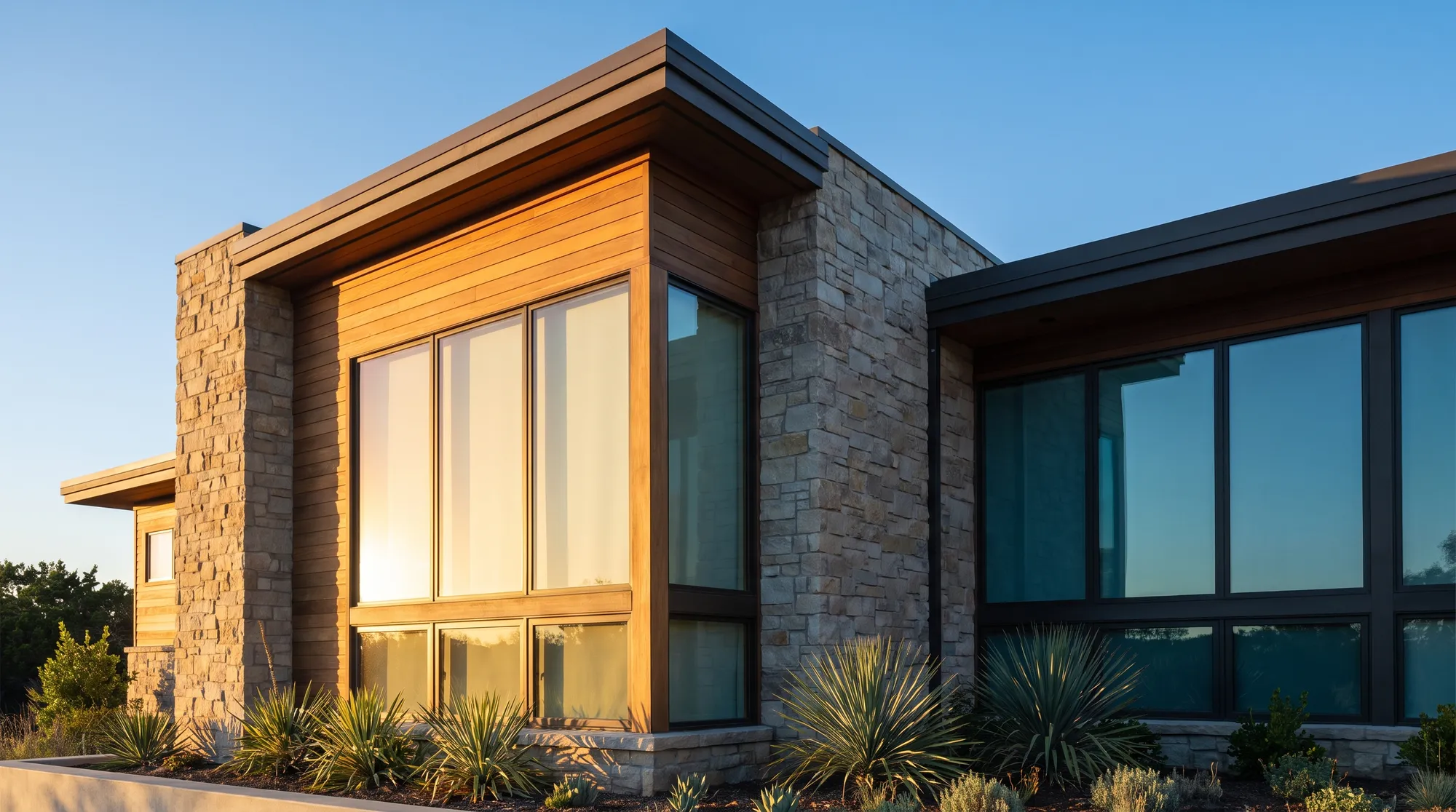
Most homes are glazed as if every wall faced the same direction — the same glass package in every opening, chosen from a price list. Yet a south window in Quebec can collect free heat all winter while a west window overheats the living room every July evening, and a north window does nothing but lose heat unless its U-factor is excellent. Choosing glass by orientation costs little extra and changes how the whole house performs. Here is the facade-by-facade logic.
Same Window, Four Different Jobs
In a climate with 4,500 to 5,500 heating degree-days like southern Quebec, a window is not just a hole that loses heat — it is also a passive solar collector, a glare source, and an overheating risk, depending entirely on which way it faces. A south facade in Montreal receives several times more winter solar energy than a north facade; a west facade receives most of its solar load on summer afternoons, exactly when you want it least. One glass recipe cannot optimize four such different jobs.
The industry has quietly acknowledged this. Glass manufacturers offer low-emissivity coatings in distinct families — high solar gain, moderate, and low solar gain — precisely so designers can tune each facade. The extra cost of specifying two or three glass packages across a house is typically a few percent of the window order, because the frames, spacers and gas fills stay identical; only the coating changes.
Two numbers drive every decision. The U-factor (W/m²·K) measures how fast heat conducts through the assembly — lower is better, always. The SHGC (solar heat gain coefficient, 0 to 1) measures what fraction of solar energy passes through — and whether higher or lower is better depends on the orientation. Learning to read these two numbers on an ENERGY STAR label is the whole game.
U-Factor, SHGC and ER: Reading the Label
U-factor is the rate of heat loss through the whole window — glass, spacer and frame combined. In Canada it is expressed in W/m²·K: a good double-glazed low-E argon window sits around 1.4 to 1.6, a good triple around 0.9 to 1.1. ENERGY STAR certification for Canada's current criteria requires a U-factor of at most 1.22, or a minimum Energy Rating — and for Quebec's climate (the former Zone 2/D territory in older maps), aiming below 1.2 is money well spent on every facade.
SHGC tells you how much of the sun's energy crosses the glass. A clear double-glazed unit runs around 0.60 to 0.70; a high-solar-gain low-E coating preserves roughly 0.50 in double glazing (about 0.42 to 0.45 in triple); a low-solar-gain coating cuts it to 0.25 to 0.30. Crucially, modern coatings decouple heat from light: a low-SHGC glass can still admit most visible light, so 'solar control' no longer means dark or mirrored glass.
The Energy Rating (ER) rolls U-factor, SHGC and air leakage into one heating-season number calibrated for Canadian climates — higher is better, and current ENERGY STAR criteria accept ER 34 or more as an alternative qualifying path. ER is useful shorthand, but it assumes averaged orientations; when you are deliberately tuning glass per facade, read U and SHGC directly rather than relying on the composite. Rénoclimat's incentive of roughly $150 per opening applies to qualifying ENERGY STAR replacements regardless of which coating strategy you choose.
South: Harvest the Winter Sun
A south-facing window in southern Quebec is the only building component that can show a positive energy balance over the heating season: with the right glass, it gains more solar heat from October to April than it loses. The winter sun sits low — about 22 degrees above the horizon at noon in Montreal at the solstice — so it drives deep into south glazing all day. The glass to specify here is a high-solar-gain low-E: SHGC of 0.40 or higher, with the best available U-factor.
The classic worry — will high SHGC cook the house in July? — mostly answers itself on true south. The summer sun stands high (nearly 68 degrees at noon), striking south glass at a steep, glancing angle that reflects much of the energy, and any modest roof overhang or awning shades a south window almost completely in summer while leaving it fully exposed in winter. This geometry is why passive solar design always favours south glass: the seasons self-regulate.
Practical notes: high-gain coatings such as the LoE-180 family are stocked by Quebec fabricators, and in triple glazing you can pair one high-gain coating with clear lites to keep SHGC up while the third pane pulls the U-factor down. If a south window is permanently shaded by a neighbouring building or mature conifers, treat it as a north window instead — solar strategy only pays where the sun actually reaches.
West: Control Glare and the 6 p.m. Oven
West is the problem orientation. On a July afternoon the sun descends toward the horizon directly in line with west windows, entering at a low angle no overhang can block, precisely when the day's air temperature peaks. The result is the familiar Quebec condo phenomenon: a living room at 30 °C at suppertime, blinds drawn against blinding glare, and an air conditioner running flat out. Winter offers little compensation — by late afternoon in January the sun is weak and soon gone.
The prescription is the opposite of the south wall: a low-solar-gain low-E with SHGC around 0.25 to 0.30 (coatings in the LoE-366 class), combined with the same low U-factor as everywhere else. Because the coating rejects infrared while transmitting visible light, the room stays bright but the radiant blast is cut by more than half compared with clear glass. On large west-facing patio doors and picture windows, the difference is felt within one afternoon.
Glare needs its own answer, since even low-SHGC glass transmits the visible sun disc. Plan interior shading you will actually use at 6 p.m. — cellular blinds, sheer-plus-blackout combinations — or exterior solutions like a pergola or deciduous tree, which block the low sun physically. And if you are choosing where to put the big glass on a new build or extension, put the generous openings south and keep west glazing moderate: no coating beats simply not oversizing the west wall.
North: The U-Factor Race
North windows in Quebec receive essentially no direct sun from September to March — only diffuse sky light. With nothing to harvest, their energy story is pure loss, and the specification collapses to a single priority: the lowest U-factor you can afford. This is the facade where triple glazing pays back first, where insulated spacers and argon (or krypton in slim cavities) earn their keep, and where an insulated frame matters as much as the glass.
SHGC on the north wall is almost irrelevant — there is little solar gain to admit or reject — so let the U-factor and comfort decide. Comfort is the underrated argument: the interior surface temperature of double glazing at -25 °C outdoor can drop low enough to create a persistent cold draft and condensation at the glass edge, while a triple-glazed unit stays several degrees warmer, which is why a chair by a north window feels comfortable next to one and chilly next to the other.
North rooms also prize daylight, since they get no direct sun. Choose a coating package with high visible transmittance (VT above 0.50 where offered) so the modest sky light is not further dimmed, and consider slightly larger glass area balanced by the better U-factor. Condensation resistance ratings, printed on many labels, matter most here too — north glass runs coldest, so it fogs first.
East: Gentle Mornings, Easy Choices
East glazing gets the same geometry as west — low sun angles in line with the glass — but at the opposite end of the day, when it does far less harm. Morning air is the coolest of the day, the house has drained its heat overnight, and a few hours of low-angle sun into a kitchen or bedroom reads as cheerful rather than punishing. Most Quebec homeowners actively want that morning light.
The sensible default on east walls is a moderate package: mid-range SHGC around 0.35 to 0.45 with the standard low U-factor. Go lower on SHGC only in specific cases — east-facing bedrooms where summer sunrise at 5 a.m. overheats the room, or large glass areas in an open-plan space that already tends warm. Go higher toward the south recipe if the east wall is your main winter-morning solar exposure and shading trees handle the summer.
East is also where practical tiebreakers can decide: if simplifying the order matters, east openings can usually share whichever package the adjacent facade uses without measurable penalty. It is the forgiving orientation — which is exactly why it should never drive the specification for the other three.
Mixing Packages on One House: How It Works
Ordering different glass per facade is routine for manufacturers, not an exotic request. The window series, frame colour, hardware and sightlines stay identical across the house; only the coating (and sometimes the number of lites) changes inside the sealed unit. From the street and from inside, the windows look the same — modern low-E coatings differ by a barely perceptible tint that varies more with lighting than between products.
A typical Quebec single-family recipe looks like this: south — triple glazed, high-solar-gain low-E, SHGC ≥ 0.40; west — triple glazed, low-solar-gain coating, SHGC ≤ 0.30; north — best-U triple with high visible transmittance; east — moderate SHGC matching room use. Every unit still meets ENERGY STAR so the Rénoclimat incentive applies across the order, and the cost delta over a single uniform package is usually two to four percent.
The prerequisite is a supplier who will engineer at this level rather than quote one SKU for the whole house. At Unisson, every project starts with a facade-by-facade review — orientations, shading, room uses — before glass is specified, and our units are manufactured in Saint-Laurent with the coating each opening actually needs. To go deeper on how the coatings themselves work, see our guide to low-emissivity glass.
- South: SHGC ≥ 0.40 (high-solar-gain low-E), best available U-factor — harvest winter sun
- West: SHGC 0.25-0.30 (solar-control low-E) — tame summer evening overheating and glare
- North: lowest U-factor (triple glazing), high visible transmittance — pure insulation play
- East: moderate SHGC 0.35-0.45 — pleasant mornings, adjust for bedrooms
- Everywhere: ENERGY STAR certified, insulated spacer, argon fill, airtight installation
Frequently Asked Questions
What SHGC should south-facing windows have in Quebec?
Aim for 0.40 or higher with a high-solar-gain low-E coating. In a heating-dominated climate the winter sun entering south glass offsets a real share of heating costs, and the high summer sun angle plus any overhang keeps July gain modest.
Why do west-facing rooms overheat so badly in summer?
Because the late-afternoon sun sits low, in direct line with west glass, at the hottest hour of the day — and no roof overhang can block a horizontal sun. Low-solar-gain glass with SHGC around 0.25 to 0.30 cuts the radiant load by more than half while keeping the room bright.
Is triple glazing worth it for north-facing windows?
North windows receive almost no direct sun in winter, so their performance is entirely about limiting loss — and triple glazing typically brings the U-factor from about 1.5 down to 0.9-1.1 W/m²·K. It also keeps the interior glass surface warmer, eliminating the cold-draft feeling and edge condensation typical of north rooms.
Can I order different glass for different windows of the same house?
Yes — manufacturers routinely build one window series with different coatings per opening. Frames, colours and sightlines stay identical, the visual difference between coatings is barely perceptible, and the cost premium over a uniform order is typically a few percent.
What is the difference between U-factor and SHGC?
U-factor measures how fast heat conducts out through the window (lower is always better; ENERGY STAR in Canada requires at most 1.22 W/m²·K or ER 34+). SHGC measures what fraction of solar energy comes in (0 to 1) — you want it high on south facades to collect winter sun and low on west facades to prevent overheating.
Do orientation-specific glass packages qualify for Rénoclimat?
Yes, as long as each window is ENERGY STAR certified, which both high-gain and solar-control packages can be. The Rénoclimat program currently offers around $150 per opening for qualifying replacements, evaluated per window rather than per glass recipe.