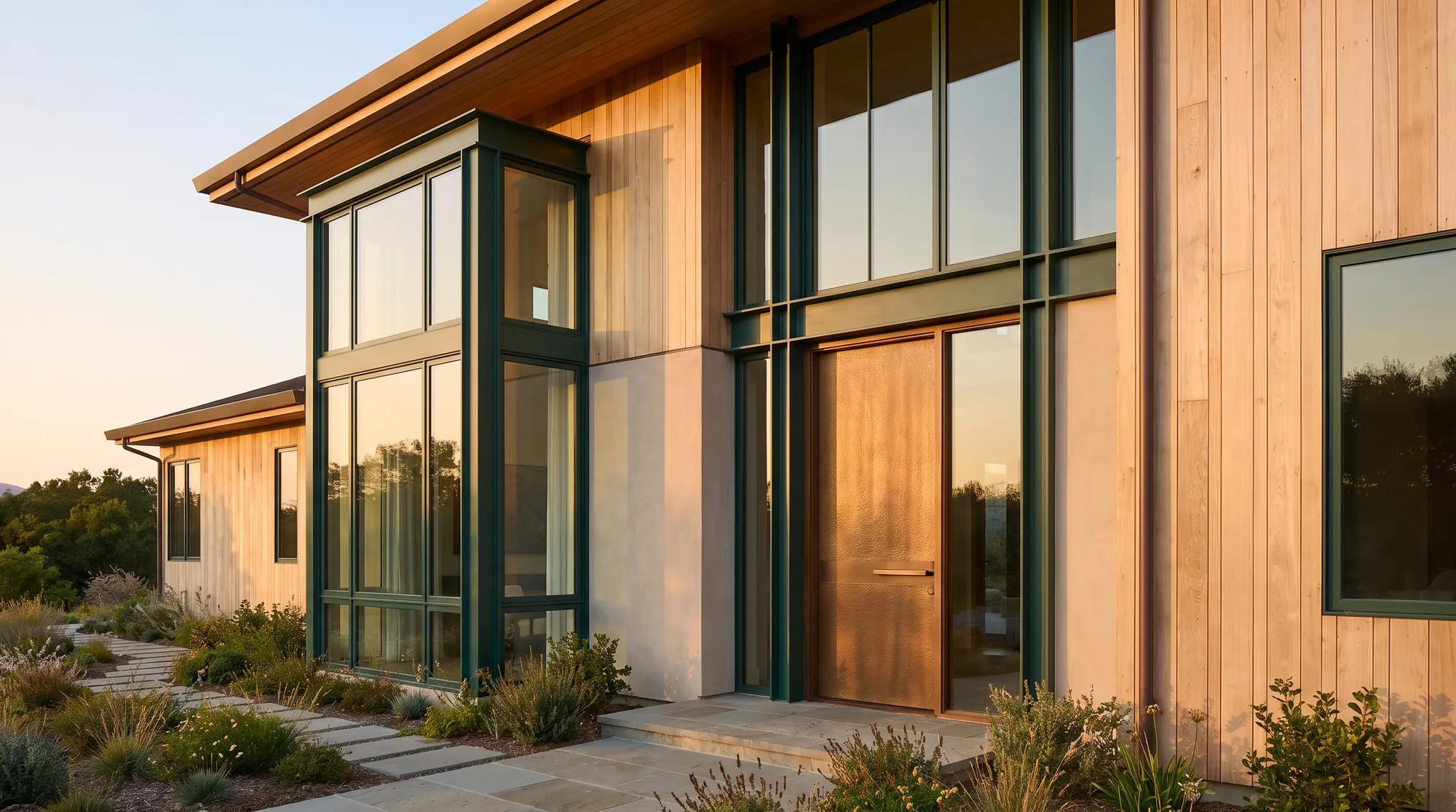
Black windows had a spectacular decade, but the palette is finally moving. For 2027, Quebec facades are warming up: bronze and earthy metallics, deep botanical greens, two-tone frames and finishes you can feel under your fingers. Here is where window and door colour is heading, and how to choose a shade you will still love in fifteen years.
After a Decade of Black
Matte black frames defined the 2015 to 2025 era so completely that they became the default on everything from Plateau triplex renovations to new builds in Brossard. Black is not disappearing; it has simply graduated from trend to classic, the way white did a generation earlier. What is changing is the appetite for something with more warmth and depth, especially on homes where black reads harsh against grey skies from November to April.
Designers describe the shift as a move from contrast to harmony. Instead of frames that outline every opening like a graphic, the 2027 palette blends windows and doors into the material story of the facade: brick, stone, wood and metal. The result is quieter, richer and, importantly for Quebec, more flattering in low winter light.
For homeowners replacing windows now, this is good news either way. Black remains a safe, proven choice, while the emerging shades offer a way to stand out from a street where every second house went black between 2018 and 2024.
Warm Bronze and Earthy Metallics
Bronze is the clearest successor to black: dark enough to frame a view crisply, but with brown and gold undertones that come alive in the sun instead of going flat. On red and orange brick, the backbone of Montreal's housing stock, bronze harmonizes where pure black fights. Commercial architecture has used anodized bronze for decades precisely because it ages gracefully, and that durability halo is now carrying into residential design.
Alongside bronze, expect more dark pewter, gunmetal and warm charcoal shades with a hint of brown, sometimes called off-blacks. These give the tailored look of black without the maintenance anxiety, since dust, pollen and water spots show far less on a mid-dark warm tone than on true black. On fiberglass and aluminum-clad products, metallic-flake finishes add a subtle shimmer that reads as depth rather than sparkle.
Deep Greens Take Over
If one colour family owns 2027, it is deep green: forest, spruce, moss and green-black shades that connect a house to the landscape. In Quebec the logic is obvious, since spruce and pine keep their colour all winter, making a deep green door or window frame look intentional in February, not just in July. Paint leaders have been circling this territory for several seasons, and window manufacturers have followed with factory greens that were special-order items five years ago.
Deep green works across eras: it is historically accurate on Victorian and wartime houses, calming on farmhouses and chalets, and unexpected in the best way on modern builds with wood siding. It pairs beautifully with white or cream trim, natural cedar, black hardware and both grey and red brick. The safest entry point is the front door; the boldest is a full window package in spruce green against a pale facade.
One caution: greens shift dramatically with light. A shade that looks black at the store can read olive on a south-facing wall at noon. Always test a large sample outdoors, on the actual facade, in morning and evening light before committing an entire order.
Two-Tone: One Colour Outside, Another In
The fastest-growing option on order sheets is the two-tone or dual-finish window: a dark, dramatic exterior with a white, cream or wood-look interior. It solves the classic dilemma where a homeowner wants black or bronze curb appeal but finds dark frames heavy inside a north-facing Quebec living room that sees little winter sun. Co-extruded and capped hybrid windows have made this combination affordable rather than a luxury upcharge.
Two-tone also future-proofs the interior. Exterior colour trends move in decade-long cycles, but a white or natural-wood interior frame has never gone out of style and adapts to any repaint of the room. Expect the 2027 twist to be richer interior options: black exterior with a warm oak-look interior is becoming the signature combination in high-end Quebec projects.
Practically, confirm how the two finishes meet at the sash and how each surface is warrantied, since exterior and interior capping can carry different fade and adhesion guarantees. A reputable manufacturer will show you a corner sample of the exact combination, not just colour chips.
Texture Is the New Colour
The second big shift for 2027 is tactile: fine-matte, sand-textured and brushed finishes are replacing smooth gloss and even smooth matte. A lightly textured surface scatters light, which hides dust, fingerprints, minor scratches and the water spotting that plagues smooth dark frames near sprinklers and eaves. On a Quebec facade that endures freeze-thaw grime and spring pollen, textured finishes simply stay presentable longer.
Woodgrain-embossed finishes have also improved enormously, with laminates and paints that mimic oak, walnut and torrefied wood convincingly at close range. They deliver the warmth of a wood door or window without wood's refinishing schedule, a decisive argument in a climate with 40-degree annual temperature swings. Specifiers are pairing these woodgrains with smooth painted siding for a contrast of texture rather than a contrast of colour, one of the defining looks of the coming years.
- Fine-matte — soft, non-reflective, hides fingerprints on dark shades
- Sand texture — scatters light, masks dust and micro-scratches
- Brushed metallic — bronze and pewter with directional depth
- Embossed woodgrain — oak and walnut warmth, zero refinishing
Matching Quebec Brick, Stone and Siding
Great window colour starts with what the facade is already saying. Montreal red brick loves bronze, deep green, cream and warm black; it argues with cool greys. Greystone in Villeray or Quebec City's Vieux-Limoilou pairs naturally with charcoal, pewter and deep green, while beige and buff brick from the 1960s and 70s suburbs comes alive with dark brown, bronze and off-black rather than stark black, which can look pasted on.
With siding, the rule is contrast in value, not just hue: mid-tone siding needs clearly darker or clearly lighter frames to avoid a muddy match. On the popular white-farmhouse look, deep green or bronze frames now signal 2027 where black signalled 2020. If you are re-siding and replacing windows together, pick the window colour first, since window finishes come in dozens of shades while siding comes in hundreds, and it is far easier to match siding to frames than the reverse.
Do not forget the fixed elements you are not changing: roof shingles, gutters, garage door and railings. A quick photo of the facade with sample chips taped in place reveals clashes that no showroom lighting will.
Colour and Resale Value
Windows are a twenty-five to forty year purchase, so the resale question is legitimate. The reassuring data point is that quality and condition move Quebec appraisals far more than colour: buyers pay for recent, efficient, warrantied windows, and colour mostly affects how fast the listing photos generate visits. Black, bronze, charcoal and deep green all photograph beautifully, which is half of modern curb appeal.
Where colour can hurt is at the extremes: a saturated red or a pale pastel package narrows the buyer pool in a way a deep neutral never will. The two-tone strategy is the elegant hedge, keeping interiors universally appealing in white or wood-look regardless of the exterior statement. And because factory finishes on aluminum and hybrid windows are warrantied for decades, a fashionable dark shade will not peel into a liability the way site-painted frames once did.
If you are choosing between two shades and one clearly belongs to the house, its brick, its roof, its era, pick that one. Colour that serves the architecture outlasts colour that serves the trend cycle, in 2027 and every year after.
Getting the Colour Right Before You Order
Colour is the one specification you cannot upgrade later without replacing the product, so slow down at this step. Order large physical samples, view them vertically against the facade at three times of day, and photograph them in both sun and overcast, since Quebec delivers plenty of both. Check the finish warranty for fade and chalking terms on dark shades, and confirm lead times, because trending colours like spruce green and bronze can add weeks in peak season.
Our design team helps homeowners work through exactly these decisions with full-size corner samples in every current finish, matched to hybrid, PVC and aluminum products built in Saint-Laurent. Explore the complete palette and product lineup on our windows page, and bring photos of your facade to your consultation, since the right colour decision starts with the house you already have.
Frequently Asked Questions
Is black going out of style for windows?
No, black has settled in as a modern classic rather than a fading trend. What is changing is that it now shares the stage with bronze, deep green and warm off-blacks. If black suits your facade, it remains a safe long-term choice for resale.
What is the biggest window colour trend for 2027?
Deep greens, spruce, forest and moss, are the headline family, followed closely by warm bronze and earthy metallics. Both flatter Quebec brick and look intentional year-round against evergreen landscapes. Textured and woodgrain finishes are the parallel trend in surface treatment.
Do dark window frames cause heat problems?
Dark frames absorb more solar heat, so quality matters: co-extruded and factory-finished dark surfaces on PVC, hybrid and aluminum windows are engineered and warrantied against warping and fading. Site-painting a light window dark, by contrast, can void its warranty. Buy the colour factory-applied and the issue disappears.
How much more does a two-tone window cost?
On most hybrid and PVC lines the dual-finish option adds roughly 10 to 20 percent over white-on-white, far less than it once did. Dark exterior with white interior is usually the least expensive combination. Woodgrain interior laminates sit at the higher end of the range.
Which window colour is safest for resale in Quebec?
A deep neutral matched to your facade, black, bronze, charcoal or a green-black, photographs well and appeals broadly. Keeping the interior side white or wood-look protects you against future decor changes. Buyers ultimately pay for window quality and age more than for any specific shade.
Can I test a colour before ordering a full house of windows?
Yes, and you should: ask for large corner samples of the exact product and finish, then view them against your brick or siding in morning, midday and evening light. Photograph the samples in sun and overcast conditions. A colour approved only under showroom lighting is the most common source of regret.