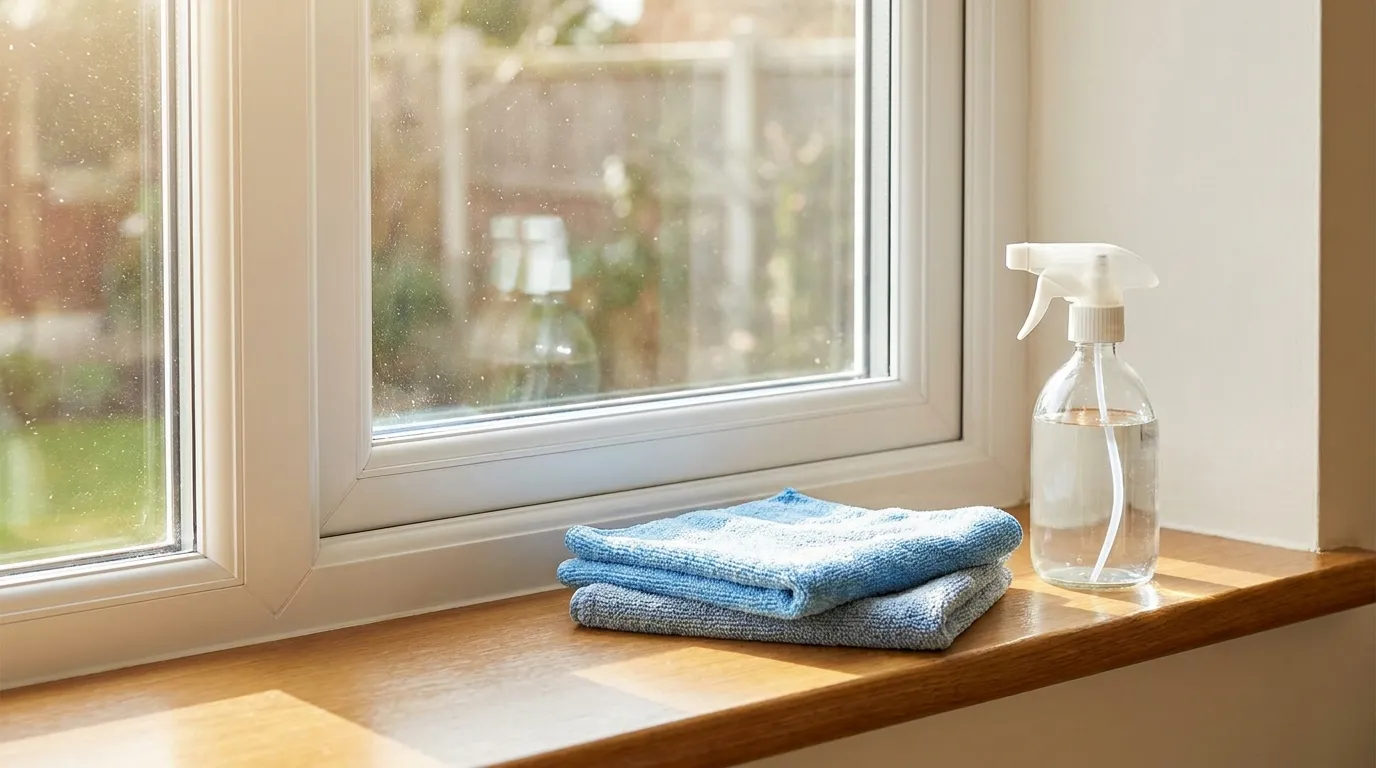
UPVC windows are marketed as maintenance-free, and compared to wood they very nearly are: no painting, no staining, no rot. But maintenance-free does not mean care-free, and the difference between a UPVC window that looks and works like new at year twenty and one that yellows, sticks, and leaks is about two hours of simple care per year. Here is the complete professional routine, adapted for Quebec's demanding climate.
Why maintenance-free UPVC still needs a routine
The UPVC frame itself genuinely needs almost nothing: the material does not rot, rust, or need refinishing, and modern formulations with titanium dioxide stabilizers resist UV yellowing for decades. What ages a UPVC window is everything attached to it, the moving hardware, the rubber weatherstripping, the drainage system, and the sealed glass unit, plus the grime that Quebec throws at all of them: road salt spray, spring pollen, construction dust, and the black film of urban air.
Neglect follows a predictable path. Grit accumulates in tracks and grinds the hardware; blocked drainage holes let water pool inside the frame, where a hard freeze can stress it; dry weatherstripping cracks and lets drafts through; and dirt left on frames for years can stain the surface it could once have been wiped from. Each of these is trivially preventable and annoying to repair.
There is also a warranty angle homeowners overlook. Most manufacturer warranties, including on premium UPVC windows, assume reasonable maintenance, and damage from blocked weep holes or abrasive cleaning is classified as neglect rather than defect. Twenty minutes per window, twice a year, keeps you inside both the warranty and the design life.
Cleaning UPVC frames: mild soap, and a blacklist
The entire approved cleaning kit for UPVC frames is warm water, a few drops of mild dish soap, a soft cloth or sponge, and a second cloth for drying. Wipe the frames down, work the soapy cloth into corners and along the glazing beads, rinse with clean water, and dry. That is the whole technique, and done twice a year it keeps white and coloured frames alike looking new. For textured or woodgrain-laminate finishes, a soft brush lifts dirt out of the grain without harming the foil.
The blacklist matters more than the technique. Solvents like acetone, nail polish remover, paint thinner, and aggressive degreasers chemically attack UPVC and can permanently dull or smear the surface; abrasives like scouring powder, steel wool, and the green side of a kitchen sponge leave micro-scratches that trap dirt forever; and melamine foam erasers are abrasive too, despite their gentle reputation. Bleach can discolour, and a pressure washer can drive water past the seals into the frame and wall. None of these ever touch a UPVC window.
Two Quebec-specific notes: wash road-facing windows in early spring, because winter leaves them coated in a corrosive film of de-icing salt that should not sit through the summer sun, and never scrape frost or ice off frames with a metal tool. If a stubborn mark survives soapy water, use a cleaner explicitly labelled safe for PVC-U, test it on a hidden spot, and stop there.
- Approved: warm water, mild dish soap, soft cloth, soft brush for textures.
- Never: acetone or solvents, scouring pads, steel wool, melamine erasers, bleach.
- Never: pressure washers, metal scrapers, razor blades on frames.
- Quebec tip: rinse off winter’s salt film every early spring.
Streak-free glass, the professional way
Professionals get streak-free glass with technique, not magic products. Clean glass on an overcast day or when the pane is shaded, because sun-heated glass flash-dries the solution and prints streaks; wash the frame first so its dirt does not run onto clean glass; and use either a quality glass cleaner or the classic mix of water with a splash of white vinegar. A microfibre cloth or a proper squeegee, pulled top to bottom with the blade wiped between strokes, finishes the job.
The one tool to keep away from your glass is a razor blade or scraper. Modern low-E coatings on the exposed surface of some units, and the ever-present risk of dragging a grit particle across the pane, make scraping a gamble that professionals reserve for paint spots, done carefully, wet, and at a shallow angle. For ordinary grime, chemistry and a squeegee always win.
While you clean, inspect. Fog, droplets, or a milky haze between the panes, not on either surface you can touch, means the sealed unit's edge seal has failed and the insulating gas is gone; no amount of cleaning fixes it, and the unit needs replacement, usually under warranty. Catching a failed seal in year eight instead of year twelve is often the difference between a warranty claim and an invoice.
Tracks, sills, and the weep holes everyone forgets
Look at the exterior bottom edge of your UPVC window and you will find a row of small slots or capped openings. These are weep holes, the drainage system that lets rain and condensation escape from the frame's internal channels, and they are the single most neglected component on any window. When they clog with dirt, dead insects, or paint, water pools inside the frame; in a Quebec November, that trapped water freezes, expands, and can stress the frame from within, and in summer it backs up over the interior sill and masquerades as a leaky window.
Clearing them takes five minutes. Vacuum the track and sill, then run a plastic zip tie, pipe cleaner, or compressed air through each weep hole until it is open; pour a little water into the track and watch it drain out the exterior face to confirm. Do this every spring and fall, and always after sanding or masonry work near the windows.
Sliding tracks on windows deserve the same attention as patio doors: vacuum out the grit, wipe the channel with a damp cloth, and resist the urge to grease the track itself, because oil and grease turn the channel into a grit magnet. Clean and dry is the correct finished state; lubrication belongs on the hardware, which is the next section.
Hardware lubrication and weatherstripping care
Every moving metal part on the window, hinges, locking points, handle mechanisms, crank operators on casements, wants a light lubrication once or twice a year. Use a silicone-based spray or a dry PTFE lubricant: a short burst on each pivot and locking cam, then work the mechanism a few times and wipe the excess. Avoid heavy oils and standard WD-40 as a lubricant, since their residue attracts the very dust that wears mechanisms out, and never let any petroleum product contact the UPVC or the rubber seals.
Weatherstripping, the flexible gaskets that seal sash to frame, is what stands between you and a January draft. Wipe the gaskets clean with mild soapy water during your seasonal wash, check for cracks, flat spots, and corners pulling loose, and restore suppleness with a thin film of silicone conditioner. In Quebec's cold, a supple gasket also resists the classic winter nuisance of a sash freezing shut against its seal.
Watch for the early warning signs between maintenance rounds: a handle that needs more force than last year, a casement that no longer pulls tight against its gasket, a whistle on windy nights, or new condensation at one corner of the glass. Each of these is a five-dollar fix in year one and a service call in year five, and the seasonal routine below is designed to catch them all.
Your Quebec seasonal maintenance schedule
The whole professional routine compresses into two main sessions and two five-minute checkups per year, timed to Quebec's seasons. Spring is the major clean, undoing winter; fall is the winterization pass, preparing the windows for six months of cold; midsummer and midwinter get a quick glance. Budget roughly 15 to 20 minutes per window for the two main sessions and you will spend perhaps two hours a year on an average home.
The payoff is disproportionate. Hardware that is cleaned and lubricated routinely lasts the life of the window instead of failing at year ten; weatherstripping that is conditioned keeps its seal instead of admitting drafts that show up on your Hydro-Quebec bill; and clear weep holes prevent the frame and sill damage that constitutes most of the serious UPVC repairs technicians ever see. Maintenance is the cheapest energy efficiency and the cheapest insurance you can buy.
If a checkup turns up something beyond the routine, a failed sealed unit, a cracked frame, hardware that no longer aligns, address it promptly rather than nursing it along, and lean on your warranty first. A well-maintained UPVC window should deliver 25 to 40 Quebec winters; the routine below is how you collect them.
- Spring: full wash of frames and glass, clear weep holes, vacuum tracks, inspect seals after winter.
- Summer: quick glass clean, check screens, confirm smooth operation.
- Fall: lubricate all hardware, condition weatherstripping, clear weep holes again, verify sashes lock tight.
- Winter: wipe condensation promptly, check for drafts and frost patterns, no scraping on frames or glass.
Frequently Asked Questions
What is the best thing to clean UPVC window frames with?
Warm water with a few drops of mild dish soap, applied with a soft cloth and dried with a second cloth, is all a UPVC frame ever needs. Avoid solvents like acetone, abrasive pads, melamine erasers, and bleach, all of which can permanently dull, scratch, or discolour the surface.
What are the little holes at the bottom of my window frame?
Those are weep holes, the drainage outlets that let rain and condensation escape from inside the frame. Keep them clear with a zip tie or compressed air every spring and fall, because blocked weep holes cause water to pool in the frame, freeze in winter, and eventually damage the window or spill onto the interior sill.
How do I get streak-free windows?
Clean on an overcast day so the sun cannot flash-dry the solution, wash the frames first, and use a glass cleaner or water with white vinegar, finished with a microfibre cloth or a squeegee wiped between strokes. Skip razor scrapers, which risk scratching the glass and any exposed low-E coating.
What should I lubricate window hardware with?
A silicone-based spray or dry PTFE lubricant, applied lightly to hinges, locking points, and crank mechanisms once or twice a year, then worked in and wiped. Avoid heavy oils and standard WD-40 as lubricants, since their residue attracts grit, and keep all petroleum products away from UPVC surfaces and rubber gaskets.
Why is there condensation between my window panes?
Fog or haze between the panes, where you cannot wipe it, means the sealed unit's edge seal has failed and its insulating argon and dry air have escaped. Cleaning cannot fix it; the sealed unit needs replacement, which is routine and typically covered by a 10-to-20-year manufacturer warranty if claimed promptly.
How long will UPVC windows last in Quebec's climate?
A quality UPVC window should deliver 25 to 40 years in Quebec, with modern UV-stabilized formulations resisting yellowing throughout. The realistic limiters are hardware, weatherstripping, and sealed units, and the two-hours-a-year routine of cleaning, weep hole clearing, and lubrication is what lets the window reach the far end of that range.