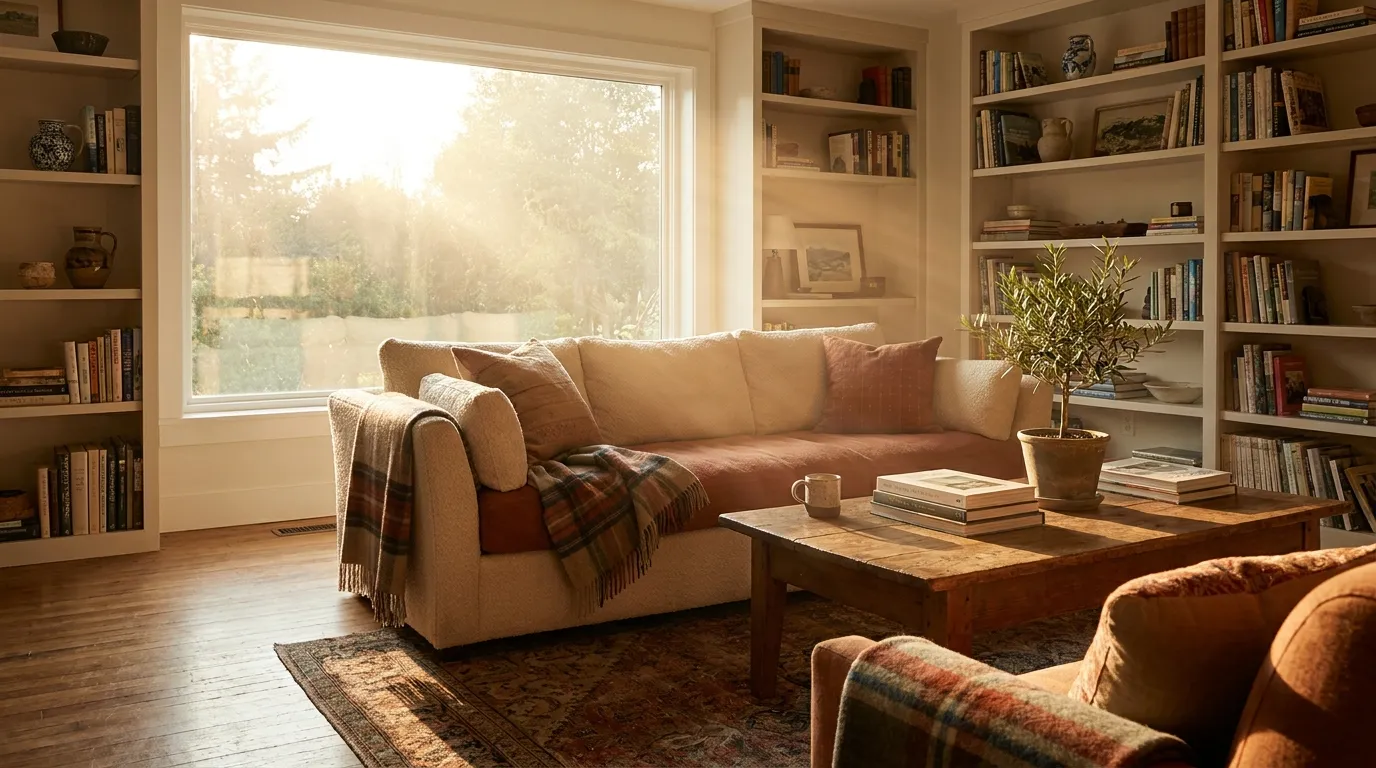
That patch of faded hardwood by the patio door and the sun-bleached spine of a favourite book share a single culprit: ultraviolet light streaming through ordinary glass. Low-emissivity coatings can block roughly 95% of those rays while letting daylight pour in, protecting what you own without darkening your rooms. Here is how the technology works and what it means for a Saint-Laurent home under the intense Quebec summer sun.
Why sunlight fades your floors, furniture and art
Fading is a photochemical reaction. When high-energy light strikes the dyes and pigments in a material, it breaks the chemical bonds that give them colour, and the surface gradually turns pale or yellow. Ultraviolet radiation carries the most energy of any light reaching your windows, so it does the most damage, but visible light (especially the blue end) and heat both contribute to the total.
The materials most at risk are the ones we care about most: hardwood and engineered floors, area rugs, upholstered sofas, curtains, framed photographs, oil paintings, and wood furniture. South- and west-facing rooms take the worst of it because they catch direct sun for the longest part of the day. In Montreal, the summer sun climbs to nearly 68° above the horizon at the solstice, driving light deep into a room.
Fading is cumulative and irreversible. A hardwood floor may look fine for a season, but three or four summers of unfiltered exposure can leave a permanent light stripe wherever the sun lands, framed by darker wood that a rug or sofa protected. Once the colour is gone, refinishing or reupholstering is the only fix, which is why prevention at the glass matters.
What low-E glass actually is
Low-emissivity (low-E) glass is ordinary glass finished with a microscopically thin, transparent metallic-oxide coating, often based on silver. The layer is measured in nanometres, so you cannot see it, yet it dramatically changes how the glass handles different wavelengths of energy. The coating is engineered to be selective: it lets useful visible daylight through while reflecting invisible ultraviolet and infrared radiation.
There are two broad families. Passive (hard-coat) low-E is baked onto the glass during manufacturing and admits more solar heat, which suits north-facing or shaded windows where a little free winter warmth helps. Solar-control (soft-coat) low-E is applied in a vacuum chamber and blocks far more heat and UV, making it the better choice for sun-drenched south and west exposures.
Most quality windows today are double- or triple-glazed sealed units with the low-E coating on an interior surface of the glass, protected inside the airspace, and the cavity filled with argon gas. This construction is standard on ENERGY STAR certified windows and is the same platform that delivers both the fade protection and the winter insulation Quebec homes need.
How the coating blocks up to 95% of UV
Sunlight is a spectrum. Roughly 3% arrives as ultraviolet, about 44% as visible light, and the rest as infrared heat. A single pane of clear glass already stops most UV-B, but it lets a large share of UV-A pass straight through, and UV-A is a major driver of fading. This is why an untreated window offers almost no real fade protection.
A low-E coating targets the ultraviolet and infrared bands specifically. Good solar-control low-E units block on the order of 95% of UV radiation, cutting the single most aggressive cause of fading to a fraction of what plain glass admits. Because the coating is spectrally selective, it does this while still transmitting most of the visible light, so the room stays bright rather than dim or tinted.
The practical result is dramatic. A sofa or floor that would show visible fading within a couple of summers behind ordinary glass can look essentially unchanged for many years behind low-E. It is not a total block — visible light and heat still cause slow fading over long periods — but removing 95% of the UV load removes the fastest and most destructive part of the problem.
- UV-A and UV-B: the highest-energy, fastest-fading wavelengths — blocked at up to ~95%.
- Visible light: mostly transmitted, so rooms stay naturally lit.
- Infrared (heat): largely reflected, lowering solar heat gain and cooling costs.
- Winter warmth: the same coating reflects indoor heat back inside, improving comfort.
SHGC, U-factor and UV: reading the label
When you compare windows you will see three numbers that all relate to sunlight and heat, and it helps to keep them straight. U-factor measures how well the window resists heat loss — lower is better for a Quebec winter, and quality triple-glazed units reach roughly 0.14 to 0.20 (an R-value near 5 to 7).
Solar Heat Gain Coefficient (SHGC) is the fraction of the sun’s heat that passes through, from 0 to 1. A lower SHGC keeps a sunny room cooler in July, while a slightly higher SHGC on a shaded north window captures a bit of free winter heat. Solar-control low-E lowers SHGC without darkening the glass.
UV blockage is a separate property tied to the coating, often quoted as a percentage of ultraviolet stopped. A window can have a moderate SHGC yet still block ~95% of UV, because the coating handles the ultraviolet band independently of overall heat gain. For a fade-sensitive room, ask specifically about the UV-blocking figure rather than assuming SHGC tells the whole story. Our guide to low-emissivity glass breaks these ratings down in more detail.
The Quebec summer sun and your exposures
Quebec summers deliver long, high-angle days. Around the June solstice the Montreal region gets more than 15 hours of daylight, and the sun tracks high and far around the sky, hitting east windows hard in the morning, south windows through midday, and west windows late into a bright evening. That is a lot of exposure for interiors to absorb.
West-facing rooms are usually the toughest case. The late-afternoon sun is low, so it drives straight into the room past most overhangs and awnings, and it arrives when the day is already warm, adding heat on top of fading. South rooms get the longest total exposure. North rooms fade the least, but a bright north sky still delivers UV over time.
Because exposures differ, the right glass can differ room by room. A common approach in a Saint-Laurent or Ahuntsic home is solar-control low-E on the south and west elevations to protect finishes and cut cooling load, with a passive low-E on north windows to keep a little winter warmth. Matching the coating to the exposure gives you the best of protection and comfort.
Low-E versus ordinary glass, side by side
The clearest way to appreciate low-E is to compare it directly with the plain double glazing still found in older homes. The difference shows up in fading, comfort, and energy bills all at once, without any visible change to how the window looks from the street or the sofa.
Ordinary clear glass admits most of the UV-A that causes fading, gains heat freely on sunny days, and loses interior warmth quickly on cold nights. Low-E flips all three: it blocks the bulk of the UV, tempers summer heat gain, and reflects indoor heat back inside during winter. You get a room that stays truer in colour, cooler in summer, and warmer in winter.
- UV blocked: plain glass ~25 to 45%; solar-control low-E up to ~95%.
- Fade risk: visible fading in a few summers vs. finishes protected for many years.
- Summer heat: strong solar gain vs. tempered, more comfortable rooms.
- Winter warmth: heat escapes quickly vs. reflected back inside for lower bills.
- Appearance: both look clear — low-E adds protection without a visible tint.
Real benefits, plus the rebates that offset the cost
Beyond protecting your belongings, low-E glass earns its keep on comfort and energy. Reflecting summer heat means less work for the air conditioner, and reflecting indoor warmth in winter trims heating costs through Montreal’s long -30°C cold snaps. Fewer freeze-thaw drafts and warmer interior glass surfaces also cut condensation. These windows are the ones that meet ENERGY STAR requirements for Zone D, the coldest Canadian climate zone that covers Quebec.
The upgrade is also well supported by rebates. Through Rénoclimat, energy-efficient window replacements can qualify for up to $150 per rough opening, and the federal Canada Greener Homes program has offered up to $5000 for a package of eligible upgrades. Stacking provincial and federal support can meaningfully offset the cost of a full window project.
As an RBQ-licensed manufacturer in Saint-Laurent, we build sealed low-E units matched to each exposure of your home and help you document them for rebate programs. Expect installed pricing in the range of roughly $900 to $1,800 per window depending on size, frame material, and whether you choose double or triple glazing — an investment that pays back in preserved finishes, comfort, and lower bills.
Frequently Asked Questions
Does low-E glass make my rooms darker?
No. Low-E coatings are spectrally selective, so they block invisible UV and infrared while transmitting most visible daylight. Rooms stay bright and naturally lit; the glass looks clear rather than tinted from both inside and out.
Will low-E glass completely stop fading?
It dramatically slows fading but cannot stop it entirely. Blocking up to 95% of UV removes the fastest cause of colour loss, yet visible light and heat still fade materials very slowly over many years. Combining low-E with curtains or UV film on the most exposed windows gives the strongest protection.
Is low-E worth it if I already have double-glazed windows?
Often yes, especially on south- and west-facing rooms with valuable floors or furniture. Older clear double glazing lets most UV-A through, so upgrading to solar-control low-E adds real fade protection along with lower cooling and heating costs that help offset the investment over time.
Which windows should get solar-control low-E?
Prioritize south and west exposures, which receive the most direct sun and the highest UV load in Quebec. North windows fade least and can use a passive low-E that captures a little winter warmth. Matching the coating to each exposure balances protection and comfort.
Are low-E windows eligible for Quebec and Canadian rebates?
Yes. ENERGY STAR certified low-E windows can qualify for Rénoclimat support of up to $150 per rough opening, and eligible packages have qualified for up to $5000 under Canada Greener Homes. We help document the ratings you need for each program.
Does low-E help in winter too, or only against summer fading?
Both. The same coating that reflects UV and summer heat also reflects indoor heat back into the room in winter, lowering heating costs during Montreal’s -30°C cold snaps and reducing condensation. It is a year-round upgrade, not just a summer one.