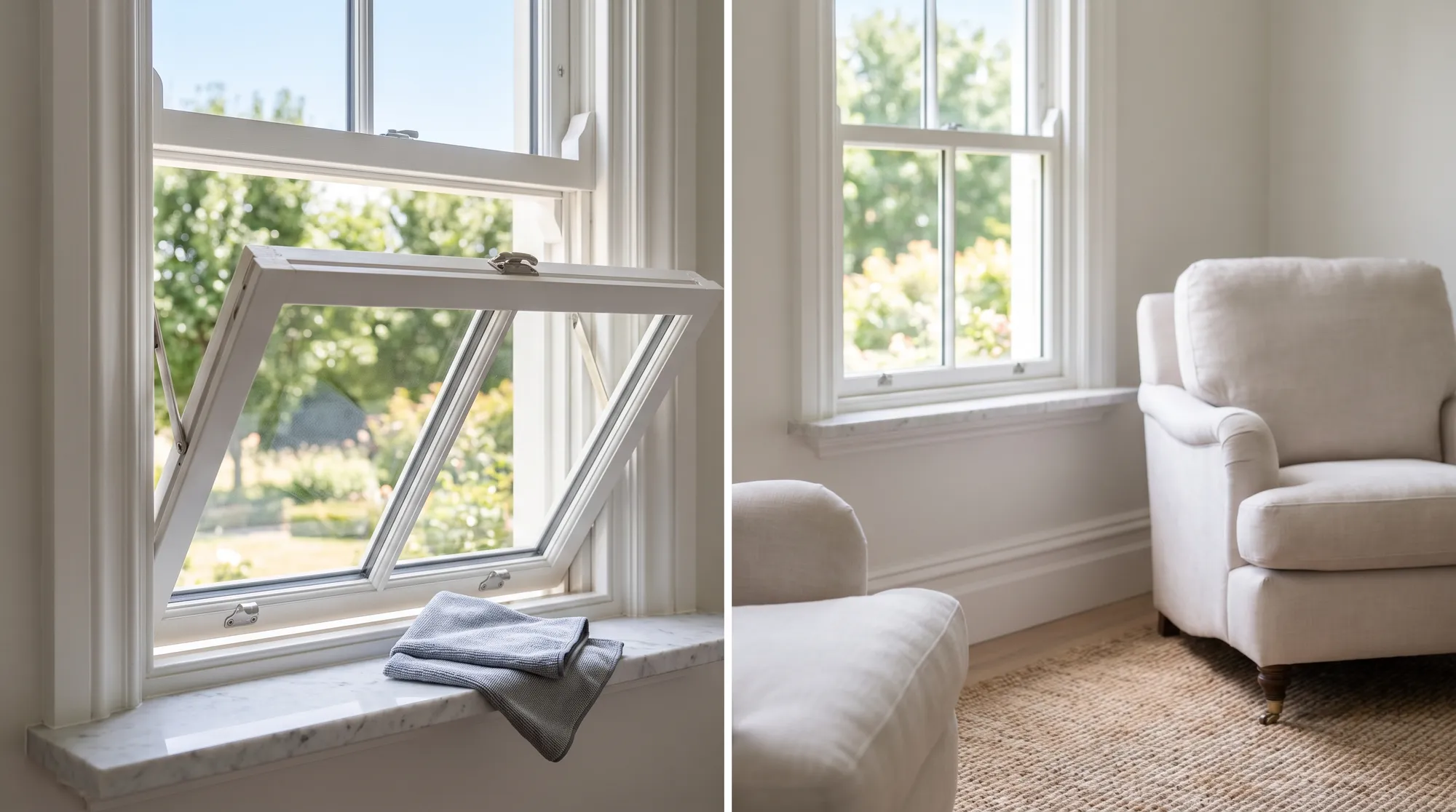
Washing the outside of a second-floor window used to mean a ladder on frozen or muddy ground, or a cheque to a window-cleaning crew twice a year. Tilt-in sashes changed that: squeeze two latches, pivot the sash toward you, and wipe the exterior glass while standing safely in your bedroom. Here is how the mechanism actually works, how to tilt without damaging anything, and which window styles offer the feature.
What a Tilt-In Sash Actually Is
A tilt-in sash is an operable window panel that, in addition to sliding up-and-down or side-to-side, can pivot inward on its bottom edge until it lies almost horizontal inside the room. The pivot points are two small shoes that ride in the jamb tracks, and the top of the sash is held in the track by a pair of spring-loaded tilt latches. Release the latches and the sash rotates freely on the shoes, exposing the exterior face of the glass to whoever is standing inside.
The feature was developed for hung windows in the 1980s and is now standard on most quality double-hung and single-hung models sold in Quebec, as well as on many horizontal sliders where the sash lifts out or tilts in a similar way. It adds no visible hardware beyond the two discreet latches on the top rail, and a properly engineered tilt system does not compromise the weatherseal when the sash is locked back in place.
The practical payoff is obvious in our climate. Montreal windows collect road salt film, pollen and construction dust, and the exterior side needs washing at least twice a year to stay clear. With tilt-in sashes the entire job happens indoors — no ladder, no hose in October, no waiting for a mild weekend.
How the Tilt Latches and Pivot Shoes Work
At each top corner of the sash sits a tilt latch: a small plastic or metal slider with a spring that pushes a bolt sideways into a groove in the jamb liner. When both bolts are extended, the sash is captive in its track and slides normally. Squeeze both latches toward the centre of the sash at the same time and the bolts retract, freeing the top rail so the sash can rotate toward you.
At each bottom corner, the sash engages a pivot shoe — a sliding block inside the jamb track that contains a cam. When you tilt the sash, the cam in each shoe rotates and locks the shoe in place, so the balance springs cannot fire the shoe up the track while the sash is out of its channel. This detail matters: the shoes carry the full weight of the tilted sash and anchor the spring tension. On a quality window the shoes are metal-reinforced; on bargain units they are unfilled plastic and become the first failure point.
The balance system — coiled springs or block-and-tackle balances hidden in the jambs — keeps working whether the sash is upright or tilted. That is why a tilted sash feels light and why it snaps crisply back into its track: the balances are still tensioned through the shoes the whole time.
How to Tilt a Sash Safely, Step by Step
Tilting is simple, but doing it in the wrong order is how latches and shoes get broken. The sash must be partially open before it tilts — pivoting a closed sash strains the latches against the head jamb — and it must be supported the whole time it is out of its track. A double-hung sash of tempered triple glazing can weigh 15 to 25 kg; treat it like a door you have taken off its hinges.
Follow the same sequence every time:
- Unlock the window and raise the lower sash about 10 to 15 cm — enough that the tilt latches clear the frame.
- Squeeze both tilt latches inward simultaneously and pivot the top of the sash toward you, keeping one hand on each side of the top rail.
- Lower the sash gently until it rests just short of horizontal — many models let it rest against the frame or a stop; never let it slam down.
- Clean the exterior glass, then raise the sash back to vertical with both hands until both latches click audibly into their grooves.
- Test by sliding the sash up and down a few centimetres before locking. If it binds, a latch has not re-engaged — tilt slightly and reseat it, and never force it.
- For the upper sash on a double-hung, lower it partway first and repeat the same procedure; clean and restore the upper sash before tilting the lower one back.
The Second-Floor Advantage: Retire the Ladder
The strongest argument for tilt-in sashes is the floors you cannot reach from the ground. Falls from ladders send thousands of Canadians to emergency rooms every year, and the classic window-washing scenario — leaning sideways from an extension ladder on soft spring ground — is precisely the highest-risk manoeuvre. On a two-storey home or an upper duplex in Montreal, tilt-in sashes eliminate that risk entirely: every pane, on every floor, is cleaned from inside a room with your feet on the floor.
There is a financial angle too. Professional exterior window cleaning for a two-storey home in the Montreal area typically runs $150 to $350 per visit, and most homeowners who cannot self-clean book it twice a year. Over the 25-to-40-year life of a quality window, tilt-in hardware pays for itself many times over in avoided service calls alone.
Renters and condo owners in triplexes benefit just as much: upper-floor units often have no legal or practical exterior access at all, so tilt-in sashes are effectively the only way those windows ever get washed properly.
Which Window Styles Offer Tilt-In Sashes
Tilt-in sashes are native to hung windows. A double-hung window offers the full version of the feature: both the upper and lower sash tilt inward, so all four glass faces are reachable from inside. A single-hung tilts only its operable lower sash — the fixed upper pane still needs exterior access, which is worth knowing before you order for a second floor.
Horizontal sliders handle it differently depending on the manufacturer: some sashes tilt in like a hung window turned sideways, while others simply lift out of the track entirely for cleaning. A lift-out sash achieves the same goal but demands more care, since you are holding the full weight of the panel with no pivot supporting it.
Casement and awning windows do not tilt — they do not need to. A casement cranks open a full 90 degrees, which swings the exterior face of the glass within arm's reach of the opening; the same logic applies to awnings on the ground floor. Fixed and architectural windows have no operable sash at all, so plan exterior access — or hire out that cleaning — when you specify large fixed units upstairs.
Tilt Hardware in a Quebec Winter
A tilt mechanism only earns its keep if it still works after a decade of Quebec seasons. The stress points are the latch springs and the pivot shoes, and temperature is their enemy: cheap plastic latches grow brittle at -30°C and can crack if someone forces a frozen sash, while quality windows use reinforced nylon or metal latches that stay ductile in deep cold. Ask the manufacturer what the latches and shoes are made of — it is a two-second question that separates commodity windows from ones built for this climate.
The tilt feature has no effect on energy performance when the window is closed: the sash compresses the same weatherstripping whether or not it can pivot, and tilt-equipped hung windows routinely meet ENERGY STAR thresholds for Canada's coldest zone requirements. What does matter is re-seating the sash correctly after cleaning. A latch that has not clicked home leaves the top rail fractionally out of its track, which shows up as a draft at head height and, in January, as a frost line along the top of the glass.
Keep the jamb tracks clean and dry-lubricated with silicone spray once a year, ideally in fall. Grit in the tracks is what wears pivot shoes; thirty seconds with a vacuum crevice tool during your autumn cleaning protects the most expensive moving parts in the window.
What to Check Before You Buy
Not all tilt systems are equal, and the differences are easy to test in a showroom. Tilt a display sash yourself: the latches should release with firm, even finger pressure — not a struggle, not a feather touch — and the sash should pivot smoothly and re-seat with a clear double click. Wobble, grinding or a sash that needs jiggling to re-engage are signs of loose tolerances that will only get worse with use.
Ask specifically about the balance system and shoe construction, and about hardware warranty terms — quality Quebec manufacturers back operating hardware for a decade or more, and lifetime warranties on the sealed unit are the norm. If you are replacing windows in an older home, confirm that the installer holds an RBQ licence, and note that ENERGY STAR certified replacements may qualify for Rénoclimat rebates of roughly $150 per opening when the program's evaluation conditions are met.
Finally, think through which openings genuinely need the feature. A sensible specification mixes styles: tilt-in hung windows upstairs and on street-facing elevations that collect grime, casements where you want maximum ventilation, and fixed glass where nothing needs to open. Paying for tilt hardware everywhere is unnecessary; skipping it on the second floor is a mistake you will regret every May.
Frequently Asked Questions
Do tilt-in sashes make a window less airtight?
No. When the sash is upright and latched, it compresses the same weatherstripping as a non-tilting sash, and tilt-equipped hung windows routinely achieve ENERGY STAR certification for Canada's coldest requirements. Drafts only appear if the sash is re-seated incorrectly after cleaning — always listen for both latches clicking home.
Can both sashes tilt on a double-hung window?
On a true double-hung, yes — both upper and lower sashes tilt inward, so you can clean all four glass surfaces from inside. On a single-hung, only the bottom sash operates and tilts; the fixed upper pane must still be cleaned from outside, which matters when choosing windows for upper floors.
How much weight can I put on a tilted sash?
None — a tilted sash is not a shelf and should never be leaned on. The pivot shoes are engineered to carry the sash itself (typically 15 to 25 kg with triple glazing) plus gentle cleaning pressure. Leaning on the sash or letting children hang on it can crack the shoes or bend the top rail.
My sash will not tilt back into its track. What am I doing wrong?
Usually one tilt latch has retracted while the other extended early, leaving the sash cocked at a slight angle. Bring the sash fully level, align both top corners with their grooves, and raise it evenly with a hand on each side until you hear two distinct clicks. Never force it — a cracked latch means a service call.
Are tilt-in windows worth it on a bungalow?
They are less critical when every window is reachable from the ground, but they still save real effort: no hose, no moving flowerbeds and shrubs to place a ladder, and cleaning in February is exactly as easy as in June. Many bungalow owners specify tilt-in sashes on the rear elevation where deck railings and landscaping block exterior access.
Does cold weather damage tilt hardware?
Quality latches and pivot shoes in reinforced nylon or metal are rated for Quebec winters and survive decades of -30°C nights. The realistic risks are forcing a sash that is frozen to its weatherstripping and letting grit accumulate in the tracks. Free a frozen sash gently from inside after warming, and vacuum plus silicone-spray the tracks every fall.