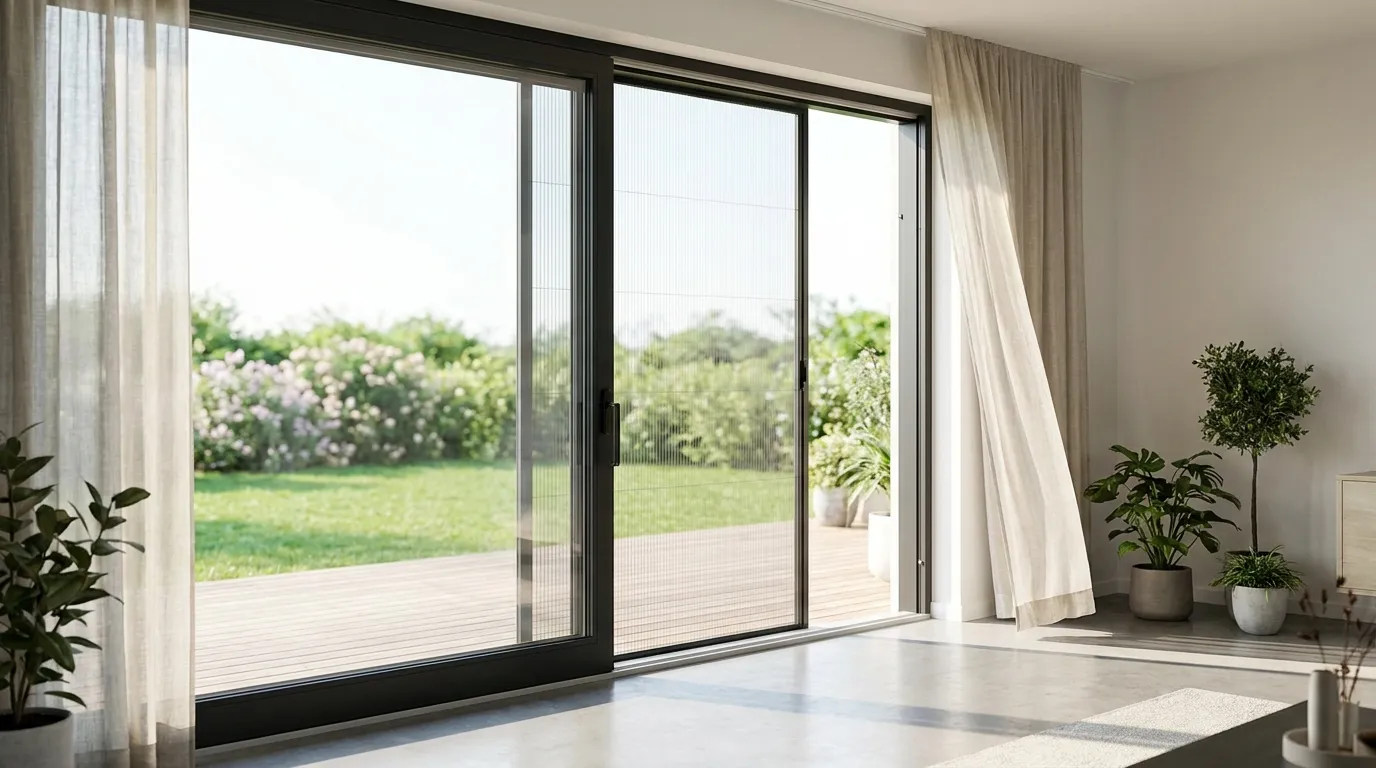
The screen on your patio door is the one component nobody thinks about until a June mosquito changes their mind. A good screen lets a Quebec summer breeze flow through the house while keeping the bugs on the deck where they belong, and it does it quietly, year after year, if you choose and care for it well. This guide walks through the screen types worth knowing, the mesh options that actually matter, and the simple maintenance that keeps a slider gliding instead of grinding.
The main types of patio screen doors
The most common patio screen is the sliding screen door: a lightweight frame with mesh that rides on its own track alongside the glass door and rolls left or right on small wheels. It is simple, inexpensive, and does its job well when the rollers and track are in good shape. Because it lives outside on the exposed track, it takes the brunt of grit, pollen, and winter weather, which is exactly why it needs the occasional bit of care.
The retractable screen is the more refined option. Its mesh rolls into a slim cassette mounted on the door frame, much like a projector screen, and you draw it across only when you want it, then let it disappear when you do not. It keeps your clean sightline through the glass in winter, avoids the worn, sagging look an old fixed screen can develop, and tucks away out of the weather when the door is closed.
For wide openings, sliding patio doors and folding walls sometimes use a larger sliding screen panel or a double-cassette retractable that meets in the middle. The right style depends on how wide your opening is, how often you open the door, and whether you would rather have a permanent screen always ready or a hidden one that only appears on demand.
- Sliding screen door: classic, affordable, always in place, rides its own track.
- Retractable screen: mesh rolls into a cassette, hidden when unused, clean sightlines.
- Wide-opening screens: larger panels or double cassettes for big sliders and folding walls.
Insect mesh versus solar mesh
Not all screen mesh is the same, and the material makes a real difference. Standard insect mesh is usually fibreglass or aluminum woven fine enough to stop mosquitoes, blackflies, and the other Quebec summer regulars while still letting air through freely. Fibreglass is the everyday choice because it is flexible, does not dent or crease, and is easy to work with; aluminum is more rigid and holds up in high-traffic spots but can crimp if bumped.
Solar or sun-shading mesh is a tighter, darker weave that blocks a significant share of the sun's heat and glare in addition to insects. On a south- or west-facing patio door that turns the adjacent room into a greenhouse on a July afternoon, a solar screen can noticeably cut the heat and cost you only a little airflow and view. It is a smart upgrade where summer overheating, not just bugs, is the real complaint.
There are finer specialty meshes too. A no-see-um or micro-mesh is woven tightly enough to stop the tiny biting midges that ordinary screen lets through, which is worth it near water or wooded lots. Whatever the mesh, look for a tight, even weave with no gaps at the corners, since that is where bugs actually get in.
- Fibreglass insect mesh: flexible, forgiving, the everyday standard.
- Aluminum mesh: rigid and durable, but can crimp if knocked.
- Solar shading mesh: blocks heat and glare as well as insects, great for hot exposures.
- No-see-um micro-mesh: stops tiny midges near water or wooded lots.
Pet-resistant screens for cats and dogs
If you have a dog or cat, ordinary screen mesh is on borrowed time. Claws, scratching, and the occasional determined lunge will tear a standard fibreglass screen in a single season. Pet-resistant mesh is built for exactly this: a heavier, vinyl-coated polyester woven several times stronger than regular screen, tough enough to shrug off claws and repeated pawing without ripping.
The tradeoff is that pet mesh is a thicker, more visible weave, so it slightly reduces airflow and dims the view compared with a fine insect screen. Most pet owners find that an easy trade against constantly patching or replacing torn mesh. If only the bottom of the door takes abuse, some homeowners fit a pet-resistant panel to the lower portion and a finer mesh above, getting durability where the paws are and a clearer view up top.
A pet door built into the screen is another option for households whose cat or dog wants to come and go. Whatever you choose, a taut, well-tensioned screen also helps, since a loose, saggy panel is far more inviting for a pet to push against and eventually breach.
Keeping the bugs out all summer
A screen only works if it actually seals. The most common reason bugs get in is not the mesh but the gaps around it: a screen that does not close fully against its jamb, worn weatherstripping on the leading edge, or a bottom sweep that no longer reaches the track. Run your eye around the whole perimeter with the screen closed and look for daylight, because anywhere light gets through, a mosquito will too.
The leading edge of a sliding screen usually has a fuzzy weatherstrip or a flexible fin that seals against the jamb when the door is closed. When that strip flattens or falls out, the door stops sealing at the very edge, which is a classic July nuisance. Replacing that strip is a cheap fix that solves a surprising number of bug complaints on otherwise good screens.
Habits help too. Blackflies and mosquitoes are worst at dusk, so closing up before the evening peak keeps most of them out, and keeping the screen latched rather than propped slightly open removes the easy gap they exploit. A well-fitted, well-sealed screen, closed at the right times, is what lets you leave the glass door open through a warm Quebec night without paying for it in bites.
- Check the full perimeter for daylight with the screen closed.
- Replace worn edge weatherstripping and a flattened bottom sweep.
- Close up before the dusk mosquito and blackfly peak.
- Keep the screen latched, not propped slightly open.
Cleaning and adjusting the rollers
When a sliding screen starts to drag, stick, or jump the track, the culprit is almost always the track and rollers, not the door itself. The bottom track collects grit, sand, pollen, and dead bugs all season, and that debris is what makes the wheels grind and hop. A yearly clean-out with a vacuum and a stiff brush, followed by a wipe of the track, restores most of a screen's smooth glide on its own.
The rollers themselves are adjustable on most sliding screens. Look for a small screw at each bottom corner of the screen frame: turning it raises or lowers that corner, which lets you set the door to sit square in the opening and roll evenly. If your screen tilts, rubs at one corner, or pops off the top track, a few turns of these screws usually squares it up and reseats it.
A dry, silicone-based lubricant on the clean track keeps things gliding without attracting dirt the way oil or grease would. Avoid oily lubricants entirely, since they turn the season's dust into a gummy paste that makes the sticking worse. Clean track, squared rollers, a touch of silicone: that trio fixes the vast majority of cranky sliding screens.
- Vacuum and brush the bottom track clear of grit and debris each spring.
- Adjust the corner screws to set the screen square and rolling evenly.
- Use a dry silicone lubricant, never oil or grease, on the track.
- Check that top guides hold the screen on its track so it cannot jump off.
Replacing torn or damaged mesh
Torn mesh is one of the few home repairs that is genuinely DIY-friendly. On a standard sliding screen, the mesh is held in the frame's channel by a flexible rubber cord called a spline. You pry out the old spline, lift out the damaged mesh, lay in a fresh piece cut slightly oversized, and roll a new spline into the channel with an inexpensive spline roller tool, trimming the excess mesh at the end. A single-door re-screen is an easy afternoon job.
The key to a good result is tension. The mesh should go in taut but not overstretched, because a screen that is too loose sags and a screen pulled too tight can bow the light frame. Working from one side to the opposite and keeping the mesh square as you roll the spline gives you a flat, drum-tight finish. Choosing the same mesh type you had, or upgrading to pet-resistant or solar mesh at the same time, is entirely up to you.
Retractable screens are a different story. Their mesh and spring mechanism live inside a sealed cassette, and re-meshing one is best left to the manufacturer or installer rather than tackled at the kitchen table. If a retractable screen tears, jams, or stops retracting, that is the moment to call the people who supplied the door.
When to repair, replace, or upgrade
Most screen problems are worth repairing rather than replacing. A dragging door usually just needs a clean track and adjusted rollers; a torn screen needs new mesh; a leaky edge needs fresh weatherstripping. None of these mean the door is finished, and a good sliding screen frame can last for many years with this basic upkeep.
There are moments, though, when an upgrade makes more sense than another patch. A frame that is bent, corroded, or repeatedly jumping the track despite adjustment; a household that has switched from a fine insect screen to needing pet-resistant mesh; or a hot exposure that would benefit from solar shading, are all reasons to move to a better screen. Retractable screens are also a popular upgrade for anyone tired of a permanent screen's look and winter clutter.
The cleanest results come when the screen is matched to the door as a system, so the mesh, track, and seals all work together. If you are already replacing or planning a patio door, it is the ideal time to specify the right screen for your climate, your pets, and your exposure. Explore our patio doors and request a quote to pair the right screen with your opening.
- Repair when the frame is sound: clean the track, adjust rollers, re-mesh, re-seal.
- Upgrade a bent, corroded, or chronically off-track frame rather than fighting it.
- Match the screen to the door and your needs, pets, sun, and insects, as one system.
Frequently Asked Questions
What is the difference between a sliding and a retractable screen door?
A sliding screen is a permanent mesh panel that rides its own track beside the glass door and is always in place. A retractable screen rolls its mesh into a slim cassette on the frame, so it stays hidden when you do not need it and keeps a clean sightline through the glass.
Which screen mesh is best for keeping Quebec bugs out?
Standard fibreglass insect mesh stops mosquitoes and blackflies, but if you are near water or a wooded lot, a tighter no-see-um micro-mesh is worth it to keep out the tiny biting midges. Whatever the mesh, a tight, even weave with sealed corners is what actually keeps insects out.
Are pet-resistant screens worth it if I have a dog or cat?
For most pet owners, yes. Pet-resistant mesh is a vinyl-coated polyester woven several times stronger than ordinary screen, tough enough to resist claws and pawing that would shred a standard fibreglass panel in a single season. It slightly reduces airflow and view, which most owners accept over constant repairs.
Why does my sliding screen door stick or jump off the track?
Almost always because the bottom track is clogged with grit or the rollers need adjusting. Vacuum and brush the track clean, then turn the small screw at each bottom corner to set the door square and rolling evenly, and check that the top guides are holding it on its track.
Can I replace torn screen mesh myself?
On a standard sliding screen, yes, and it is an easy afternoon job. You pry out the old rubber spline, lay in a fresh piece of mesh cut slightly oversized, and roll new spline into the channel to hold it taut. Retractable screens are different and are best re-meshed by the installer.
What should I put on the track to help the screen slide?
Use a dry, silicone-based lubricant on a clean track. Avoid oil or grease entirely, because they attract the season's dust and turn it into a gummy paste that makes the sticking worse rather than better.