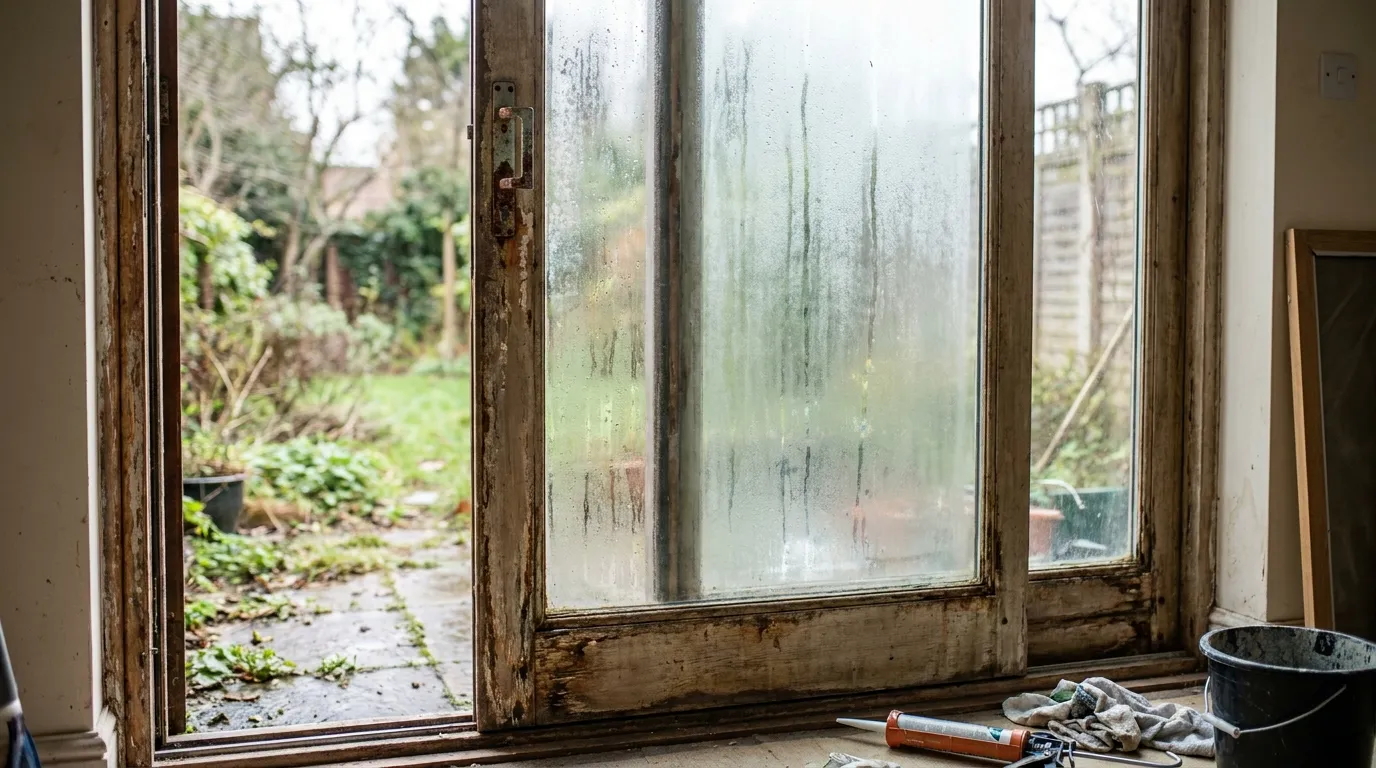
A patio door is the largest moving piece of glass in most homes, and it takes a beating from our climate that a wall never does. Sun, wind-driven rain, road salt and dozens of freeze-thaw cycles a winter slowly wear down its seals, rollers and weatherstripping. Knowing the warning signs, and whether they call for a repair or a full replacement, saves you money on both energy and repeated service calls.
Drafts and cold air along the edges
The most common complaint is a noticeable draft near the patio door, or a distinct cold zone in the room it opens onto. On a windy January day you may feel air moving at the meeting rail of a slider or along the sill, and a candle or a strip of tissue held near the edges will flutter where cold air is leaking in. This is a clear sign the door is no longer sealing against our winter.
Drafts usually trace back to worn weatherstripping, a sagging panel that no longer meets the frame squarely, or a door that has racked slightly out of alignment. Early on this is a repair; weatherstripping can be replaced and rollers adjusted. But when the panel itself has warped or the frame has shifted, no amount of new gasket will restore a tight seal.
In Quebec that leakage costs real money. Your furnace runs harder to fight the incoming cold, and the room nearest the door becomes the one nobody wants to sit in. When a patio door leaks air badly enough to feel across the room, it has usually reached the point where replacement pays for itself in comfort and heating savings.
- Feel for moving air at the meeting rail, sill and edges on a windy day.
- Use a candle flame or tissue strip to locate exactly where cold is entering.
- A cold zone in front of the door that never warms up points to a failing seal.
- New weatherstripping is a repair; a warped panel or shifted frame is a replacement.
Sticking, grinding or hard to slide
A patio door should glide with one finger. When it grinds, sticks, or takes two hands and a shoulder to move, something in the track or rollers has failed. Often it is dirt and debris packed into the track, which is a simple clean, but just as often it is worn or broken rollers, the small wheels the panel rides on at the bottom.
Rollers wear out because the whole weight of a heavy glass panel rides on them thousands of times a year. As they flatten or seize, the panel drags on the track, which then wears the track itself and pulls the panel out of square, worsening drafts at the same time. Replacing rollers is a common repair on a quality door and can restore smooth operation for years.
The concern is when the frame or track is bent, corroded or worn beyond adjustment, or when the panel has dropped so far it no longer seals top and bottom. At that point you are chasing several failures at once, roller, track and seal, and a new door with fresh hardware is usually the smarter investment than repeated fixes on a worn frame.
Foggy glass and a failed seal
Fog, haze or a milky film trapped between the panes, where you cannot wipe it away, is the unmistakable sign of a failed sealed unit. The glass in a patio door is an insulated unit: two panes with an inert gas like argon sealed in the gap. When the perimeter seal fails, that gas escapes, moisture-laden air seeps in, and it condenses between the panes as the temperature changes.
A failed seal means the insulating value of the glass has dropped significantly, because the gas that did most of the insulating is gone. You lose energy performance and clarity, and in cold weather the fog often turns to frost or ice trapped inside the unit. It is both an efficiency problem and an eyesore you cannot clean away.
The good news is that on some doors the sealed glass unit alone can be replaced without swapping the whole door, which is a mid-cost repair. But if the door is older, the frame is tired, or multiple panels have failed, replacing the entire door with a modern low-emissivity, argon-filled, ENERGY STAR Zone D unit restores both the efficiency and the look in one step.
Interior condensation, water and rot
Condensation on the room-side surface of the glass or frame, especially heavy condensation that pools on the sill, tells you the door is running cold and humid air is meeting a chilled surface. Occasional light condensation on very cold days can be a humidity issue in the home, but persistent water on the frame and sill points to a poorly insulating door and often a failing seal.
That standing water is what leads to the most damaging sign of all: rot and deterioration around the door. Water repeatedly wetting a wooden frame, sill or the wall below it will, over Quebec winters, cause wood to soften, swell and rot, and can feed mould behind the trim. Once you find soft wood or dark staining at the base of a patio door, the damage may extend into the framing behind it.
Rot is rarely a repair. Softened, water-damaged framing needs to be opened up, dried, treated or rebuilt, and reinstalling a door into compromised structure just repeats the problem. When you see rot at a patio door, it is both a signal to replace the door and a reason to have the surrounding opening inspected properly.
Rising energy bills and outside noise
A patio door is a huge expanse of glass, so when it underperforms, your heating and cooling bills feel it. An old single-pane or failed-seal door can be one of the biggest sources of heat loss in a home, and if your bills have climbed while your habits have not, an aging patio door is a prime suspect alongside the windows.
Modern replacement doors close that gap dramatically. A quality ENERGY STAR Zone D sliding or swing door with low-emissivity glass and argon fill, tight multipoint sealing and a thermally broken frame can cut the heat loss of that opening substantially compared with a twenty-year-old unit. The comfort difference in the adjacent room is usually obvious within the first cold snap.
Noise is a related clue. If you suddenly hear the street, the wind or the neighbour's snowblower far more clearly through the patio door than you used to, the seals and glass are no longer doing their job. A new insulated door with good weatherstripping noticeably quiets the room as a bonus to the energy savings.
- Unexplained rises in heating or cooling bills point to a leaky, poorly insulating door.
- Modern low-e, argon-filled ENERGY STAR Zone D doors sharply reduce heat loss.
- More outside noise coming through means the seals and glass are failing.
- Rooms near the door that never feel comfortable are a quality-of-life sign to replace.
Worn hardware and security concerns
Patio doors are a common target for break-ins because older sliders in particular can be lifted off their track or forced at a flimsy latch. If the lock feels loose, does not engage firmly, or the panel can be jiggled and lifted in its track, the door is no longer providing the security your home needs. Worn rollers that let the panel lift are both an operation and a security problem.
Older patio doors often rely on a single hook or latch that is easy to defeat, whereas modern doors offer multipoint locking that secures the panel at several heights, anti-lift blocks that stop the panel being lifted out, and laminated or tempered security glass. If your current door has none of these, upgrading is as much about safety as comfort.
Weatherstripping and hardware wear are sometimes a repair, but when the locking hardware is obsolete, the panel lifts freely, and the frame is worn, a new door delivers current security features that simply cannot be retrofitted to an old slider. For a ground-floor or backyard door, that peace of mind often drives the decision to replace.
Repair or replace: making the call
The honest rule of thumb: single, isolated failures on an otherwise sound door are repairs, while multiple failures, or any structural damage, mean replacement. New weatherstripping, a fresh set of rollers, or a single replaced sealed unit can give a good door years more life at modest cost. It is worth doing when the frame is straight and the rest of the door is healthy.
Replacement becomes the smarter choice when the signs stack up: drafts and sticking and fog and rising bills together usually indicate a door at the end of its service life, where repairs only buy short reprieves. Rot in the frame or the surrounding structure, or a door old enough to predate low-e glass and multipoint locks, tips the decision firmly toward replacement.
In our climate a modern patio door is also an efficiency and comfort upgrade, not just a fix. If you are seeing several of the signs above, an ENERGY STAR Zone D replacement will pay you back in heating savings, comfort, quiet and security. Explore options and get sizing advice on our patio doors page, and note that a qualifying replacement may be eligible for Rénoclimat and Canada Greener Homes support of up to $5,000.
Frequently Asked Questions
Why is my patio door foggy between the panes?
Fog trapped between the panes that you cannot wipe away means the sealed glass unit has failed and its insulating gas has escaped, letting moist air condense inside. This lowers the glass's insulating value, and on some doors the sealed unit can be replaced on its own without swapping the whole door.
Can a drafty patio door be fixed without replacing it?
Sometimes. If the draft is from worn weatherstripping or slightly misadjusted rollers, replacing the gasket and tuning the rollers can restore the seal. But if the panel has warped or the frame has shifted out of square, no new weatherstripping will seal it and replacement is the real fix.
Why has my patio door become hard to slide?
Usually the rollers, the small wheels the panel rides on, have worn out or the track is packed with debris. A clean or a fresh set of rollers often restores smooth operation, but a bent, corroded track or a panel that has dropped out of square points toward replacing the door.
Is a foggy or drafty patio door raising my energy bills?
Very likely. A patio door is a large expanse of glass, so a failed seal or worn weatherstripping can make it one of the biggest sources of heat loss in the home. Upgrading to an ENERGY STAR Zone D door with low-e, argon-filled glass sharply reduces that loss.
When should I replace rather than repair my patio door?
Replace when several signs appear together, drafts, sticking, fog and rising bills, or when there is any rot in the frame or surrounding structure. A single isolated issue on a sound door is usually a worthwhile repair; stacked failures mean the door has reached the end of its life.
Are new patio doors more secure?
Yes. Modern patio doors offer multipoint locking that secures the panel at several heights, anti-lift blocks that prevent the panel being lifted off its track, and laminated or tempered security glass, none of which can be retrofitted to an old single-latch slider that can be jiggled loose.