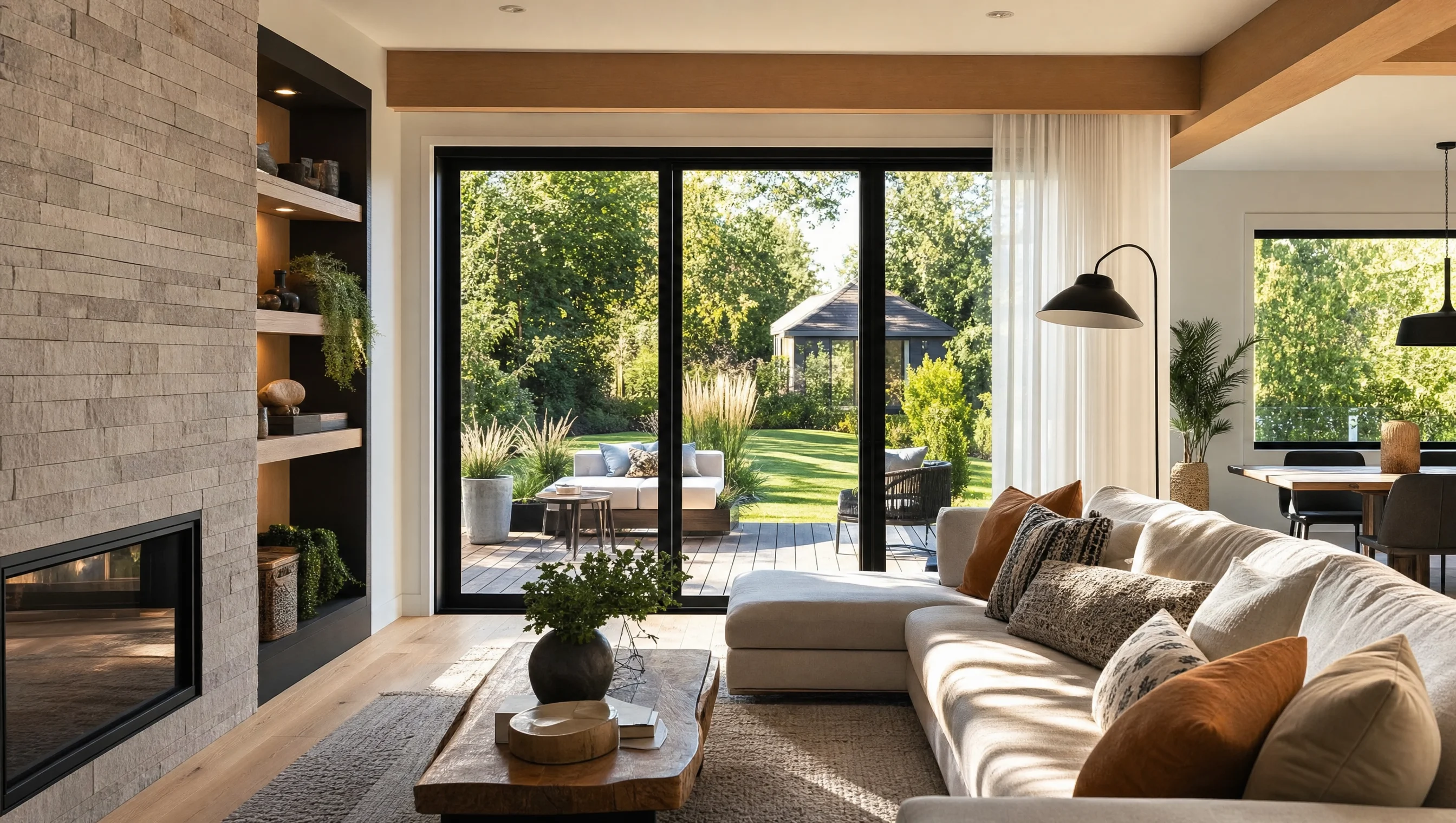
Patio door or garden door? The choice shapes how your home opens to the backyard, how it seals against a Quebec winter, and how much floor space you give up. This side-by-side comparison covers footprint, ventilation, air-sealing, security, screens, accessibility, cost and maintenance so you can choose with confidence.
What sets them apart
A patio door is a sliding door: one or more panels glide horizontally on a track, with at least one fixed panel and one operating panel that slides past it. Because the panels move sideways rather than swinging, a patio door never intrudes into the room or the patio, which is its defining advantage and the reason it’s so common in Quebec homes.
A garden door — often called a French door — is a swinging door with one or two hinged panels that open like a traditional door. A single garden door has one active panel and a fixed sidelite or panel; a double (true French) configuration has two active panels that meet in the centre. The swinging action gives a wider, unobstructed opening but requires clear floor space for the arc.
Both deliver large glass areas and bright, view-filled connections to the backyard, so the decision rarely comes down to looks alone. It comes down to how each behaves in the dimensions that matter for a Quebec home: space, sealing, security and day-to-day use. You can see both families on our doors collection, with details on the patio doors page.
Footprint and space
Footprint is the most immediate practical difference. A sliding patio door needs zero swing clearance, so it fits tight kitchens, small dining rooms and condos where a swinging panel would collide with a table, an island or furniture. In a compact Montreal triplex or a Laval townhouse, that space saving can be the deciding factor on its own.
A garden door needs room to swing, typically inward in Quebec so the door isn’t blocked by snow or fighting the wind. A single panel needs a clear arc on the hinge side, and a double French door needs even more. In exchange you get a generous, fully open passage with no centre track or fixed panel narrowing the way — ideal for moving furniture or entertaining.
Think about how the adjacent space is used before deciding. A patio door is the safe pick when interior square footage is tight or the wall is short; a garden door shines when you have the room and want that wide, welcoming opening onto a deck or patio. Measuring the actual wall and swing zone is the step that prevents regret.
Ventilation and airflow
Ventilation is where the two diverge meaningfully. A sliding patio door typically opens up to half its total width — the operating panel can only slide as far as the fixed panel allows — so on a standard two-panel unit you get roughly 50 percent of the opening for airflow. That’s plenty for everyday breezes but caps your maximum.
A garden door can open fully. A double French configuration swings both panels wide for nearly the entire opening, flooding a room with air on a mild Quebec evening and creating a seamless indoor-outdoor flow for summer gatherings. For homeowners who prioritize that big, open feeling, the swinging door wins on raw airflow.
Consider your climate use pattern. Quebec summers are short and intense, and many homeowners value the ability to throw a garden door wide open for those few perfect weeks. Others find the constant half-open convenience of a slider — easy to crack for a breeze with one hand — better suited to daily life across the seasons.
Energy efficiency and cold-climate sealing
In a climate that hits minus 30, air-sealing is arguably the most important factor, and here the doors differ by design. A swinging garden door seals by compressing weatherstripping against the frame as it latches, which can create an excellent, tight seal — comparable to a quality entry door — when the hardware is well-adjusted. That compression seal is a real cold-weather strength.
A sliding patio door seals against brush or fin weatherstripping as the panel slides into its closed position, which historically made sliders slightly more prone to air leakage. Modern, well-engineered patio doors have closed that gap substantially with multi-point locks that pull the panel tight, interlocking meeting rails and ENERGY STAR-certified glass packages built for Climate Zone D. The technology matters more than the category.
Whichever you choose, the install and the glazing decide real-world performance. Triple-glazed, low-E, argon-filled units with a proper thermal break, set with low-expansion foam and continuous flashing, will keep a Quebec home comfortable and your Hydro-Québec bills in check. Look for ENERGY STAR certification for Zone D and confirm the door carries it before you buy.
- Garden door: compression weatherstrip seal, naturally tight when latched
- Patio door: brush/fin seal, now excellent with multi-point locks and interlocks
- Both: insist on triple-glazed low-E argon glass certified for ENERGY STAR Zone D
Security, screens and accessibility
On security, both can be excellent with the right hardware. Garden doors with a multi-point locking system that throws bolts into the head and sill are very secure, and modern sliding patio doors with multi-point locks and laminated or tempered glass are equally resistant to forced entry. Avoid bargain single-latch hardware on either type; the lock is what counts, not the swing style.
Screens favour the slider in everyday convenience. A patio door pairs naturally with a sliding screen that’s always in place and easy to use one-handed. A garden door needs a retractable or hinged screen, which works well but adds a moving part and a bit of cost. If bug-free summer airflow with zero fuss is a priority, the patio door has an edge.
For accessibility, the sliding patio door is often the friendlier choice: many feature a low or near-flush sill that’s easier to cross with a walker, stroller or wheelchair than a raised threshold. A garden door’s swing also needs clear floor space that can be awkward in mobility situations. If aging-in-place or barrier-free movement matters, weigh the sill height and clear opening carefully.
Cost and best use cases
Pricing overlaps more than people expect, and quality varies more by build than by category. As a rough guide for Quebec in 2026, a standard sliding patio door commonly installs in the $2,000 to $4,500 range, while a garden or double French door runs roughly $2,500 to $5,500 installed, with premium sizes, finishes and triple glazing pushing either higher. Hardware grade and glass package move the number more than the open-or-slide question.
Choose a patio door when floor space is tight, when you want the easiest screen and accessibility story, or when a clean, modern sliding look suits the room. It’s the pragmatic default for condos, smaller homes and any wall where a swing would be awkward. Explore configurations and sizes on our patio doors page.
Choose a garden door when you have the room and want a wide, fully open passage, a classic French-door aesthetic, or the naturally tight compression seal. It’s a strong fit for larger homes, formal dining rooms opening to a deck, and anyone who entertains outdoors in summer. When you’re ready to compare quotes for your exact opening, reach us through our contact page.
Maintenance over the years
Maintenance habits differ in small but real ways. A sliding patio door’s main upkeep is the track: keep it clean of grit, sand and debris so the rollers glide smoothly, and lubricate them periodically. Quebec’s winter sand and spring grit are the usual culprits behind a slider that’s suddenly hard to move, and a five-minute cleaning usually fixes it.
A garden door’s wear points are the hinges and the multi-point latch. Hinges may need occasional adjustment to keep the door swinging true and sealing tightly, especially after the house settles or seasons change. Because the door swings, it’s also more exposed to wind catching it, so a closer or hold-open hardware is worth considering.
Both benefit from the same annual ritual: inspect and clean the weatherstripping, check that the locking points engage fully, and confirm the glass seals show no fogging. A few minutes each spring and fall protects the air-tightness you paid for and keeps a Quebec door performing through decades of freeze-thaw. Browse the full range on our main doors page.
Frequently Asked Questions
What is the difference between a patio door and a garden door?
A patio door slides horizontally on a track and never intrudes into the room, while a garden (French) door swings open on hinges. The patio door saves space; the garden door offers a wider, fully open passage.
Which is better for a Quebec winter?
Both can be excellent. A garden door’s compression seal is naturally tight when latched, but modern patio doors with multi-point locks and ENERGY STAR Zone D triple glazing seal just as well — the build quality and install matter more than the type.
Which door takes up less space?
The sliding patio door, by far. It needs zero swing clearance, making it ideal for small kitchens, condos and tight walls where a swinging garden door would collide with furniture.
Are patio doors or garden doors more secure?
Either is very secure with a multi-point locking system and tempered or laminated glass. Don’t judge by the swing style — the quality of the lock and glass is what determines security.
Which is easier for wheelchairs or strollers?
The patio door usually wins, since many models offer a low or near-flush sill that’s easier to cross than a raised threshold, and there’s no swing arc to navigate around.
How much do they cost installed in Quebec?
As a 2026 guide, sliding patio doors commonly run $2,000 to $4,500 installed and garden or French doors about $2,500 to $5,500, with premium sizes, finishes and triple glazing pushing either higher.