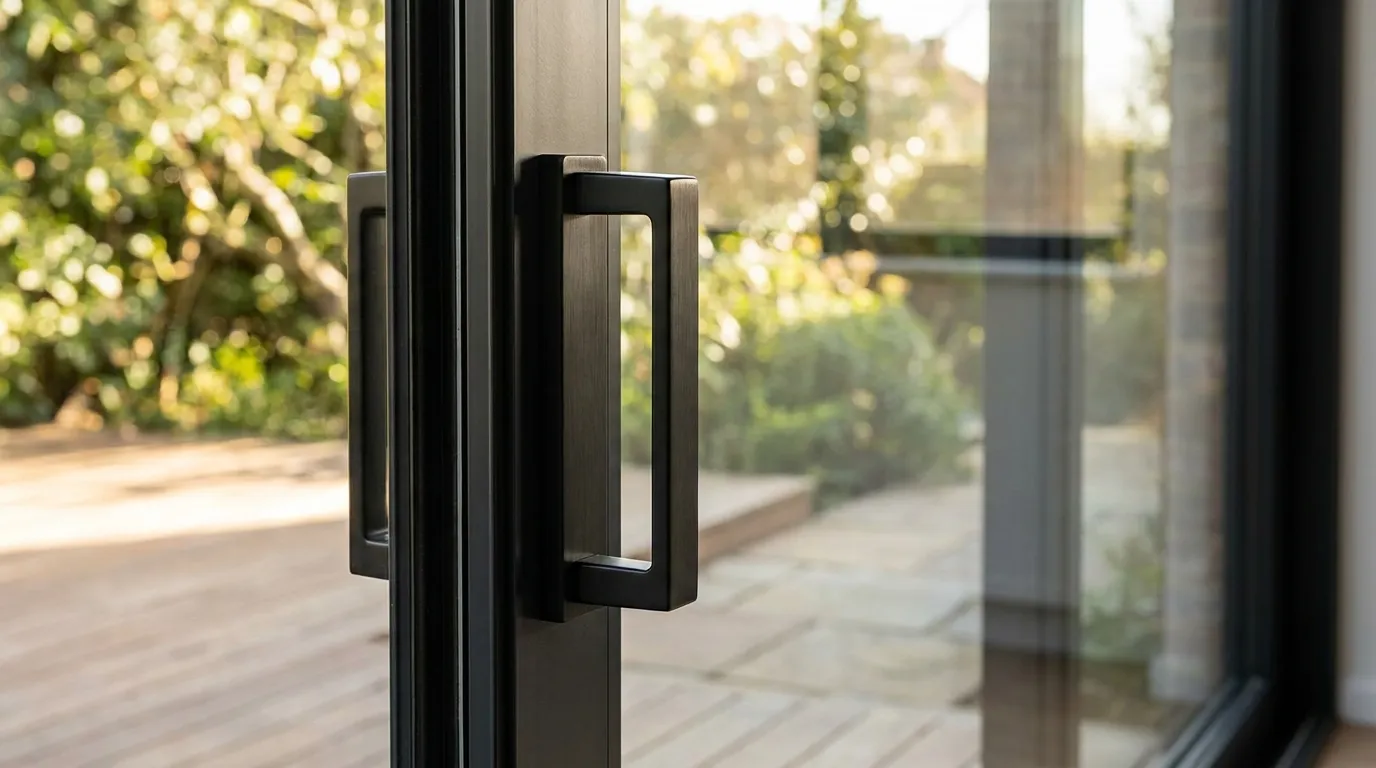
The handle is the only part of a patio door you touch every single day, and the rollers beneath it decide whether that daily interaction is a smooth glide or a two-handed wrestling match. Yet hardware is the line item most buyers skip past on a quote. This guide covers handles, locks, rollers, and tracks, what wears out first, and when smart hardware upgrades can postpone a full door replacement by years.
The anatomy of patio door hardware
A sliding patio door is a simple machine with four hardware systems doing all the work. The handle set gives you grip and houses the latch mechanism; the lock, usually a hook-style bolt driven by a mortise gearbox inside the door stile, secures the panel to the frame; the rollers carry the full weight of the sliding panel, often 45 to 90 kg with modern double or triple glazing; and the track is the rail those rollers live on.
These systems age at very different rates. Glass and frames on a quality door are engineered for 25 to 40 years, but rollers and lock mechanisms are wear components with a working life closer to 10 to 15 years under Quebec conditions, where grit, salt residue tracked in from winter boots, and freeze-thaw condensation all accelerate wear. Understanding that mismatch is the key insight of this whole guide: many doors are replaced when only their hardware has died.
When comparing quotes for a new door, ask specifically what hardware is included. Two doors with identical glass specs can differ enormously in the gauge of the hook bolt, the bearing quality of the rollers, and whether the track has a stainless-steel cap. Those details, not the brochure photo, determine how the door feels in year twelve.
Handle styles and finishes: function first, then fashion
Patio door handles come in three broad families. Flush-mount handles sit recessed into the stile so panels can slide past each other, which is mandatory on the fixed-panel side and common on older doors. Offset or D-pull handles project outward for a full-hand grip, dramatically easier for anyone with limited hand strength or arthritis. Integrated handle sets combine the pull, the thumb latch, and often a key cylinder in one escutcheon, which is the modern standard on quality doors.
Finishes are where design happens, and current Quebec demand runs heavily to matte black, followed by brushed nickel, satin chrome, and classic white. More important than colour is coating quality: look for PVD or powder-coat finishes with a corrosion-rating warranty, because a coastal-grade finish shrugs off the de-icing-salt-laden air of a Montreal winter that will pit cheap electroplating within a few seasons.
One practical note for our climate: metal handles get cold. On an uninsulated aluminum handle at -20 C, the interior grip can be unpleasant to touch, so several manufacturers now offer handles with thermally broken or composite cores. It is a small detail that says a lot about whether a door was designed for a northern market.
- Flush-mount: recessed, lets panels bypass; standard on fixed panels.
- Offset / D-pull: full-hand grip, best for accessibility and heavy panels.
- Integrated sets: pull, latch, and key cylinder in one unit; today’s standard.
- Finish tip: PVD or powder-coat with a corrosion warranty beats bargain electroplating in Quebec air.
Locks: hook bolts, foot bolts, multi-point, and smart options
The workhorse of patio door security is the hook bolt: a curved, hardened claw that rotates out of the door edge and hooks behind a keeper in the jamb, resisting both sliding and prying forces far better than a straight latch. Better doors use a two-point version, with hooks engaging above and below the handle from a single gearbox, spreading any attack across two anchors. When you see a manufacturer advertise a multi-point lock on a sliding door, this is what they mean.
Secondary devices add cheap, meaningful security. A foot bolt, a small pedal-operated pin at the bottom rail, drops into the track or sill and immobilizes the panel independently of the main lock, and it doubles as a ventilation lock in many models by allowing a fixed 10 cm opening. Security bars and track pins do a similar job. Because the classic burglary technique on old sliders is lifting the panel off its track, also confirm your door has anti-lift blocks in the head channel.
Smart locks have finally arrived for patio doors, mostly as retrofit deadbolt-style units or handle sets with keypad and app control. They are convenient for cottages and rental units, but in Quebec verify two things before buying: the battery chemistry is rated for -30 C, because alkaline cells fade badly in a cold vestibule, and the mechanical key override is present, because a frozen electronic lock on a January night is not a hypothetical.
Rollers and tracks: where quality lives or dies
If you learn one thing from this guide, make it this: rollers are the component that determines whether you will love or hate your patio door. Entry-level doors ride on single nylon wheels with plain bushings; quality doors use tandem rollers, two wheels per carriage, with sealed stainless-steel ball bearings. Tandem stainless carriages spread the panel weight, resist corrosion from tracked-in calcium and slush, and keep a 90 kg triple-glazed panel gliding with one finger for a decade or more.
The track matters just as much. Bare aluminum tracks peen and flatten under years of point loading, creating the wavy, gritty feel of an old slider. Better doors fit a stainless-steel cap or rail over the track, which is dramatically harder than the wheel that rides on it, so wear goes into the replaceable roller rather than the frame. Ask any patio door salesperson two questions: tandem stainless rollers, yes or no, and stainless track cap, yes or no.
Rollers are also adjustable, and this is the most underused feature on any patio door. A small screw at each end of the bottom rail raises or lowers each carriage, letting you level the panel so it meets the jamb evenly and the hook bolt aligns with its keeper. A door that suddenly drags or refuses to lock usually needs a two-minute roller adjustment, not a service call.
What wears out first, and the warning signs
Hardware failure follows a predictable sequence. Rollers go first, typically announced by a door that grows heavier to slide each season, a grinding or clicking sound, or visible flat spots and black dust in the track. Next comes lock alignment: as rollers wear, the panel sags, the hook bolt scrapes its keeper, and eventually the handle needs a lift-and-jiggle to lock, a symptom nearly every ten-year-old door owner recognizes.
Handles and gearboxes follow. Thumb latches loosen, key cylinders stiffen from dried lubricant, and in mortise gearboxes the zinc gears can strip, leaving a handle that spins without moving the hook. Weatherstripping and the track-mounted bumpers wear on their own clock, and their failure shows up as drafts and water at the sill rather than as an operating problem.
None of this is a death sentence for the door. Every component in the sequence above is a replaceable part, and catching wear early, ideally with an annual clean and lubrication, dramatically slows the cascade, because a gliding door does not stress its lock and a aligned lock does not stress its handle.
- Stage 1, rollers: door drags, grinds, or needs two hands.
- Stage 2, alignment: hook bolt scrapes; lift-and-jiggle to lock.
- Stage 3, gearbox and handle: handle turns loosely or spins free.
- Anytime: drafts and sill water mean weatherstripping, not mechanics.
Upgrading hardware vs replacing the door
Here is the honest math. A pair of quality tandem stainless rollers costs $40 to $120, a mortise lock gearbox $50 to $150, a full handle set $80 to $250, and a locksmith or door technician in greater Montreal charges roughly $150 to $300 for the visit. So a complete mechanical refresh of a structurally sound door lands somewhere between $200 and $600, against $3,000 to $8,000 installed for a good replacement patio door. If the frame is square, the glass is clear, and the seals are dry, hardware repair wins easily.
Replacement becomes the right call when the problems are beyond the hardware. Fogged or milky glass means the sealed unit has failed and the door has lost its insulating value; a warped, cracked, or rotten frame cannot hold any hardware in alignment for long; and a 1990s-era single-hook, single-pane slider is a security and energy liability that no roller swap can fix. Repeated hardware failures in a door under warranty are also a signal to escalate rather than keep patching.
If you do replace, buy the door around its hardware, not just its glass. Modern doors from our patio door lineup pair ENERGY STAR Zone D glazing with multi-point hook locks, tandem stainless rollers, and low-profile thresholds, which means the door you buy in 2026 should still glide with one finger in 2040. That, more than any finish or colour, is what premium hardware buys you.
Frequently Asked Questions
Why is my patio door so hard to slide?
Worn rollers are the cause in the vast majority of cases, often aggravated by a dirty track. Vacuum and wipe the track, then try raising the adjustment screws at the bottom rail; if the door still drags or grinds, the roller carriages need replacement, a $200 to $400 repair that transforms the door.
Are hook bolt locks secure enough for a patio door?
A hardened hook bolt engaging a properly screwed keeper resists prying far better than the straight latches on older doors, and a two-point version is better still. For real-world security, pair it with a foot bolt or track pin and confirm the door has anti-lift blocks, since lifting the panel is the classic sliding-door attack.
Can I put a smart lock on a sliding patio door?
Yes, several keypad and app-controlled units are made for sliding doors, either as retrofit bolts or full handle sets. In Quebec, choose one with lithium batteries rated for -30 C and a mechanical key override, because cold kills alkaline cells and a frozen electronic lock in January is a genuine risk.
Is it worth replacing the rollers instead of the whole door?
If the frame is square, the glass is clear, and the seals are dry, absolutely. New tandem stainless rollers cost $40 to $120 in parts and restore one-finger gliding, versus $3,000 to $8,000 for a new installed door. Replace the door only when the sealed glass has fogged or the frame itself has failed.
What patio door hardware finish holds up best in Quebec?
Powder-coated and PVD finishes with a stated corrosion warranty handle Quebec's salt-laden winter air far better than budget electroplating, which can pit within a few seasons. Matte black and brushed nickel in these coatings are the current favourites and keep their look for decades.
How often should patio door hardware be maintained?
Twice a year is the sweet spot: vacuum the track, wipe the rollers' path, and apply a silicone-based lubricant to the track, lock, and hinges every spring and fall. Ten minutes of maintenance breaks the wear cascade in which a dragging door strains its lock and the lock then strains its handle.