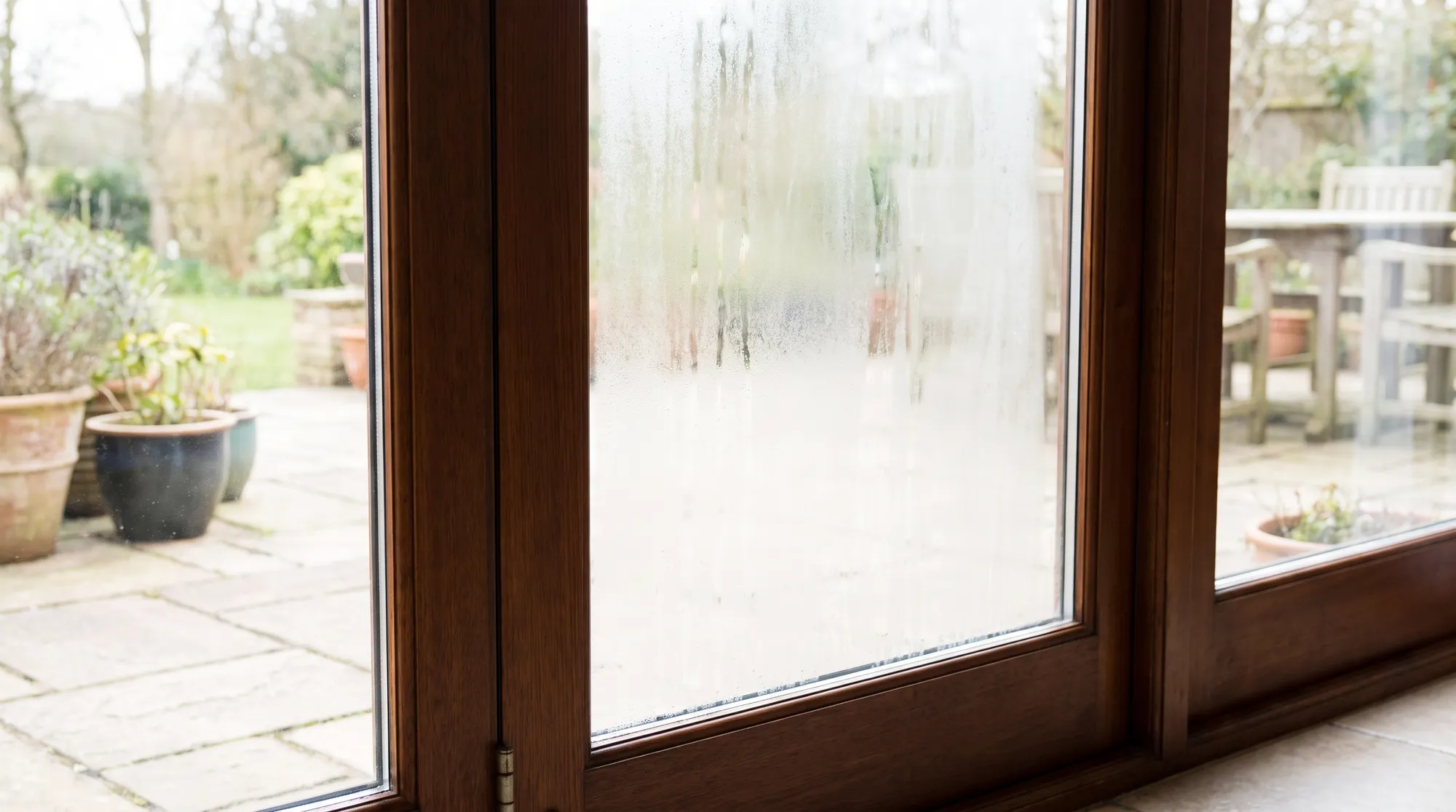
One morning the view through your patio door is permanently hazy — a milky film between the panes that no cleaner on earth can reach. The sealed unit has failed, and you now face a genuinely two-sided decision: swap the glass for a few hundred dollars, or replace the whole door for a few thousand. Both answers are right for different doors; here is how to tell which one is yours.
Why Patio Doors Fog Up: Anatomy of a Failed Sealed Unit
The glass in your patio door is an insulated glazing unit (IGU): two or three panes bonded to a perimeter spacer, the cavity filled with argon and sealed, with a desiccant inside the spacer drinking up any trace of moisture. Over the years, thermal cycling — minus 25 in January, plus 60 on sun-baked glass in July — works the seal like a hinge until microscopic paths open. Argon escapes, humid air enters, and once the desiccant saturates, water vapour condenses on the inner glass surfaces where no cloth can ever reach.
Patio doors fail earlier than windows of the same vintage for predictable reasons: the panes are among the largest in the house (more edge, more expansion stress), the bottom edge sits in a track that collects water and grit, and the door slams — a mechanical shock windows never see. Typical IGU life runs 15 to 25 years; a big south- or west-facing slider on the sunny side of the house often sits at the early end of that range.
Beyond the haze, a failed unit is a quiet energy leak. The argon that made the glass insulate is gone, and moisture in the cavity further degrades performance — a failed double unit behaves closer to single glazing with a decorative second pane. The fog is cosmetic; the heat loss is monthly.
When Replacing Just the Glass Makes Sense
An IGU swap replaces only the sealed glass unit inside the existing sash — the frame, panels, rollers, track and hardware all stay. It is the right call when the glass is the only thing wrong: the door slides smoothly, latches securely, the frame is straight and rot-free, the weatherstripping still seals, and the door is young enough (roughly under 15 years) that its other components have useful life left.
The economics are attractive. A replacement sealed unit for a standard patio door panel typically runs $350 to $800 supplied and installed in the Montreal area, depending on size, low-E coating and whether tempered safety glass is doubled on both faces — which code requires for doors. Against $3,500 to $8,000+ for a quality full replacement, fixing a single failed pane on an otherwise healthy door is easy math.
Two upgrades are worth ordering with any swap, since the labour is already paid: a modern low-E coating with argon (often better than what the door shipped with), and warm-edge spacers that resist the next seal failure and reduce edge condensation. Insist on the new unit being measured by the glazier, matched for thickness and airspace, and warranted in writing — five to ten years on the seal is a normal expectation.
- Door slides, latches and locks smoothly — rollers and track healthy
- Frame and sash straight, no rot or delamination at the bottom rail
- Weatherstripping intact and still compressing
- Door under ~15 years old with decent original energy specs
- Budget check: swap at $350-$800 vs full door at $3,500-$8,000+
When Full Replacement Is the Honest Answer
A failed sealed unit is often the first symptom of a door failing as a system, and putting fresh glass into a dying door is the renovation equivalent of a new engine in a rusted car. The signs are familiar to anyone with a 1990s slider: you lift and shove to move a door that should glide, the rollers are flat-spotted and the track worn shiny, the latch needs body English to catch, and in February frost blooms across the aluminum frame from the inside.
Rot and structural issues end the debate immediately. A wood or clad-wood door soft at the bottom rail, a sill delaminating, water stains on the interior floor after driven rain — these mean the assembly is compromised, and new glass changes nothing about where the water goes. The same verdict applies to frames racked out of square by settling: the perfect new IGU will sit in a sash that still will not seal against its weatherstripping.
Energy specifications are the quieter reason. A 1995 aluminum-frame slider with a clear double unit loses two to three times the heat of a modern ENERGY STAR door with triple or high-performance double glazing, insulated frame and dual-stage compression seals — and no glass swap can fix a conductive frame or thirty-year-old brush weatherstripping. If the door is on borrowed time anyway, the $500 glass swap is not savings; it is a deposit on a door you have already decided to replace.
The Cost Comparison, Honestly Done
Put the two options side by side over a ten-year horizon rather than a single invoice. The IGU swap wins outright when the door is healthy: $350 to $800 now, no other costs, and the door serves out its natural life. The calculation shifts as soon as other components are marginal — add $150 to $400 for roller and track service, $100 to $200 for weatherstripping, and you are approaching $1,000 on a door that still has an aging frame, dated security and 1990s thermal performance.
A full replacement at $3,500 to $8,000 installed buys the things a swap cannot: an insulated multi-chamber frame, modern multi-point locking, smooth heavy-duty hardware, fresh sill flashing and perimeter air sealing (where much of the real-world heat loss lives), plus a warranty covering the whole assembly. Heating savings of $50 to $150 a season versus a degraded old slider are realistic for a large opening, and a new patio door adds resale presentation that a clear pane in an old frame does not.
A fair rule of thumb: when foreseeable repairs approach 25 to 30 percent of replacement cost, or the door is past 20 years, replace; when the failure is isolated and the door is under 15, swap. Between those lines, let the frame condition and your planned years in the house decide.
A Ten-Minute Diagnostic Before You Call Anyone
You can sort your own door into the right column with a short inspection. Work through the checklist below on a bright day, and note results — the same answers will make any quote conversation faster and keep the recommendation you receive honest.
Weigh the whole wall, not just the door. If the surrounding windows are the same age and starting to fog or stick, a coordinated replacement project prices better per opening than piecemeal fixes spread over five years — and matching frames and colours across the elevation is only possible when it is planned as one job.
- Glass: fog, water lines or white mineral staining between panes = failed IGU, confirmed
- Glide test: the panel should move with two fingers — grinding or lifting means rollers and track are gone
- Latch and lock: should engage without lifting or slamming; check for a functioning secondary lock
- Frame check: press the bottom rail and sill with a screwdriver tip — any softness is rot
- Winter memory: frost on the interior frame, or a draft you can feel at the jamb, means the assembly leaks
- Age: under 15 years favours the swap; over 20 favours replacement
If You Swap: Doing It Right
An IGU swap is a job for a glazier or door specialist, not a general handyman. Patio door glass must be tempered on both panes by code — it shatters into pebbles instead of shards — and a unit this size is heavy, awkward and unforgiving of measurement error. The glazing stops that retain it are easy to crack on removal and must be re-bedded properly, or the first driven rain finds its way into the sash.
Specify the new unit rather than accepting a generic duplicate: low-E coating appropriate to the door's orientation, argon fill, warm-edge spacer, and overall thickness matched to the sash. Ask for the seal warranty in writing and confirm who returns if fog reappears in year three. A competent shop measures, orders and installs in one to three weeks, with the actual on-site work taking about an hour per panel.
Use the same visit to service what remains: new rollers if there is any hesitation in the glide, fresh weatherstripping, a cleaned and lubricated track. Those small items decide how the door feels daily, and doing them with the glass out is the cheapest they will ever be.
If You Replace: What to Look For in a New Patio Door
If the diagnosis points to replacement, buy for the Quebec winter first. The specification list that matters: ENERGY STAR certification for the current standard, triple glazing or high-performance double with dual low-E and argon, an insulated multi-chamber frame in PVC or hybrid aluminum-PVC, warm-edge spacers, dual-stage compression weatherstripping, and a thermally broken sill. On security, a multi-point lock and laminated glass option address the patio door's reputation as the easiest entry in the house.
Consider the format while the opening is open. Standard sliders preserve floor space; lift-and-slide hardware moves very large panels with one finger and seals tighter at rest; French-style garden doors swing for a traditional look and the tightest compression seal of all. If the view matters, slimmer frames and larger glass proportions changed dramatically in the last decade — a new door is not just a warmer version of the old one.
Finally, insist that installation quality match the product: full perimeter low-expansion foam, sill pan flashing, exterior backer rod and sealant, and an installer whose RBQ licence and labour warranty are on the contract. The patio door is the largest moving part of your home's envelope — it deserves the same installation rigour as any window wall.
Frequently Asked Questions
Can a foggy patio door be fixed without replacing the whole door?
Yes, in most cases. The fog means the sealed glass unit (IGU) has failed, and a glazier can replace just that unit — typically $350 to $800 per panel installed in the Montreal area — provided the frame, rollers, track and hardware are still in good condition. The fix restores clarity and most of the insulating value.
How long does a patio door sealed unit last?
Typically 15 to 25 years. Large panes, sun exposure and the mechanical shock of sliding and closing age patio door seals faster than window seals of the same vintage. South- and west-facing doors tend to fail at the early end of the range; a written 5-to-10-year seal warranty on the replacement unit is a normal expectation.
Is it worth putting new glass in a 20-year-old patio door?
Rarely. Past 20 years, rollers, track, weatherstripping and the frame's energy performance are usually all marginal, so the $500 swap becomes a deposit on a door you will replace anyway. The practical threshold: if foreseeable repairs approach 25 to 30 percent of replacement cost, put the money toward a new door.
How much does a new patio door cost installed in Quebec?
A quality ENERGY STAR patio door typically runs $3,500 to $8,000+ installed, depending on size, glazing (triple versus double), frame material, hardware and format — lift-and-slide and oversized units cost more. The price includes what a glass swap cannot buy: insulated frame, multi-point locking, new sill flashing and perimeter air sealing.
Does a failed sealed unit increase heating costs?
Yes. Once the seal fails, the argon fill is gone and moisture in the cavity further degrades the glazing — a failed double unit performs closer to single glazing. On an opening as large as a patio door, that is real money over a Quebec heating season, which is why a hazy unit should be addressed rather than tolerated.
Should the new glass be tempered?
It must be — building code requires tempered safety glass in doors, on both panes, because glass at floor level in a traffic path is an impact risk. Tempered glass breaks into small granular pebbles instead of shards. Order the replacement IGU from a shop that certifies tempering and matches thickness to the sash.