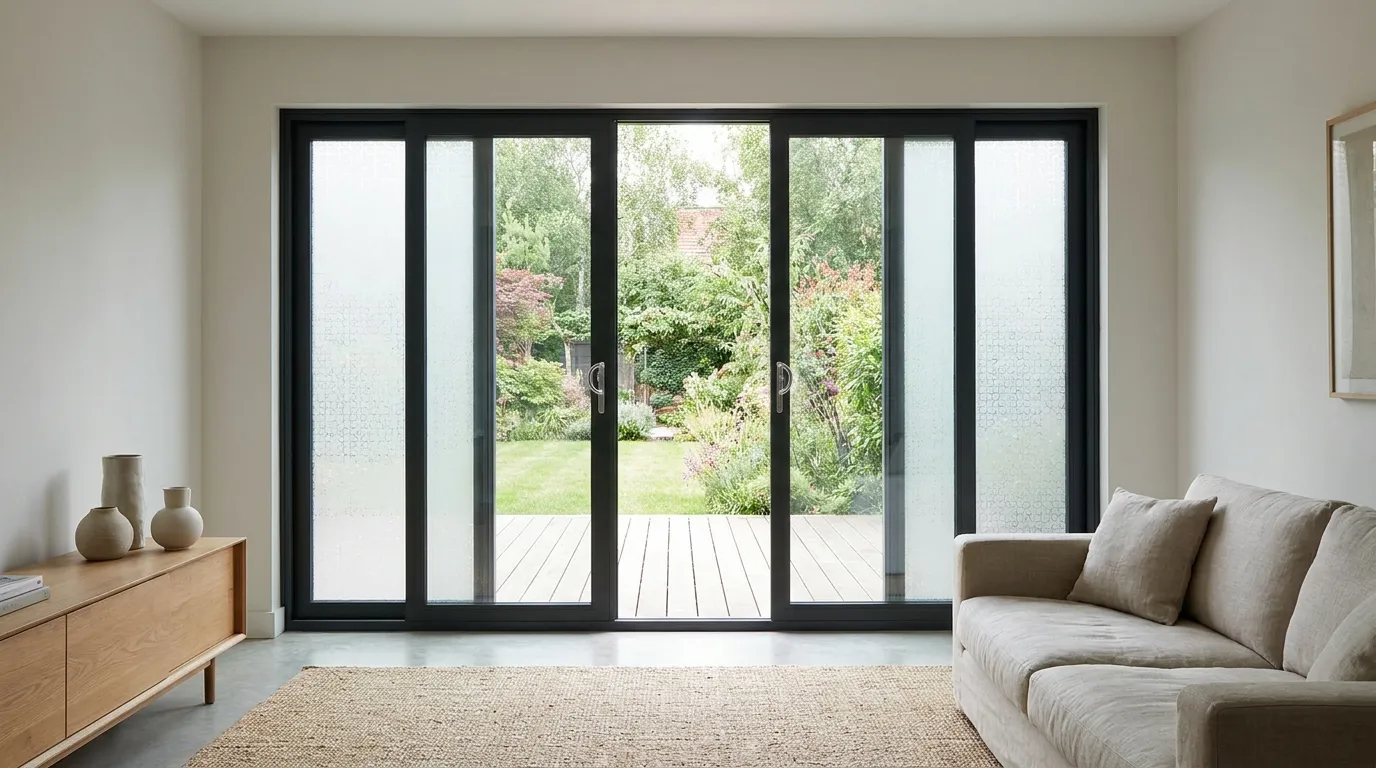
A patio door is really a wall of glass, and the glass you specify decides how much heat, light, and privacy pass through it every day. The choice runs far deeper than clear versus frosted: low-E coatings, tints, obscure patterns, and blinds sealed between the panes all change how the door performs and feels. In a Montreal climate that swings from a blazing July afternoon to a January deep freeze, getting that glass right is the difference between a door you love and one you fight with.
How patio door glass is actually built
Every quality patio door in Quebec uses an insulated glass unit, or IGU: two or three panes of glass separated by a spacer and sealed around the edge, with argon or krypton gas filling the cavity between them. That sealed gas layer is what does most of the insulating, which is why a double- or triple-pane door keeps your living room warm while a single sheet of glass would be a heat sieve.
On its own, ordinary glass still lets radiant heat pour in and out. That is why nearly every modern IGU carries a low-emissivity, or low-E, coating: a microscopically thin, all-but-invisible metallic layer that reflects heat back to where it came from. In winter it bounces your furnace heat back inside; in summer it reflects the sun's heat away. Almost everything else on this page, tint, frosting, privacy patterns, is layered on top of that low-E base.
The two numbers to know are the U-factor, which measures how much heat escapes (lower is better), and the SHGC, or solar heat gain coefficient, which measures how much of the sun's heat gets through (0 to 1). For an ENERGY STAR door in Zone D, which covers Montreal and most of southern Quebec, you want a U-factor around 1.4 to 1.6 in metric terms and an SHGC tuned to your exposure. Every glass option below nudges those numbers.
Clear low-E glass: the default worth understanding
Clear low-E glass is what most patio doors ship with, and for good reason. It gives you the fullest possible view of your yard and the most natural daylight, while the low-E coating still handles the heavy lifting on energy performance. If your patio door faces a private backyard rather than a neighbour's window, clear glass is usually the right starting point.
The subtlety is that low-E coatings come in different flavours tuned for different sun exposures. A high-solar-gain coating lets more warmth in and suits a north-facing door in our climate, where you want to capture every bit of free winter heat. A low-solar-gain coating blocks more of the sun and makes sense on a south- or west-facing door that would otherwise bake your living room on a July afternoon.
Clear glass does nothing for privacy, and that is the honest limitation. From dusk onward, with the lights on inside, a clear patio door becomes a lit stage visible from the yard. If your door faces a lane, a neighbouring deck, or a busy street, you will want to combine clear glass with a treatment, or choose one of the options below instead.
- Best view and light: nothing between you and the yard.
- Pick the low-E for your exposure: high-gain for north, low-gain for south and west.
- Weakest on privacy: plan a blind or film if the door faces neighbours.
Tinted glass for glare and heat
Tinted glass has a colour baked into the pane itself, most often a bronze, grey, or green-blue hue. Its job is to cut glare and absorb a portion of the sun's heat before it reaches you, which can make a west-facing patio door far more comfortable through a long summer evening. The tint also lends the exterior a subtle, uniform look that many homeowners like on a modern facade.
The tradeoff is that a tint darkens your view and dims the daylight coming in, and it works by absorbing heat rather than reflecting it, so the glass itself can get quite warm. In Quebec's climate you rarely want a heavy tint on a north- or east-facing door, where you are trying to hold onto winter warmth and gentle morning light, not block it. Tint pairs best with a low-solar-gain low-E on doors that genuinely overheat.
Tinting offers only mild privacy, and mostly in daylight. From outside during the day the darker glass makes the interior harder to read, but once your indoor lights come on at night that advantage largely disappears. Treat tint as a comfort and glare solution first, and a privacy solution a distant second.
Frosted and obscure glass for true privacy
Frosted, or obscure, glass is where genuine privacy begins. The surface is acid-etched, sandblasted, or moulded with a texture that scatters light, so shapes and shadows come through but detail does not. It is the classic choice for a patio door that opens onto a shared lane, a tight side yard, or a spot where a neighbour's window looks straight in.
Obscure glass comes in a whole catalogue of patterns and privacy levels, from a light, barely-there frost to deeply textured designs like reeded, rain, or satin that block the view almost completely. Higher privacy ratings obscure more but also let through slightly less light, so the choice is a balance between how much you want to hide and how bright you want the room. A satin or fully frosted finish is popular because it still floods the room with soft, even light while giving you complete daytime and nighttime privacy.
One practical note for a patio door: because these are doors you walk through and past constantly, a full-height obscure panel can feel enclosed. Many homeowners choose obscure glass only for the sidelites or the lower portion of a design, or reserve full frosting for the door and keep adjacent windows clear, so the room still feels open.
- Light frost: softens the view, keeps the room bright, modest privacy.
- Reeded or rain patterns: vertical or textured distortion, strong privacy with movement of light.
- Satin or full frost: near-total obscurity day and night, soft even daylight.
Privacy glass and blinds-between-the-glass
If you want privacy on demand rather than permanently, blinds-between-the-glass is the standout option for patio doors. A slim mini-blind is sealed inside the insulated glass unit and operated by a magnetic slider or a small crank on the frame. You raise, lower, and tilt it exactly like a normal blind, but it lives inside the sealed cavity where dust, pet hair, and grabbing hands never reach it.
For a busy Quebec household this is a genuinely practical upgrade. There are no dangling cords for kids or pets, nothing to wipe down after a winter of closed windows, and nothing that swings and clatters every time the door slides open. Because the blind sits within the argon-filled cavity, it does not compromise the door's low-E performance, and it adds a small measure of shading when fully closed.
At the high end, switchable privacy glass turns from clear to opaque at the flick of a switch using an electric charge, and it is a striking feature for a contemporary home. It carries a premium price and needs a power connection, so it is less common on residential patio doors than blinds-between-the-glass, but it is worth knowing the option exists if you want a completely clean, hardware-free look.
- Blinds-between-glass: privacy on demand, sealed clean, no cords, keeps low-E performance.
- Switchable smart glass: clear-to-opaque at a switch, premium, needs power.
- Applied privacy film: a lower-cost retrofit, but it can trap heat and void some sealed-unit warranties.
Tempered glass and the safety rules
This one is not really optional. Patio doors are considered a hazardous location under the building code because people, especially children, can walk into them. That means the glass must be safety glass, and for patio doors that almost always means tempered. Tempered glass is heat-treated to be several times stronger than ordinary glass, and if it does break it crumbles into small, dull granules rather than long, dangerous shards.
You do not usually have to ask for it, since a reputable manufacturer builds every patio door with tempered glass as a matter of code compliance. What is worth confirming is that any sidelites, transoms, and adjacent low windows within the code's hazard zone are tempered too, because those are the spots occasionally missed on a cheap or improvised installation.
For doors on the ground floor of a walk-out or a busy urban lot, some homeowners step up to laminated glass, which sandwiches a plastic interlayer between two panes so the glass holds together even when cracked. Laminated glass adds security against forced entry and cuts outside noise, which is a welcome bonus on a door facing a busy Montreal street. It can be combined with tint, obscure patterns, and low-E.
Choosing the right combination for your home
The best glass for your patio door is a combination, not a single feature, and it starts with which way the door faces. A north-facing door onto a private yard wants clear, high-solar-gain low-E to capture free winter warmth and daylight. A west-facing door that cooks every summer evening wants low-solar-gain low-E, and possibly a tint, to tame the heat and glare. A door that faces a neighbour or a lane wants obscure glass or blinds-between-the-glass for privacy.
Budget matters too, and the good news is that most of these choices are incremental. Upgrading the low-E coating or adding a tint is modest; blinds-between-the-glass typically adds a few hundred dollars per door; switchable smart glass is a genuine luxury line item. Weigh each against how you actually live with the room, since a comfortable, private space you use every day is worth far more than a spec sheet.
Because glass performance is baked into the sealed unit at manufacture, this is a decision you make once, up front, not something you retrofit easily later. That is exactly why it pays to walk through your exposure, privacy, and comfort needs with someone who builds the doors. Explore our patio doors and request a quote to spec the right glass package for each opening in your home.
- Map each door's orientation before you choose a low-E and SHGC.
- Add obscure glass or blinds-between-the-glass only where privacy is genuinely needed.
- Confirm tempered or laminated safety glass on the door and every adjacent hazard-zone pane.
- Remember the glass is sealed at manufacture, so choose deliberately the first time.
Frequently Asked Questions
What is the most private glass for a patio door?
For permanent privacy, a satin or fully frosted obscure glass blocks the view almost completely day and night while still letting soft light through. For privacy you can control, blinds-between-the-glass let you go from clear to covered on demand, sealed inside the unit so they stay clean.
Does tinted glass give me privacy at night?
Not really. A tint darkens the view from outside during the day, but once your indoor lights come on at night the interior becomes visible again. Tint is best thought of as a glare and heat solution, with only mild daytime privacy as a side benefit.
Is patio door glass always tempered?
For the door panels themselves, yes, because the building code treats patio doors as a hazardous location that requires safety glass, and tempered is the standard. It is worth confirming that adjacent sidelites, transoms, and low windows in the hazard zone are tempered too.
Will privacy or tinted glass hurt my energy efficiency?
Not if it is built on a proper low-E, argon-filled unit. Obscure and blinds-between-the-glass options keep the low-E coating intact, so your U-factor and SHGC stay in the right range for ENERGY STAR Zone D. Applied aftermarket films are the exception and can trap heat or void a sealed-unit warranty.
What glass suits a west-facing patio door in Quebec?
A west-facing door catches the harsh late-day summer sun, so a low-solar-gain low-E coating, sometimes paired with a bronze or grey tint, keeps the room comfortable and cuts glare. Just avoid heavy tint on north- and east-facing doors, where you want to hold onto winter warmth and morning light.
Can I add blinds between the glass to an existing patio door?
No. Blinds-between-the-glass are sealed inside the insulated unit during manufacture, so they cannot be added to a door you already own. If you want privacy on an existing door, your options are applied film, a mounted blind or shade, or replacing the sealed unit.