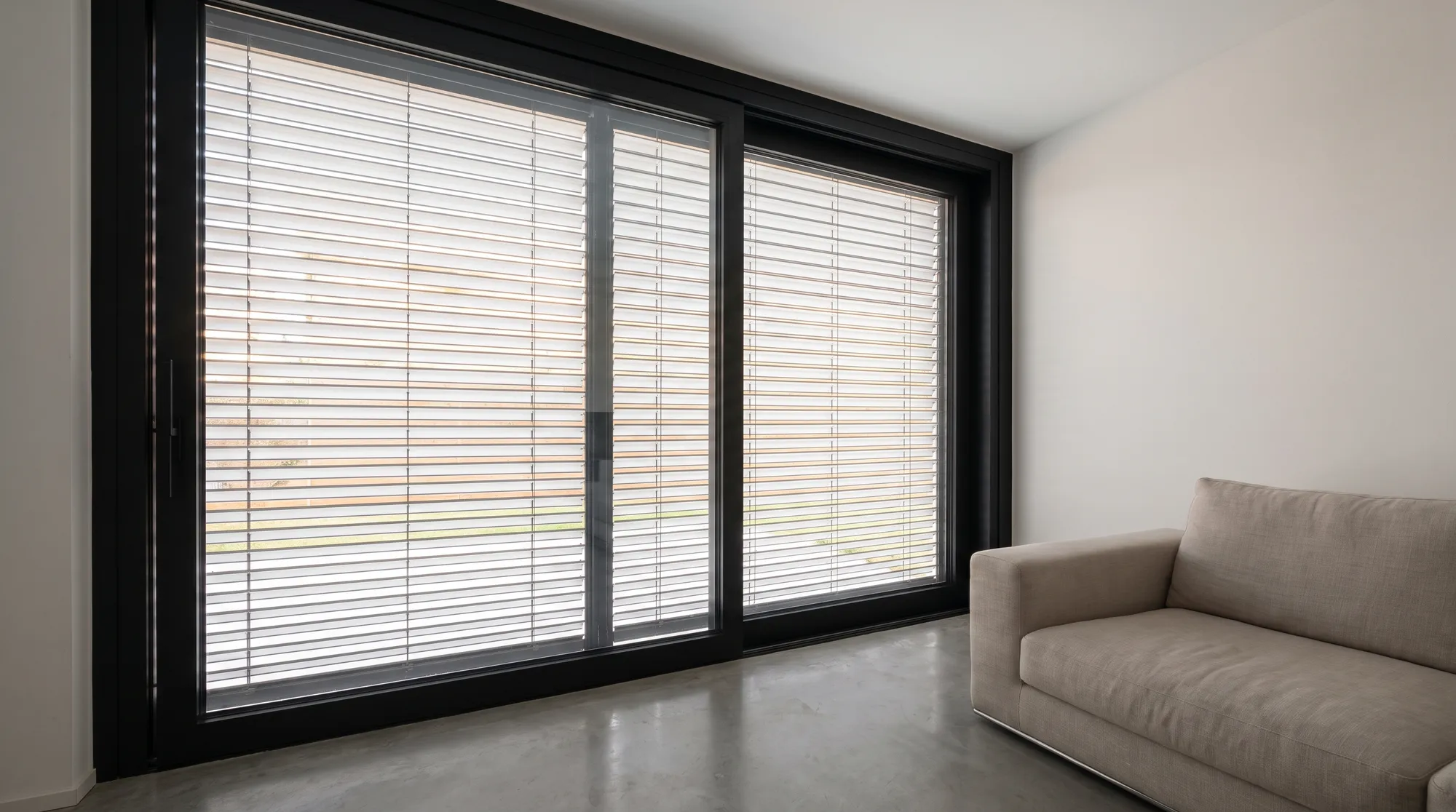
Anyone who has tried to dust vertical blinds on a patio door — or untangle a cord from a toddler's hands — understands the appeal instantly: blinds sealed inside the glass unit itself, where dust, fingers and pets can never reach them. Integrated blinds have moved from novelty to mainstream option on patio doors in Quebec. Here is how they work, what they genuinely solve, what they cost, and where their limits are.
How Blinds Between Glass Actually Work
An integrated blind is a slim aluminum venetian blind mounted inside the sealed glass unit of the door — between two panes, in the same hermetic cavity that provides the insulation. The slats, ladder cords and rails live in a clean, dry, dust-free environment that was sealed at the factory and stays sealed for the life of the unit. Nothing about the door's exterior changes: from outside it looks like ordinary glazing until the blind is lowered.
Control happens without breaking the seal. Most systems use a magnetic slider or dial on the interior glass surface: a magnet inside the cavity follows the magnet in your hand, tilting the slats or raising and lowering the blind. Higher-end versions offer motorized operation with a wall switch or remote, which is worth considering for wide multi-panel doors where a slider means walking the whole span.
Because the blind is part of the glass unit, it is specified when you order the door, not added later. The glazing package is typically a double-glazed unit with the blind cavity, or on better doors a triple-glazed configuration where the blind occupies one of the two cavities — an important distinction for energy performance we will come back to.
The Cleaning Argument: Dust Simply Cannot Get In
Standard patio-door coverings are dust magnets with terrible ergonomics. Vertical blinds collect grime on every vane and clatter in the breeze from the open door; curtains soak up cooking odours and need seasonal washing; horizontal blinds wide enough for a two-metre opening are heavy and awkward to clean slat by slat. Most households simply give up, and the covering on the biggest glass surface in the house becomes the dirtiest object in the room.
Sealed-in blinds end this entirely. The cavity was assembled in a factory clean room and hermetically sealed; there is no path for dust, pollen, grease aerosols or pet hair to reach the slats — ever. Cleaning the door means wiping two smooth glass surfaces, exactly as if no blind existed. For allergy sufferers, removing a large textile or slatted dust reservoir from the main living area is a measurable air-quality improvement, not just a convenience.
The same sealing protects the mechanism itself. No greasy film on the slats means the tilt action stays light for decades, and there are no exposed cords to fray, kink or yellow in the sun. Quality systems are tested to tens of thousands of cycles precisely because nobody can service the inside of a sealed unit.
Child and Pet Safety: No Cords, Period
Corded window coverings are a documented strangulation hazard for young children — enough that Health Canada's regulations have progressively banned long accessible cords on products sold in Canada, and safety authorities have recommended cordless alternatives in homes with children for years. A patio door is the worst location for cords: floor-to-ceiling glass means cords hang exactly at child height, right where kids and pets play by the light of the biggest window in the house.
Integrated blinds remove the hazard by design rather than by vigilance. The operating cords are inside the sealed cavity; the only accessible control is a smooth magnetic slider or a remote. There is nothing to wrap around a neck, nothing for a cat to shred, nothing for a dog's tail or a passing laundry basket to snag. Families with young children frequently cite this — not the cleaning — as the deciding factor.
Durability follows from the same fact. The classic failure modes of patio-door coverings — bent slats from a dog pushing through vertical blinds, vanes snapped by kids, chewed cords — are all impossible when the blind sits behind tempered glass. The covering on the most heavily used door in the house is the one protected from the traffic.
Tilt, Lift and Privacy on Demand
Integrated venetians give you the full range between open view and full privacy in one gesture. Tilt the slats to cut glare while keeping daylight and the view of the yard; close them fully for privacy from neighbours; raise the blind entirely and the door is pure glass. This matters on patio doors more than anywhere else, because they typically face the backyard where you want maximum light and view by day, and maximum privacy after dark when interior lighting turns the glass into a display window.
The magnetic controls are genuinely simple — a child or a person with limited hand strength can operate them, with none of the wand-twirling and cord-yanking of vertical blinds. Motorized versions integrate with home automation, so the blinds can close automatically at sunset or when the sun load peaks in summer afternoons.
One honest limitation: you are choosing from the manufacturer's palette of slat colours (typically whites, creams, silvers and greys), not from the infinite fabric universe of curtains. If a specific decorative textile look matters to your design, integrated blinds solve function, not fashion — though nothing prevents pairing them with purely decorative side panels that never need to actually cover the glass.
- Tilt: adjust slat angle for glare control while keeping daylight and the view.
- Lift: raise the blind fully for an unobstructed glass door.
- Privacy on demand: full closure in one gesture — no neighbour sightlines after dark.
- Motorized option: wall switch, remote or home-automation schedules for wide door spans.
The Energy Question, Answered Honestly
Blinds inside the glass do have thermal effects, and they cut both ways. In summer, closing the slats intercepts solar radiation inside the glazing cavity before it enters the room, reducing solar gain meaningfully — useful for a west-facing patio door that turns the dining room into a greenhouse on July afternoons. This shading is more effective than an interior curtain, which absorbs the sun's heat after it has already passed through the glass into the room.
In winter, the effect is modest. Closed slats add a small amount of radiant shielding at night, but the blind does not meaningfully change the U-factor of the door — insulation comes from the glazing itself. The honest engineering point is the opposite one: a blind cavity occupies space that argon and a low-E surface would otherwise serve, so a double-glazed unit with an integrated blind typically insulates slightly worse than the same double glazing without one.
The Quebec answer is to specify the right glazing package. On a quality door, choose a triple-glazed configuration where one cavity holds the blind and the other keeps its low-E coating and argon fill — you retain strong winter performance and gain the summer shading. Ask for the certified U-factor of the exact unit with the blind, not the brochure figure for the plain glazing, and compare it against the ENERGY STAR threshold before ordering.
Integrated vs Vertical Blinds and Curtains
Vertical blinds remain the cheapest option and offer wide colour choice, but they are also what most people are trying to escape: dust-laden vanes, cords and chains at child height, clatter in every breeze, and vanes that block part of the view even when open. Curtains offer the richest decorative palette and some acoustic softening, but they eat floor space beside the door, obstruct the passage, and are the most demanding to keep clean above a high-traffic doorway.
Between-glass blinds win on cleaning (nothing to clean), safety (no cords), durability (untouchable), and door clearance (nothing protrudes, nothing swings when the door slides). They lose on upfront cost, decorative range, and replaceability — you cannot swap the colour next year on a whim, and in the rare case of a mechanism failure outside warranty, the fix is replacing the sealed glass unit, not a $30 part.
A fair summary: if the patio door is a design statement in a formal room, curtains still have arguments. If it is the hardest-working door in a family home — kids, pets, barbecue traffic, winter condensation — the integrated blind is the option engineered for exactly that life. You can see the configurations we offer on our patio doors page.
What It Costs in Quebec — and When It Is Worth It
Expect integrated blinds to add roughly $300 to $700 per door panel to the price of a quality patio door in Quebec, depending on door size, motorization and the glazing package — on a two-panel sliding door where typically only the sliding or fixed section gets the blind, the practical premium usually lands between $400 and $900. Compare that honestly against the alternative: decent vertical blinds or made-to-measure curtains for a two-metre opening run $200 to $600, need periodic replacement, and add recurring cleaning labour for as long as you own the door.
Over a patio door's 25-to-35-year life, coverings get replaced two or three times, which brings lifetime costs surprisingly close — before assigning any value to the safety, the air quality, or the hundreds of cleaning hours you skip. Buyers with young children or allergies usually find the premium easy to justify; buyers furnishing a rarely used formal room may not.
Two buying tips. First, order the blind with the door — retrofitting a sealed unit later means replacing the glass, which erases any savings from waiting. Second, ask about the warranty on the blind mechanism specifically: quality manufacturers warrant the internal blind separately (commonly 5-10 years) on top of the sealed-unit warranty, and that document is your protection since the mechanism is not serviceable.
Frequently Asked Questions
Can blinds between glass be repaired if they break?
The sealed cavity cannot be opened, so a mechanism failure outside warranty means replacing the sealed glass unit — not the whole door. This is rare: quality systems are cycle-tested for decades of use precisely because they are unserviceable, and the mechanism is warranted separately (commonly 5-10 years). Ask for that warranty in writing when ordering.
Do integrated blinds make a patio door less energy efficient?
Slightly, if specified naively: a blind cavity in a double-glazed unit displaces some of the insulating function. The fix is a triple-glazed package where one cavity holds the blind and the other keeps its low-E coating and argon. In summer the blinds actually help, intercepting solar heat inside the glass before it enters the room.
Are blinds between glass safe for children?
Yes — this is one of their strongest arguments. All cords and ladder strings are sealed inside the glass unit, and the only accessible control is a smooth magnetic slider or remote. Health Canada has restricted long accessible cords on window coverings precisely because of strangulation risk; integrated blinds eliminate the hazard by design.
Can I add integrated blinds to my existing patio door?
Sometimes, by replacing the sealed glass unit in your existing door frame with a new unit containing the blind — feasible when the frame is in good condition and the glazing pocket accepts the thicker unit. It is usually more economical to order the blind with a new door, so decide at purchase time. See our patio door options.
How much do blinds between glass add to a patio door price?
In Quebec, plan for roughly $300 to $700 extra per panel depending on size, glazing package and motorization — typically $400 to $900 on a standard two-panel sliding door. Over the door's lifespan that is competitive with buying and replacing conventional coverings two or three times, before counting the cleaning time saved.
Do the blinds block the view or darken the room when open?
No — fully raised, the blind stacks into a compact bundle at the top of the glass unit, leaving the door essentially clear glass. Tilted open, the thin aluminum slats admit most daylight while cutting glare. You lose nothing on bright days and gain one-gesture privacy at night.