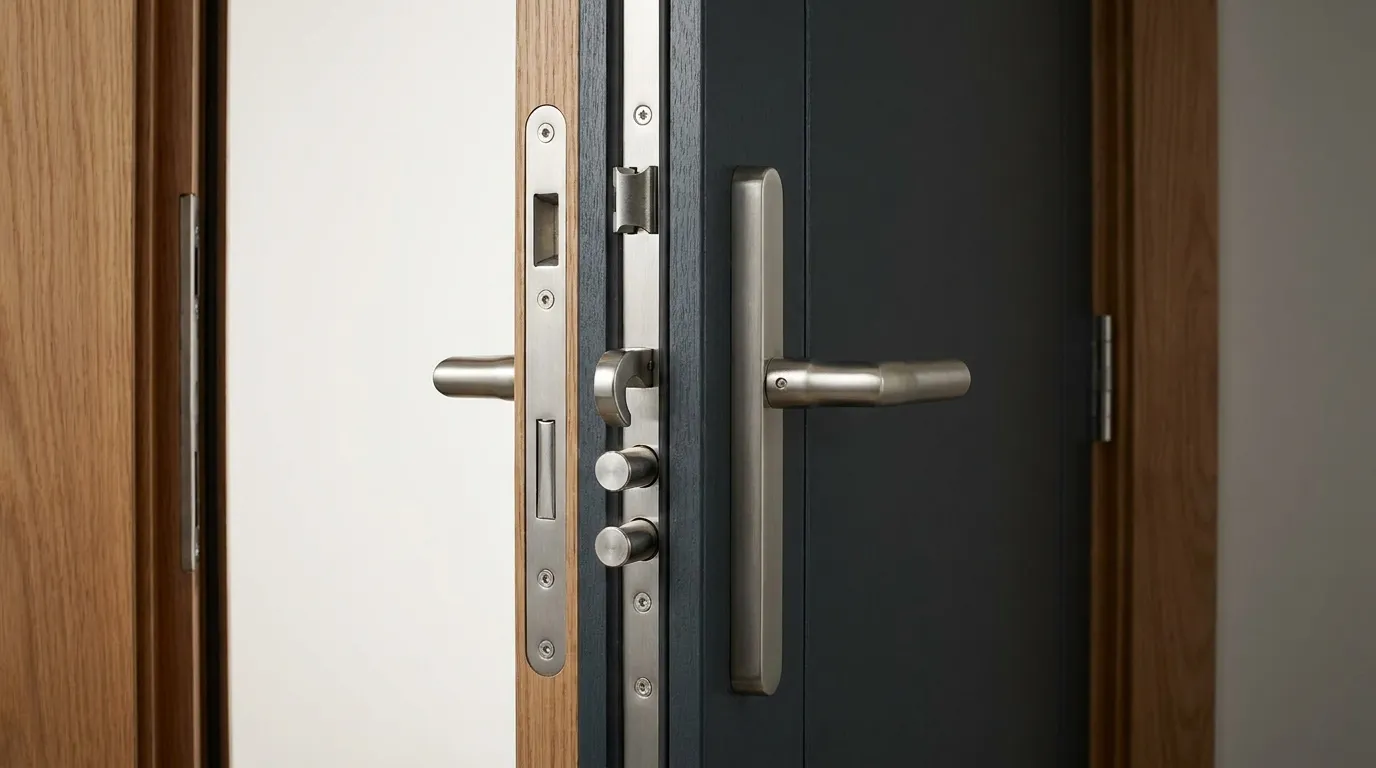
Your front door is the single most important barrier between your family and the outside world, yet most homes still rely on a lone deadbolt spinning into a strike plate. A multipoint locking system changes that equation entirely, engaging the frame at three or more heights with one lift of the handle. In a climate like Montreal's, that same mechanism does double duty, clamping your door tight against the cold long after a standard lock would let the draughts in.
What a multipoint lock actually is
A multipoint lock is a single locking mechanism that secures a door at several points along the frame simultaneously, rather than at one central spot. When you lift the handle and turn the key, a series of hooks, bolts, and rollers extend from the edge of the door and bite into keeps mounted in the jamb. Most residential systems engage at three points, though heavier or taller doors may use five.
The genius of the design is that all of those points are driven by one continuous steel gear rail hidden inside the door slab. Lifting the lever compresses the door against its weatherstripping and shoots every bolt at once, so there is no fumbling with separate locks at the top and bottom. One motion, and the entire door is pinned to the frame from head to sill.
This is standard equipment on European-engineered doors and has become the expectation on premium Canadian entry systems. If you have shopped for a high-performance fibreglass or steel door in the last few years, chances are the good ones already came with a multipoint mechanism built in.
- Hooks: swing out and grab the keep, resisting the door being pried or jimmied sideways.
- Deadbolts: square or round bolts that throw into the frame like a traditional lock, but at multiple heights.
- Rollers or mushroom cams: adjustable studs that pull the door snug and take up seasonal movement.
Why it beats a single deadbolt
A single deadbolt concentrates all of a door's security at one point, usually around waist height. A determined intruder with a pry bar only has to defeat that one spot, and because the top and bottom of the slab are unsecured, the door can flex enough to pop the strike plate out of the jamb. Roughly a third of break-ins are simple forced entries through a door, and the lone deadbolt is exactly the weakness they exploit.
Multipoint locks distribute the load. With bolts engaging near the top, middle, and bottom of the frame, the force of a kick or a pry is spread across the full height of the opening and into the structural framing on both sides. There is no single hinge point to lever against, which is why insurers and security professionals consistently rate multipoint doors above conventional ones.
The bolts themselves are also harder to reach. On many systems the hooks wrap behind the keep, so even if someone spreads the frame, the door stays latched. Pair that with a reinforced strike and a solid door slab and you have a barrier that buys the minutes a burglar simply does not have.
The weather-sealing bonus in a Quebec winter
Security is only half the story. In our climate, the compression a multipoint lock creates is arguably just as valuable. When you lift the handle, the rollers and cams draw the door evenly against its weatherstripping along the entire perimeter, not just where a single latch pulls. That uniform seal is what keeps a January wind from finding its way around the edges of your slab.
Montreal winters routinely dip toward -30°C, and the pressure difference between a warm house and that frigid air outside will exploit any gap it can find. A door held tight at one point tends to bow slightly, leaving the corners loose and letting in the very draughts that make your entryway cold and your furnace work overtime. A multipoint door stays flat and sealed.
There is a durability angle too. Our freeze-thaw cycles, sometimes several in a single week, make doors swell and shrink constantly. The adjustable rollers on a good multipoint system let an installer fine-tune the compression seasonally, so the door that seals perfectly in July does not bind or leak in February.
- Even compression around the full perimeter, eliminating corner draughts.
- Tighter seal means a lower U-factor in practice and less heat loss through the opening.
- Adjustable cams absorb the swelling and shrinking of freeze-thaw cycles.
- Better sealing also cuts wind-driven rain and reduces the risk of ice forming at the threshold.
Options and configurations
Not all multipoint systems are the same, and the differences matter for both security and daily use. The most common residential setup is a lift-to-lock mechanism: you lift the handle to throw the bolts, then turn the key or thumbturn to lock them. Some premium doors use an automatic version where the bolts fire the moment the door closes, so it is always secured even if you forget to lift the lever.
You will also choose how the lock is operated from inside and out. A keyed cylinder on the exterior paired with a thumbturn inside is typical, but multipoint mechanisms integrate cleanly with smart locks and keypads too, letting you keep the security of multiple bolts while ditching the key. For double doors, the inactive leaf gets its own multipoint or a pair of flush bolts to lock it to the frame.
Handle and finish choices are wide open. Because the mechanism lives inside the door, you can specify almost any lever or grip set and finish, from brushed nickel to matte black, without compromising the locking system underneath.
- Lift-to-lock: the standard, reliable and inexpensive.
- Automatic multipoint: bolts throw on closing, ideal for busy households.
- Smart-lock ready: keypads and app control layered over multiple physical bolts.
- Double-door hardware: flush bolts or a second multipoint for the passive leaf.
Why installation is half the battle
A multipoint lock is only as strong as the frame it bolts into. The keeps that receive the hooks and bolts must be anchored into solid framing, not just the thin jamb, and the whole assembly has to be plumb and square so every point engages at once. A door installed even slightly out of alignment will have bolts that catch or miss their keeps, defeating the point of the system.
This is where a manufacturer-installer with experience on Quebec homes earns its keep. Older houses in the Plateau or Rosemont often have out-of-square openings that need shimming and reinforcement before a multipoint door will operate smoothly for decades. Proper anchoring into the rough opening, insulation of the gap, and a correctly set threshold all feed into how well the lock seals and secures.
It is worth confirming that whoever installs your door holds the appropriate RBQ licence and will stand behind both the door and the lock mechanism. A well-fitted multipoint door should latch with a reassuring, effortless click, never a shove.
What to ask for when you shop
When you sit down to spec an entry door, treat the lock as a first-class decision rather than an afterthought. Ask specifically how many locking points the door uses and what types they are, since a system with hooks resists prying far better than one with plain bolts alone. Confirm the mechanism is stainless or corrosion-resistant, because road salt and humidity are hard on hardware near our doors.
Ask whether the strike keeps are reinforced and how they anchor into the framing, and whether the cams are field-adjustable for seasonal tuning. If security is a priority, ask about the cylinder grade and whether it resists bumping and picking. And because you will use this handle thousands of times a year, try the lift-and-lock action yourself to make sure it feels smooth.
Ready to see how a properly engineered entry system feels? Explore our exterior doors and request a soumission to discuss the right multipoint configuration for your home.
- How many locking points, and do they include hooks as well as bolts?
- Is the mechanism corrosion-resistant and rated for our climate?
- Are the strike keeps reinforced and anchored into solid framing?
- Are the rollers or cams adjustable for seasonal fine-tuning?
- What cylinder grade is used, and is it bump- and pick-resistant?
Frequently Asked Questions
Is a multipoint lock really more secure than a deadbolt?
Yes. A multipoint system secures the door at three or more points across its full height, so the force of a kick or pry is distributed instead of concentrated at one spot. This makes forced entry substantially harder and is why insurers and security pros rate these doors higher.
Do I still need a key with a multipoint lock?
Not necessarily. Multipoint mechanisms work with traditional keyed cylinders, thumbturns, keypads, and smart locks alike, so you can keep the security of multiple bolts while going keyless if you prefer.
Will a multipoint door help with my heating bill in winter?
It can. By compressing the door evenly against its weatherstripping around the whole perimeter, a multipoint lock eliminates the corner draughts that plague single-latch doors, cutting heat loss and easing the load on your furnace during a Montreal cold snap.
Can a multipoint lock be adjusted over time?
Good ones can. The rollers or mushroom cams are field-adjustable, letting an installer tune the compression to account for the swelling and shrinking that our freeze-thaw cycles cause throughout the year.
Can I use a multipoint lock on a double door?
Absolutely. The active leaf carries the multipoint mechanism, while the passive leaf is secured with flush bolts or its own multipoint, locking both leaves firmly to the frame.
Are multipoint locks worth the extra cost?
For an entry door, most homeowners find they are. The combined gain in security and weather-sealing addresses two problems at once, and on premium fibreglass and steel doors the multipoint mechanism is often included rather than an add-on.