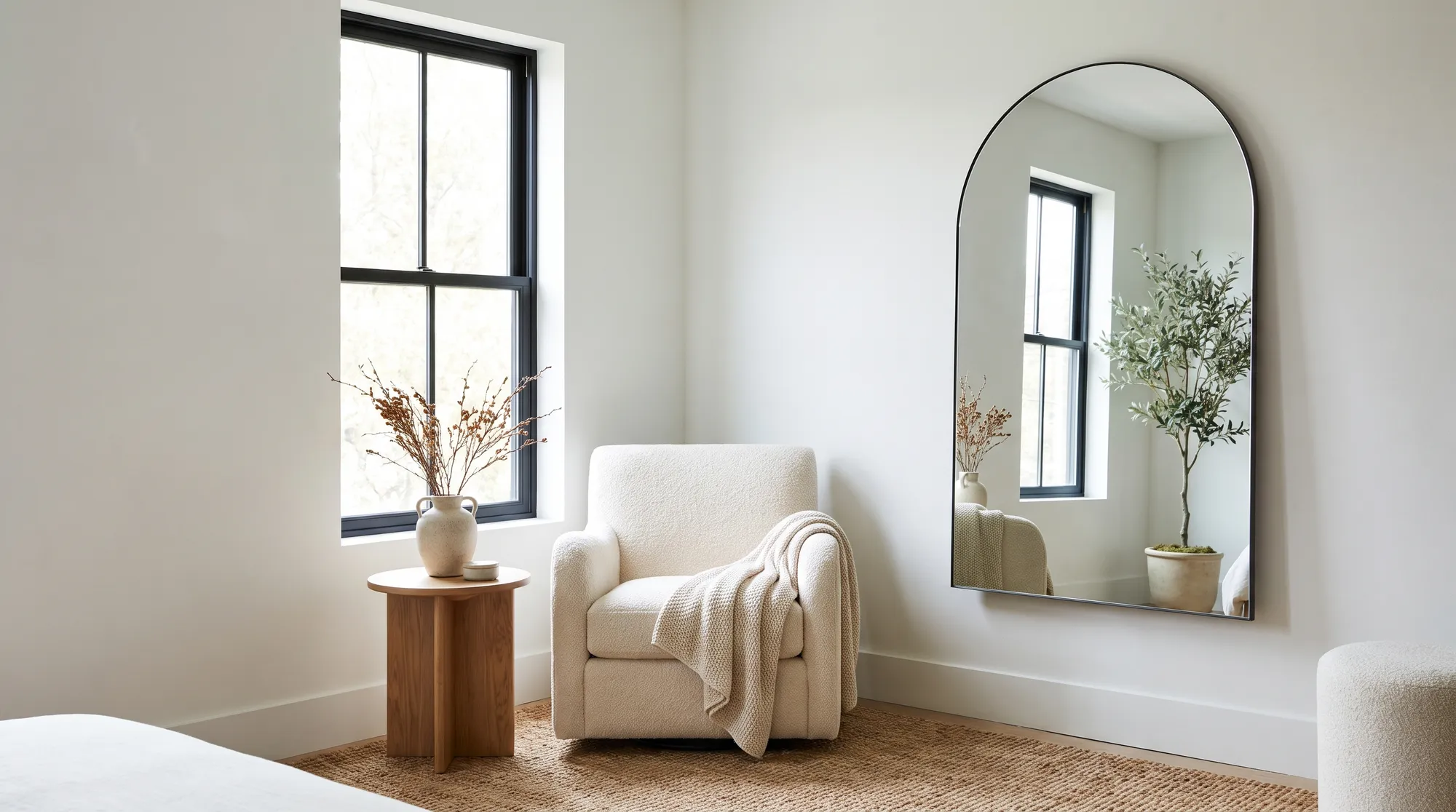
Montreal's housing stock is full of rooms that fight for daylight: shoebox bedrooms in triplexes, narrow shotgun living rooms, semi-basements that get sun for an hour a day. In a small room, the window is not just an opening — it is the single design decision that determines whether the space feels like a den or a cell. Here are the strategies, from frame profiles to glass chemistry, that pull the most daylight through the least wall.
Glass Area Beats Window Area: The Frame-Ratio Secret
Two windows of identical rough-opening size can deliver dramatically different amounts of light, because what illuminates the room is glass, not frame. A builder-grade slider in a 1 m × 1,2 m opening can lose 30 % or more of its area to frame, sash profiles and a central meeting rail; a fixed unit with slim modern profiles in the same opening keeps close to 90 % glass. In a small room where the opening cannot grow, switching to slimmer profiles is the cheapest square-metre of daylight you can buy.
When comparing quotes, ask for the visible glass dimensions of each unit, not just the window size — manufacturers can provide them, and the differences will surprise you. Hybrid and aluminum-clad frames generally achieve narrower sightlines than all-vinyl at equal strength, and fixed (non-opening) units always beat operable ones because they need no sash within the frame.
Fewer, larger windows also beat many small ones. Every additional unit multiplies frames and mullions, and every mullion is a shadow. If a wall currently carries two small windows separated by a strip of wall, combining them into one wide opening during replacement — a structural change requiring a proper lintel and, in Quebec, an RBQ-licensed contractor — typically transforms the room more than any other single move.
Picture + Operable Combinations: Light Where It Counts, Air Where You Need It
You rarely need an entire window to open; you need some of it to open. That is the logic of combination units: a large fixed picture window doing the daylight work, flanked or topped by a slim casement or awning that handles ventilation. Because the fixed section has no operating hardware, it maximizes glass, seals better, insulates better and costs less per square metre than operable glazing — a rare case where the high-performance option is also the budget option.
In a small bedroom, a common high-performing layout is a wide picture window with a single casement on the side closest to the bed: full daylight across the wall, cross-ventilation where the sleeper wants it, and one set of hardware to maintain instead of three. In a narrow living room, a picture unit flanked by two slim casements reads architecturally like a classic three-part window while carrying far more glass than three equal operables.
Combination units also solve the egress question intelligently. Quebec code requires bedroom windows to provide an unobstructed openable area of at least 0,35 m² with no dimension under 380 mm; a properly sized casement in the combo satisfies this while the fixed section is free to be pure glass. Confirm egress sizing with your installer for every bedroom — it is a code obligation, not an option.
Transoms and High Glass: Daylight from Above
Light entering high in a wall travels deeper into the room — roughly, daylight penetrates usefully to about 1,5 times the height of the window head. Raising the head of a window from 2,1 m to 2,4 m via a transom — a fixed glass band above the main unit — pushes usable daylight a full metre farther into a deep, narrow room. This is the geometry behind the tall windows of Montreal's Victorian triplexes, and it still works.
Transoms shine where privacy constrains the main glazing. On a street-facing bedroom or a wall close to the neighbouring duplex — a 1,5 m side setback is a Montreal classic — a clear transom above obscure or curtained lower glass delivers sky light all day without a sightline into the room. Interior transoms over doors and partitions do the same job between rooms, borrowing daylight from a bright room into a dark hallway with zero exterior work.
Above doors, in stairwells and over kitchen cabinets, small fixed transom or clerestory units are inexpensive precisely because they are fixed and small — often 300 $ to 700 $ installed in an existing wood-frame wall, before structural surprises. In a renovation, they are the highest daylight-per-dollar opening you can add.
High-VT Glass: The Spec That Decides Brightness
Visible transmittance (VT) measures the fraction of visible light a glazing unit lets through, from 0 to 1, and it is printed on the same NRCan/ENERGY STAR label as the U-factor. The differences are not subtle: a clear double-glazed unit runs around VT 0,60 to 0,65, a triple-glazed unit with two low-E coatings can drop to 0,40 to 0,45, and heavily tinted solar-control glass falls below 0,35. In a small north-facing room, the gap between VT 0,60 and VT 0,40 is the gap between a bright room and a gloomy one.
The good news is that you do not have to choose between warmth and light. Modern high-transmittance low-E coatings — the type marketed for heating climates — hold U-factors at ENERGY STAR levels (1,22 W/m²·K or better, the old Zone D threshold) while keeping VT near 0,50 or above, and they pair with high solar heat gain (SHGC), which is exactly what a Quebec heating season rewards. What you should avoid in a dark room is glass engineered for Arizona: strong solar-control coatings and grey or bronze tints that solve a cooling problem Quebec homes mostly do not have.
Practical spec for a light-starved room: ask your supplier for the highest-VT low-E package that still meets ENERGY STAR, typically VT 0,45 to 0,55 in triple glazing or around 0,55 to 0,60 in double. And skip the accessories that steal light — grilles between the glass, decorative internal muntins and heavy obscure textures each shave meaningful percentage points off effective transmittance.
- VT 0,55 and up: clear or high-transmittance low-E double glazing — maximum brightness
- VT 0,45-0,55: quality triple glazing with heating-climate low-E — the Quebec sweet spot
- VT 0,35-0,45: multiple coatings or light tint — acceptable in sun-rich rooms only
- Below VT 0,35: solar-control or tinted glass — avoid in small or north-facing rooms
Sills, Reveals and Wall Colours: Free Light Multipliers
Once daylight is through the glass, the room decides what happens to it. Matte white walls reflect 80 % or more of incident light; a mid-tone grey reflects around 40 %, and a fashionable deep green under 15 %. In a small room, painting the window wall and ceiling in high-reflectance white is worth roughly as much perceived brightness as enlarging the glazing — and it costs a weekend and a can of paint.
The window's own surround matters more than people think. Splayed (angled) reveals — jambs that widen toward the room, a signature of thick-walled construction — bounce light into the room and soften the harsh contrast between bright glass and dark wall that makes windows glare. A deep sill painted gloss white acts as a light shelf, throwing daylight up onto the ceiling; a dark stone sill swallows it. When your installer trims a replacement window, requesting white-painted, slightly splayed returns instead of narrow dark casings is a zero-cost daylight decision.
Dress the window to keep its glass. Curtains that stack entirely off the glazing when open (rods extended 20 to 30 cm past the frame each side), top-down cellular shades that free the upper glass while screening the lower, and mirrors placed on the wall perpendicular to the window all preserve or recycle daylight that standard treatments waste.
Montreal Realities: Narrow Rooms, Semi-Basements and Light Wells
Montreal's row housing creates a specific problem: long, narrow floor plans with glazing only at the two short ends, so the middle of the plan lives in permanent dusk. The levers that work are end-wall glazing pushed as large as structure allows, transoms over the interior doors that ring the central corridor, and glass-panelled interior doors that let the bright ends feed the dark middle. Where a rear extension or mezzanine permits it, a modest skylight or roof window over the stair core changes the entire plan, delivering three to five times more light per square metre of glass than a vertical window.
Semi-basements — half a storey below grade, ubiquitous in Montreal duplexes — are the hardest case, and the code sets the floor: a basement bedroom needs its egress window (0,35 m² unobstructed, no dimension under 380 mm), which conveniently is also a daylight window. Enlarging basement windows usually means cutting the foundation and adding a properly drained window well; budget roughly 2 500 $ to 5 000 $ per opening including excavation, and insist on an RBQ-licensed contractor because foundation cuts are structural work. A generous well with white or galvanized-bright walls reflects noticeably more light through the same glass.
Everywhere below grade, spec for reflection: white well liners, high-VT glazing, gloss-white deep sills and pale floors. A 60 cm × 120 cm basement window feeding a bright white well and room can genuinely carry a home office; the same window over a rusted steel well into a dark-panelled room reads as a vent. The glass is half the system — the surfaces are the other half.
Planning the Project: Budget, Order of Operations, Payback
Sequence the cheap moves first: paint, window dressings, mirrors and decluttering the sills cost under 300 $ and often deliver half the perceived improvement. Next come like-for-like replacements with slimmer frames and higher-VT glass — no permits, no structure, typically 600 $ to 1 400 $ per window installed in the Montreal market depending on size and spec. Structural changes — combined openings, new transoms, enlarged basement windows — carry the big transformation and the big line items, from 1 500 $ for a simple new opening in wood framing to 5 000 $ and beyond in masonry or foundation walls.
Check the administrative layer before cutting anything: exterior alterations in many Montreal boroughs require a permit, and in heritage districts the window division pattern itself may be regulated. Any contractor touching structure or the building envelope must hold an RBQ licence, and replacement units should carry ENERGY STAR certification both for the energy math and for eligibility under efficiency rebate programs when they apply.
The payback is partly on the Hydro-Québec bill — high-SHGC glazing on south faces harvests real free heat in January — but mostly in how the house lives and appraises. Real-estate agents list natural light among the most-cited buyer priorities, and a small dark room converted to a bright one changes its function, not just its mood. In a compact home, that is renovation money working as hard as it can.
Frequently Asked Questions
What is VT and what value should I look for?
Visible transmittance is the fraction of visible light a glazing unit passes, printed on the ENERGY STAR label alongside the U-factor. For small or north-facing Quebec rooms, target VT 0,45 or higher — high-transmittance low-E packages reach it while still meeting the ENERGY STAR U-factor threshold of 1,22 W/m²·K.
Do triple-glazed windows make rooms darker?
Somewhat: each pane and coating removes a slice of light, so triples typically land around VT 0,40 to 0,50 versus 0,60 for clear doubles. Choosing heating-climate low-E coatings rather than solar-control ones keeps triples near the top of that range, which most rooms never notice — but in a genuinely dark room, specify the highest-VT package available.
What is the cheapest way to brighten a small room without construction?
Paint the window wall and ceiling high-reflectance white, move curtains so they stack completely off the glass, and keep the sill clear and light-coloured. These steps cost under 300 $ and often deliver half the improvement of new glazing, and they make any later window upgrade work harder.
Can I combine two small windows into one large one?
Yes — merging openings is often the most transformative single move for a narrow room, but it is structural work requiring a new lintel, likely a municipal permit, and in Quebec an RBQ-licensed contractor. Expect roughly 1 500 $ to 5 000 $ depending on wall construction, plus the window itself.
How do I get more light into a Montreal semi-basement?
Enlarge the window where feasible (foundation cutting with a drained window well, roughly 2 500 $ to 5 000 $ per opening), and maximize reflection: white well liners, high-VT glass, gloss-white sills, pale walls. Bedroom windows below grade must also meet egress code — 0,35 m² unobstructed with no dimension under 380 mm.
Are fixed picture windows more efficient than operable ones?
Yes, on every axis: no sash means more glass per opening, no operable joint means less air leakage, and typical fixed units achieve better U-factors at lower cost per square metre. Pairing a large picture unit with one well-placed casement gives a small room maximum daylight with code-compliant ventilation and egress.