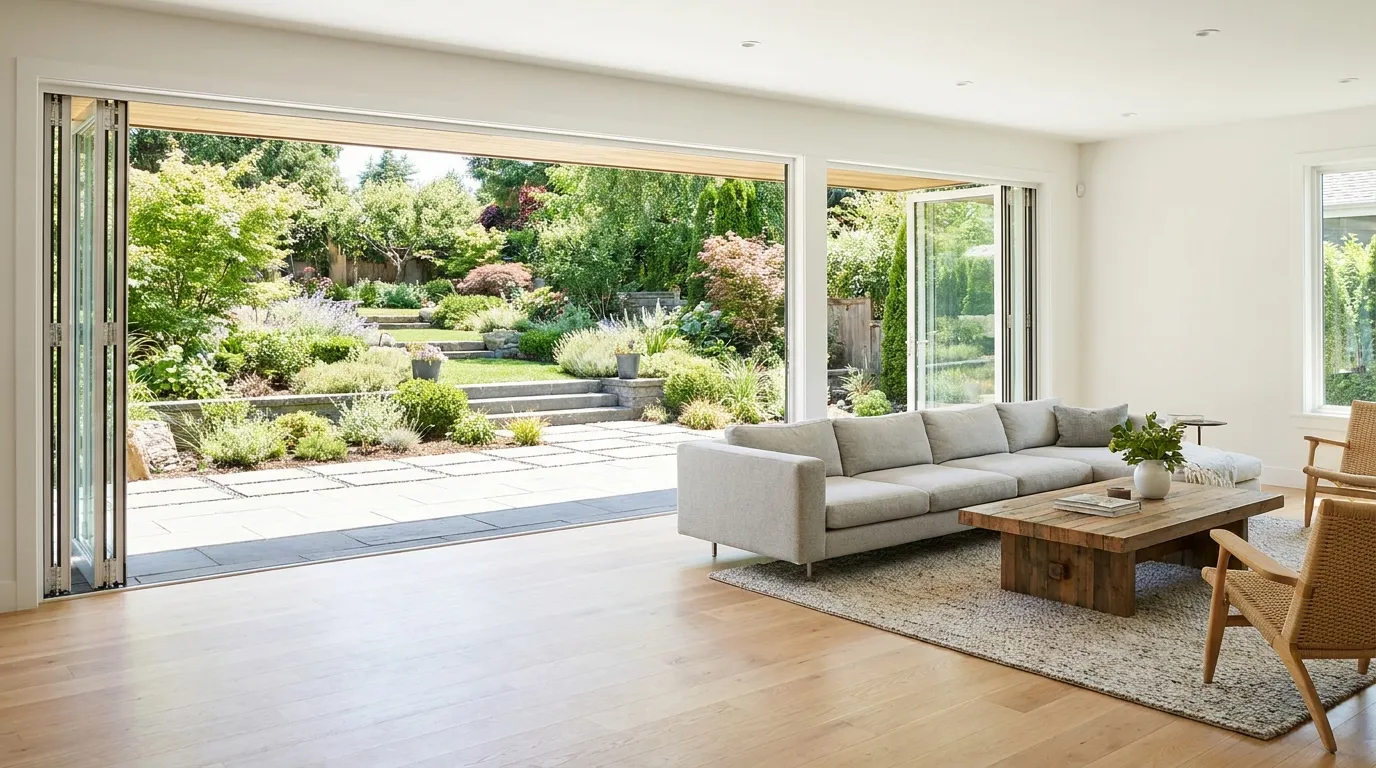
There is a particular kind of magic when the wall between your living room and your yard simply slides away. Large glass patio doors dissolve that boundary, pouring daylight across your floors and turning a deck into an extension of the room. In Quebec, the trick is doing it without paying for that expanse of glass in comfort or heating dollars, and modern high-performance glazing makes exactly that possible.
The appeal of dissolving the wall
A large glass patio door does something no window can: it lets you walk straight through the wall into the garden. On a summer evening the panels slide or fold open and the kitchen, the dining room, and the deck become a single continuous space for entertaining. Even shut through the winter, the glass keeps that connection alive, framing the snow-covered yard like a living picture.
The daylight is transformative. A broad expanse of glass floods rooms that face south or west with natural light, cutting the need for lamps during the day and making even a modest room feel larger and more open. For homes where the best views face the backyard, a large patio door turns that view into the focal point of the whole main floor.
This is why indoor-outdoor living has become a defining feature of premium Quebec renovations. Whether it is a Laval bungalow opening onto a new deck or a South Shore home framing a pool, the large glass door is the element that makes the yard feel like part of the house for the months we can enjoy it.
Sliding versus folding panels
The two main ways to build a large glazed opening are sliding and folding, and each has a distinct character. Sliding doors, including multi-panel systems where several panels stack or pass one another, are clean, contemporary, and low-maintenance. Because the panels ride on tracks rather than swinging, they suit tight spaces where a hinged door would collide with furniture or a railing.
Folding doors, sometimes called bifold or accordion doors, hinge together and concertina to one or both sides, opening up nearly the entire width of the wall. The effect when fully folded is dramatic, a genuinely wide-open threshold with almost no frame in the way, which is why they are the choice when the goal is to erase the wall entirely. The trade-off is that they need clear space to stack and involve more hardware.
For our climate, the sealing and thermal performance of the system matter as much as the mechanism. A well-engineered multi-panel slider with quality weatherstripping and a thermally broken frame can seal beautifully against a Quebec winter, while a poorly sealed folding door will leak. The right choice balances the opening you want against the performance the season demands.
- Multi-panel sliders: panels glide on tracks, ideal for tight spaces and clean modern lines.
- Folding/bifold doors: panels concertina aside to open the full width for maximum connection.
- Fixed plus operable: pairing large fixed panels with an operable door for view plus access.
- Pocket options: panels that slide into the wall cavity to disappear entirely.
Making big glass perform in Quebec
A wall of glass is only a good idea in our climate if it performs, because glass is inherently a weaker insulator than an insulated wall. The good news is that modern glazing has closed much of that gap. Low-emissivity (low-E) coatings reflect heat back into the room in winter and block solar gain in summer, while an insulating gas fill between panes slows heat transfer through the unit.
Triple glazing is where large patio doors earn their keep in Quebec. Adding a third pane and a second gas-filled cavity noticeably lowers the U-factor of the whole door, meaning far less heat escapes through that big surface on a -25°C night. On a door this size, the difference between double and triple glazing is felt directly as warmer glass, fewer draughts, and less condensation along the bottom rail.
The frame matters just as much as the glass. A thermal break, an insulating barrier separating the inside of the frame from the cold outside, stops the frame itself from becoming a highway for heat loss and a magnet for frost. Look for ENERGY STAR certification appropriate to Zone D, which covers most of southern Quebec, as a shorthand that the whole assembly, glass and frame together, is built for our winters.
- Low-E coatings: reflect heat in, block summer solar gain.
- Triple glazing: a third pane and second gas cavity for a markedly lower U-factor.
- Thermally broken frames: stop the frame from conducting cold and forming frost.
- ENERGY STAR Zone D: certification tuned to southern Quebec's climate.
Sizing and structural considerations
Big glass doors are heavy and they interrupt the structure of your wall, so sizing is not just a matter of taste. A wide opening usually requires a properly sized header or beam above it to carry the load that the removed wall once held, which means the project often involves structural work, not just a swap of the door. This is normal for large openings but it needs to be planned and, where required, engineered.
Panel size affects both looks and performance. Larger panels mean more uninterrupted glass and a more seamless view, but they are heavier, need stronger hardware, and can cost more per square foot. Configuration matters too: a three or four panel slider gives generous opening while keeping each panel manageable, whereas oversized single panels maximize the view at a premium.
Practical details deserve early attention. The threshold should be low enough for easy, safe passage yet still seal against water and snow, a real balancing act in our climate. Screen options for the bug season, and how the panels are supported and rolled, all affect how the door lives day to day. Getting these decided upfront avoids compromises later.
Cost, rebates, and value
Large glass patio doors are a premium product, and the price reflects the engineering, the volume of high-performance glass, and often the structural work involved. As a general range in Quebec, a quality multi-panel sliding or folding door, supplied and installed with triple glazing, commonly runs from several thousand dollars for a modest three-panel unit into the low tens of thousands for a wide folding wall, before any structural allowance.
Rebates can soften the cost when you choose efficient glazing. Under Rénoclimat, eligible door and window replacements can earn a grant of up to about $150 per rough opening, and the federal Canada Greener Homes framework has offered support of up to $5,000 for a package of qualifying energy upgrades. Combining an efficient patio door with other improvements is the way to make the most of these programs.
The value goes beyond the rebate. A large, efficient patio door upgrades how you live in the home every day and lifts its market appeal, since buyers respond strongly to bright, open, indoor-outdoor spaces. Explore our patio doors and request a soumission to plan the right configuration for your home and climate.
- Rénoclimat: up to about $150 per rough opening for eligible replacements.
- Canada Greener Homes: support up to $5,000 for a package of qualifying upgrades.
- Everyday value: more daylight, a better connection to the yard, warmer glass.
- Resale appeal: bright indoor-outdoor spaces are a strong selling feature.
Getting it right for your home
The best large patio door for your home depends on how you live and what your wall and yard allow. Start with the opening: how wide can it be given the structure, which way does it face for light, and what do you want to see when the panels are closed all winter. Those answers point toward a slider or a folding wall, and toward the right number and size of panels.
Then let the climate set the performance floor. In our winters, triple glazing, low-E coatings, a thermally broken frame, and quality weatherstripping are not luxuries but the baseline that keeps a wall of glass comfortable and efficient. Cutting corners here shows up quickly as cold glass, draughts, and condensation in January.
Working with a manufacturer who designs and installs for Quebec conditions means the door is engineered for the load, sealed for the winter, and finished to suit your home. If a wall that opens to the yard is the renovation you have been picturing, a conversation about the opening and the glazing is the place to begin.
Frequently Asked Questions
Can a large glass patio door really be efficient in a Quebec winter?
Yes, when it is built for the climate. Triple glazing, low-E coatings, an insulating gas fill, and a thermally broken frame together bring the U-factor down enough that even a big glass door stays comfortable at -25°C. Look for ENERGY STAR certification for Zone D as your shorthand.
Should I choose a sliding or a folding patio door?
Sliders are clean, low-maintenance, and space-efficient, ideal where you want a modern look without clearance for swinging panels. Folding doors open nearly the full width of the wall for the most dramatic indoor-outdoor connection, at the cost of needing stacking space and more hardware.
Does installing a large patio door require structural work?
Often, yes. Widening an opening for a large door usually means the wall above needs a properly sized header or beam to carry the load, so the project typically includes structural work that should be planned and, where required, engineered.
Are there rebates for energy-efficient patio doors in Quebec?
There can be. Rénoclimat has offered up to about $150 per rough opening for eligible replacements, and the federal Canada Greener Homes framework has offered up to $5,000 for a package of qualifying upgrades. Combining upgrades is the way to maximize what you receive.
How much does a large glass patio door cost?
It varies with size, configuration, and glazing, but a quality supplied-and-installed multi-panel triple-glazed door in Quebec commonly runs from several thousand dollars for a modest unit into the low tens of thousands for a wide folding wall, before any structural allowance.
Will a big glass door make my rooms too hot in summer?
Not with the right glazing. Modern low-E coatings can be tuned to block much of the summer solar gain while still letting in daylight, and pairing the door with the right orientation, overhangs, or shading keeps rooms comfortable through the warm months.