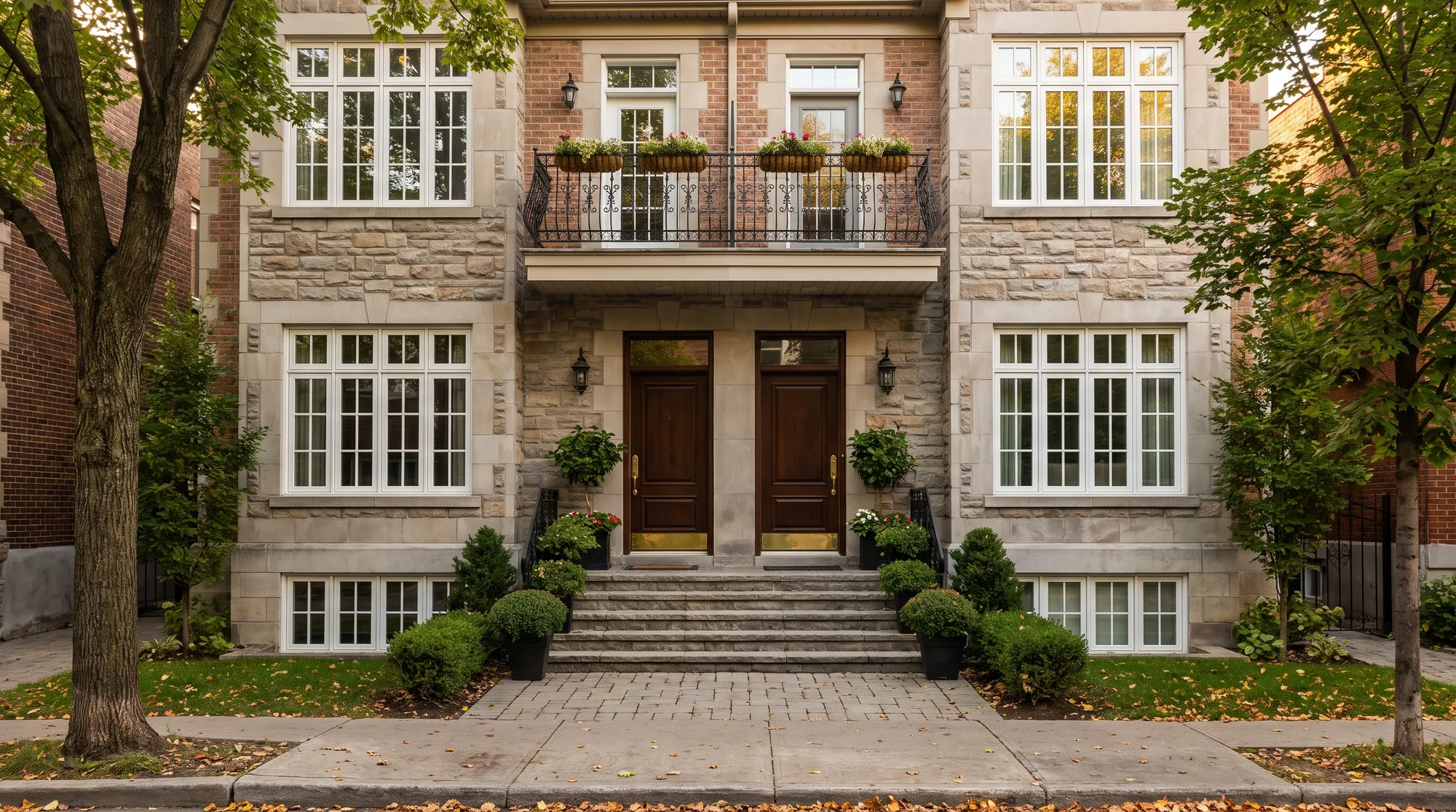
Windows in a rental property are a different investment problem than windows in your own home: you pay the capital cost, your tenants feel the comfort, and the return arrives through retention, reduced complaints and the rent-setting rules of the Tribunal administratif du logement. Done strategically — the right product, staged unit by unit, papered correctly for the TAL — a window program is one of the highest-leverage upgrades a plex owner can make. Here is the playbook.
The Rental Window Math
Most of Quebec's rental stock — the duplexes and triplexes of Montreal, Laval, Longueuil and Québec City — dates from the 1950s to 1980s, and a large share still carries original or first-generation replacement windows. For a landlord those windows generate costs on three lines at once: heating (in units where you pay it, leaky windows inflate the bill directly; where tenants pay, cold units become move-out reasons), maintenance calls for painting, re-glazing and hardware, and vacancy, because a drafty, noisy unit photographs poorly and re-rents slowly.
The revenue side is just as real. In a market where good units attract multiple applications, new windows are one of the few capital improvements that are visible in every listing photo, felt at every visit, and legitimately supported at the TAL when rent is adjusted. They also protect the asset itself — failed windows are how water gets into walls, and rot repair in a occupied building costs multiples of the window that would have prevented it.
The mistake to avoid is buying rental windows the way you would buy for your own house — either over-specifying designer features tenants will not pay for, or under-specifying to the cheapest unit available and repurchasing in twelve years. The sweet spot is durable, thermally solid and boring, which points to a specific product class.
Durable, Low-Maintenance Product Choices
For rental stock, uPVC windows are the default answer and deserve to be. The frames never need painting, do not rot, shrug off tenant condensation better than wood, and quality European-style profiles with multi-chamber construction deliver excellent thermal numbers at the lowest installed cost per opening — typically $600 to $1,200 for standard plex-sized windows in the current Quebec market. Over a 25-year horizon, the absence of refinishing labour is worth as much as the purchase price difference against wood.
Specify for abuse, not aesthetics. Choose welded frames and sashes, metal reinforced where sizes demand it; simple, robust hardware with locally available replacement parts, because handles and operators are what break in rentals; and screens with metal frames rather than light aluminum that bends the first time a tenant pops one out. White frames remain the pragmatic rental choice — colour-matched touch-ups, lower cost, and no heat-absorption concerns on south walls.
On operating style, casements seal tightest and give the best egress opening for a given size, while hung and slider windows have no protruding sash for balconies and walkways and simpler mechanisms to maintain. Many plex owners standardize on one operator type across the building — it simplifies future parts, lets trades carry the right hardware, and gives the facade a coherent look that shows in every listing.
- uPVC multi-chamber frames — no painting, no rot, best cost-per-year of service
- ENERGY STAR certified glazing — double minimum, triple where road noise or heating costs justify it
- Commodity hardware — parts a hardware store or your window supplier stocks locally
- One operator type per building — simpler maintenance, coherent facade
- White or neutral factory finish — durable, repairable, universally acceptable
Tenant Comfort Is Tenant Retention
Turnover is the silent cost in Quebec rentals: each move-out means cleaning, repainting, listing effort and often a vacant month — easily $2,000 to $4,000 per event on a typical Montreal unit. Surveys of why tenants leave consistently rank comfort complaints — cold rooms, drafts, noise, condensation and the mould that follows — just behind price. Windows sit at the centre of all four, which makes them a retention tool as much as a building component.
New glazing changes the tenant's daily experience in ways they mention to friends and in reviews: bedrooms warm enough to use in January without a space heater, street noise cut noticeably by modern double or triple glazing on arterial streets, and an end to the towel-on-the-sill condensation ritual. Tenants who are comfortable renew, and renewals at a steadily adjusted rent outperform churn-and-relist in nearly every scenario a landlord can model.
There is also a liability dimension. Persistent condensation and mould generate TAL complaints, formal demands and in bad cases rent reductions ordered against the landlord. Replacing the windows that cause chronic condensation is cheaper than litigating about the mould they produced — and it converts an adversarial file into a visible investment in the tenant's unit.
TAL Rules: How Window Work Flows Into Rent
In Quebec, window replacement is a major improvement (capital expenditure) in the Tribunal administratif du logement's rent-setting framework, not a maintenance expense. When a rent adjustment is contested, the TAL applies its published annual percentage to eligible capital costs — the rate is recalculated each year with the rent-fixing criteria and has generally sat in the range of roughly 4 to 6% in recent years. In practice: a $40,000 window project on a triplex at 5% supports about $2,000 per year, or roughly $55 per month spread across three units, on top of the base indexation.
Paper the project as if every increase will be contested, because one refusal is all it takes to end up before the tribunal. Keep itemized invoices separating windows from unrelated work, proof of payment, and the allocation logic per dwelling — by number of windows or by area, applied consistently. Subsidies matter: amounts received from a program must be deducted from the eligible cost, and the TAL will ask.
Timing follows the lease cycle. For a 12-month lease ending June 30, the increase notice must be sent 3 to 6 months before term — so work completed and paid during one year supports the notice sent the following winter. The tenant may refuse the increase without leaving; the landlord then has one month to apply to the TAL for rent fixation, where your documented capital costs enter the calculation. None of this is punitive — it is the designed mechanism by which Quebec landlords recover improvement capital, and windows are among the cleanest expenditures to run through it.
Staging Replacements Unit by Unit
Almost no plex owner should replace every window in one season. Staging the program — one unit, one facade, or one floor per year — spreads capital, keeps each year's TAL-eligible amount digestible, and lets you time work to unit turnover, when the dwelling is empty and installers can move freely. The classic sequence: start with the worst exposure (usually north and west facades or the most complained-about unit), and fold windows into the make-ready between tenants wherever possible.
Occupied-unit work is entirely feasible with the right notice discipline. The Civil Code requires 24 hours' notice for access to carry out work, performed between 7 a.m. and 7 p.m.; standard window swaps run 30 to 60 minutes per opening, so a typical 4½ is done in a day with no requirement for the tenant to vacate. Communicate a one-page schedule, protect floors, and have crews reinstall window coverings before leaving — the goodwill from a clean one-day job in an occupied unit is worth real money at renewal time.
Volume is your lever with suppliers. Committing to a multi-year program — 10 windows a year for four years, say — earns plex owners contractor pricing, priority scheduling, and consistency of product across phases so the building does not end up with three different white vinyl profiles on one facade. Order winter-to-spring for summer installation; leave October as the weather buffer, and avoid opening walls in an occupied building past early November.
Security and Egress Compliance
A window replacement is the moment code obligations crystallize: the new opening must satisfy current requirements even where the old one predated them. The one that catches landlords is bedroom egress — under the Quebec Construction Code, each bedroom without a door to the exterior needs an openable window offering an unobstructed opening of at least 0.35 m² with no dimension under 380 mm, openable from inside without tools or special knowledge. Basement units, common in Montreal plexes, are where marginal old windows most often fail this test, and where getting it right also transforms the unit's safety and rentability.
Egress interacts with hardware choices. Security bars on ground-floor bedrooms must be openable from inside without tools or keys to remain legal; sash limiters and ventilation locks are fine so long as the window can still be fully opened from inside in an emergency. Casements generally deliver the required clear opening from the smallest rough opening, which matters in older masonry buildings where enlarging openings is expensive.
Ground-floor and balcony-accessible windows deserve the security upgrades that tenants increasingly ask about: multi-point locking on casements, key-locked handles where appropriate, laminated glass on high-risk openings, and screens that do not double as a burglar's step-by-step guide to entry. These options cost tens of dollars per window at order time and become selling points in listings — "new secure windows throughout" is a phrase that earns applications.
Budgeting and Executing the Program
Build the budget from a per-opening baseline: for standard plex windows in uPVC, installed, expect $600 to $1,200 per opening, with basement egress conversions, masonry modifications and oversized units running beyond that. A 6-unit building with 30 openings therefore frames as a $20,000 to $35,000 program — significant, but spread over three phases it becomes a predictable annual line rather than a capital shock.
Treat the accounting correctly from day one: window replacement is a capital expenditure for tax purposes, depreciated rather than expensed, and the same invoices feed your TAL file. Ask suppliers for quotes broken out per dwelling — it costs them nothing and saves you an allocation argument later. If financing, note that the interest attributable to the rental building is deductible, which quietly improves the real cost of a staged program.
Finally, choose a manufacturer and installer accustomed to occupied multi-unit work: RBQ licence, proof of insurance, tenants-in-place scheduling, and product lines they will still stock when phase three arrives in year four. A window program is a relationship purchase — the plex owners who do this well buy the same window from the same people for a decade, and their buildings show it.
Frequently Asked Questions
What windows give the best return in a rental property?
Welded uPVC windows with ENERGY STAR glazing and simple, locally serviceable hardware — typically $600 to $1,200 installed per standard opening. They never need painting, tolerate tenant condensation, and deliver the lowest cost per year of service, which is the metric that matters on a building you intend to hold.
Can I raise the rent after replacing windows in Quebec?
Yes — window replacement is a major improvement in the TAL's rent-setting method. The tribunal applies its published annual percentage (roughly 4-6% in recent years) to documented, subsidy-net capital costs, which on a $40,000 triplex project supports in the order of $55 per month across the building. Keep itemized invoices and per-unit allocations in case the increase is contested.
Do tenants have to leave during window replacement?
Almost never. A standard swap takes 30 to 60 minutes per window, so a typical unit is completed within a day between 7 a.m. and 7 p.m. with the tenant in place. The Civil Code requires 24 hours' notice for access; a clear written schedule and clean same-day workmanship keep the process friction-free.
What are the egress rules for bedroom windows in rentals?
Each bedroom without an exterior door needs an openable window with an unobstructed opening of at least 0.35 m², no dimension under 380 mm, operable from inside without tools — and any security bars must open from inside without keys. Replacement is the moment to bring marginal openings, especially in basement units, up to standard.
Should I replace all windows at once or stage the work?
Stage it — one unit, facade or floor per year. Staging spreads capital, aligns work with unit turnovers when dwellings are empty, keeps each year's TAL file simple, and a committed multi-year volume earns better pricing than a one-shot order. Reserve single-season replacement for major repositioning or an emptied building.
Are new windows really worth it for tenant retention?
Turnover costs a Quebec landlord roughly $2,000 to $4,000 per move-out, and comfort complaints — cold, drafts, noise, condensation — are a leading reason tenants leave. New windows address all four, reduce mould-related liability, and are one of the few capital upgrades visible in every listing photo, which shortens vacancy on top of improving renewals.