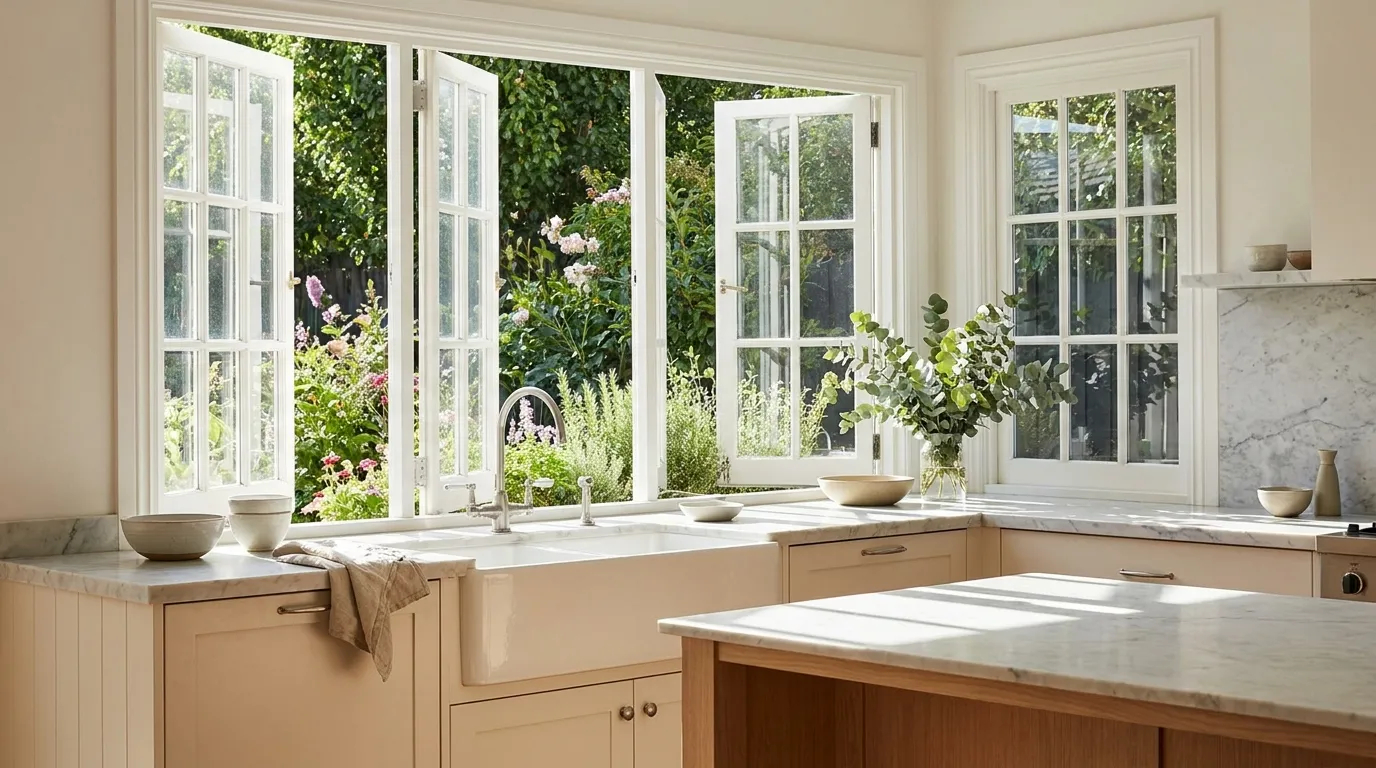
The window over the kitchen sink is the hardest-working window in the house: it is the one you look through every day, the one that vents steam from every pot of pasta, and the one you have to open while leaning over a 25-inch counter. That reach changes everything about which window style makes sense. Here is how casement, awning, garden, and hung windows compare at the sink, and how to size the opening so it works in a Quebec kitchen.
Why the sink window is not like any other window
Most windows in a house are judged on light, insulation, and looks. The kitchen window adds a fourth test that quietly disqualifies half the styles on the market: you have to operate it from behind a counter. A standard Quebec kitchen counter is about 25 inches (roughly 63 cm) deep and 36 inches high, and the sink basin pushes the window even further from your body. To open the sash you are reaching forward at full arm's length, often with wet hands, sometimes over a faucet.
The sink window also lives in the wettest, warmest microclimate in the house. Boiling water, a dishwasher venting at the end of its cycle, and a sink full of hot water all dump moisture into the air right at the glass. In a Montreal winter, when it is -20 °C on the other side of the pane, that moisture wants to condense on the coldest surface it can find. A sink window therefore needs to be easy to open for quick ventilation and well insulated enough that it is not the coldest surface in the room.
Finally, this is the window you look through more than any other, standing in one fixed spot while you rinse, chop, and wash. Sightlines matter: a style with a heavy horizontal rail at eye level cuts your view of the yard in half, while a single clear pane frames it. Keep those three tests in mind, reach, moisture, and view, and the comparison below almost settles itself.
Casement: the crank handle wins the reach test
A casement window is hinged at the side and swings outward like a small door, driven by a crank at the bottom of the frame. That crank is exactly why casements dominate over kitchen sinks: instead of gripping a sash and pushing it up, you rest your fingers on a handle at counter height and turn. A few easy rotations open the window fully, even at maximum reach, even with soapy hands. For anyone shorter, older, or dealing with shoulder or wrist issues, it is the difference between a window that gets used daily and one that stays shut.
Casements also open 100 percent of their area, the entire sash swings clear, so a modest opening moves a lot of air. Better still, an open casement sash acts like a sail that catches breezes travelling along the wall and scoops them into the kitchen, which no sliding style can do. When you crank it shut, the locking hardware pulls the sash tight against a compression seal, giving casements some of the lowest air-leakage numbers of any operable window, a real advantage a few inches from winter dishwater.
The one thing to check is what is outside the window. Because the sash swings outward, a casement over a sink should not open into a walkway, a deck path, or a branch of the neighbour's hedge. If your sink faces a spot where an outswinging sash would be in the way, that is precisely the case where the awning style below earns its keep. Ask about fold-away crank handles too: they tuck flat against the frame so they never snag a blind or a drying rack.
- Effortless reach: a crank at counter height opens the window at full arm's length, no lifting or pushing
- Full opening: 100 percent of the sash area ventilates, and the open sash scoops passing breezes inside
- Tight seal: compression locking makes casements among the most airtight operable windows for Quebec winters
- Clear view: one uninterrupted pane of glass, no meeting rail across your sightline to the yard
Awning: ventilation that ignores the rain
An awning window is the casement's close cousin: hinged at the top instead of the side, it tilts outward from the bottom and is opened with the same easy crank. The tilted sash forms a small roof over the opening, which means you can leave it open during a summer rain shower and the kitchen keeps ventilating while the rain runs off the glass. In a Montreal July, when a thunderstorm rolls through in the middle of dinner prep, that is a genuinely useful trick no other style offers.
Awnings shine in kitchens where the sink window is wide and short, a common layout when cabinets run tight to the window, or where an outswinging casement sash would block a path outside. Because the sash projects only modestly, an awning can sit above a deck walkway or a barbecue zone without knocking anyone in the head. Many Quebec kitchens pair the two: a fixed picture window over the sink for the view, flanked or topped by awning units that handle the ventilation.
The trade-off is opening size: an awning ventilates through a wedge rather than a fully cleared frame, so it moves somewhat less air than a casement of the same size. It also collects pollen and dust on the inside face of the tilted glass, so plan to wipe it down when you clean. For pure steam-dumping power choose the casement; for open-in-any-weather resilience, the awning is unmatched.
Why hung and slider windows struggle at the sink
Single- and double-hung windows are classics, but they fail the reach test at a sink. To open one you must grip the bottom rail and push the sash straight up, and doing that at full stretch across a 25-inch counter means pressing upward with your arms extended and your back arched over the faucet. Enough homeowners simply give up that kitchen designers treat a hung window over a sink as a known mistake. Hung windows also open at most 50 percent of their area, and their meeting rail sits right at standing eye level, cutting the view in two.
Horizontal sliders do a little better, a sideways push is easier than a vertical lift, but you are still leaning over the counter to grip and slide a sash along its track, and you still ventilate only half the opening. Sliders' brush-style seals also allow more air leakage than the compression seals on cranked windows, which matters on a wall where you will feel every draft while standing at the sink in January.
None of this makes hung or slider windows bad choices elsewhere in the house; they are economical and look right on many Quebec facades. The point is narrower: within arm's-length reach of a counter, crank-operated windows are the ergonomic answer, and that is why casement and awning styles are what installers recommend over sinks almost by default.
Managing steam, moisture, and winter condensation
A family kitchen produces litres of water vapour every day, and the sink window takes the brunt of it. The first defence is quick, easy ventilation, which is exactly what a cranked casement or awning provides: thirty seconds of cross-breeze after draining the pasta clears more steam than an hour of hoping. Use the window as a partner to your range hood, not a replacement; the hood captures cooking moisture at the source, and the window flushes what escapes.
The second defence is warm glass. Condensation forms when humid indoor air touches a surface below its dew point, so the colder your window's interior glass, the sooner it fogs and drips. A double-glazed unit with low-E coating and argon fill keeps the inner pane markedly warmer; triple glazing goes further and is a sensible upgrade for a north-facing sink window in the Montreal climate, where the pane never sees direct winter sun. Warm-edge spacers matter too, since the classic kitchen-window failure is a ring of condensation, then mould, around the glass perimeter.
Materials complete the picture. PVC frames shrug off splashes and steam and never need repainting, which is why they dominate Quebec kitchens; if you love a wood interior, choose an aluminum-clad exterior and keep the interior finish sealed. Whatever the frame, insist on a properly sloped exterior sill and quality caulking, because a sink window gets hosed from the inside as often as the outside.
Garden windows and other sink-wall configurations
A garden window is a mini bay that projects outward from the sink wall like a small greenhouse: a glass roof, glass sides, and a shelf that begs for fresh herbs. As a bright focal point it is charming, and the projecting shelf adds usable depth exactly where a sink wall has none. Basil in February, growing in the sunniest spot in the house, is a hard argument to beat.
Be honest about the physics, though. All that projecting glass means more surface area losing heat, and the roof pane of a garden window collects snow and tests its seals harder than any vertical unit. In the Quebec climate, choose a garden window built with insulated glass on every face, including the roof, and expect its energy performance to trail a good flat window. Treat it as a feature you love, not an efficiency play, and put the efficiency in the rest of the wall.
The other configuration worth knowing is the combination unit: a large fixed pane centred over the sink for an uninterrupted view, with narrow casement or awning flankers doing the ventilating. You get the best glass-to-frame ratio and the cleanest sightline where you actually stand, and the operable sashes sit closer to the counter edges where they are easier to reach. On wide sink walls this hybrid often beats any single window.
- Garden window: maximum charm and an herb shelf, but more heat loss; insist on insulated glass on all faces
- Fixed + casement flankers: panoramic view in the middle, easy-reach cranks at the edges
- Fixed + awning above or below: rain-proof venting with a clean main sightline
- Single casement: the simple default for standard sink openings up to about 36 inches wide
Sizing, sill height, and counter clearance
Start from the fixed geometry: a standard counter sits 36 inches (91 cm) above the floor, and a backsplash typically adds 4 inches. The classic sill height for a sink window is therefore 40 to 42 inches off the floor, which lands the frame just above the backsplash with a small caulked reveal, no awkward strip of drywall collecting splashes between counter and window. If you are replacing an existing window, keep the sill at or above the old height unless you are prepared for wall and backsplash work.
Check the faucet before you order. A tall gooseneck faucet can rise 15 inches or more above the counter, and its arc must clear the window's interior casing and any crank handle. Measure from the counter to the top of the faucet's swing and confirm your window frame and hardware start above that line, or offset the faucet from the operable sash. Fold-away crank handles buy you precious centimetres here.
For height, run the window head as close to the cabinet uppers or ceiling line as the wall allows; light from high glass travels deepest into the room. A sink window 36 to 48 inches wide suits most kitchens, and anything wider is a good candidate for the fixed-plus-flankers layout above. One code note: glass within 36 inches of a walking surface or in certain door-adjacent spots may need to be tempered, and any window this close to daily bumps and splashes benefits from tempered glass regardless, so ask your installer to spec it. A professional site measure, included with a serious quote, settles all of these numbers before anything is manufactured.
What a sink window costs in Quebec, and what it gives back
For a quality PVC window in the standard sink-window size range, installed, Quebec homeowners should budget roughly $800 to $1,500 for a casement or awning unit, with triple glazing, coloured exterior finishes, or hybrid PVC-aluminum frames pushing toward the upper end and beyond. Garden windows are a category of their own, typically $2,000 to $4,000 installed given their construction and the exterior work involved. Combination fixed-plus-operable layouts price by total size and number of sashes.
Choose an ENERGY STAR certified window for climate Zone D, which covers Montreal and southern Quebec, and the sink window stops being the cold, foggy spot on the wall. If the kitchen window is part of a larger replacement project, a Rénoclimat evaluation before and after the work can qualify you for provincial rebates on the order of $150 per opening, which quietly offsets part of the upgrade to triple glazing.
Above all, this is a window you will touch every single day for the next twenty-five years. The few hundred dollars separating an awkward window from a crank you can reach with wet hands amortizes to pennies per use. Make sure the company behind it holds an RBQ licence and backs the installation, not just the frame, with its warranty.
Frequently Asked Questions
What is the best type of window to put over a kitchen sink?
A casement window is the best all-round choice: its crank handle is easy to operate at full reach across the counter, it opens its entire area for ventilation, and its compression seal is among the tightest of any operable window. If the window faces a walkway or you want to vent during rain, choose an awning window instead.
Why not use a double-hung window over the sink?
Opening a double-hung means gripping the sash and pushing it straight up while leaning over a 25-inch counter, which is awkward enough that many homeowners stop opening it at all. Hung styles also ventilate only half their area and put a meeting rail right at eye level, splitting your view of the yard.
How high should a kitchen window be above the counter?
With a standard 36-inch counter and 4-inch backsplash, the sill typically lands 40 to 42 inches above the floor, just clearing the backsplash. Also confirm that a tall gooseneck faucet can swing freely below the frame and crank hardware before you finalize dimensions.
Are garden windows a good idea in the Quebec climate?
They are a lovely feature, a sunny projecting shelf that grows herbs even in February, but their extra glass surface and roof pane lose more heat than a flat window and must shed snow. Choose one with insulated glass on every face and treat it as a charm upgrade rather than an efficiency upgrade.
Can I leave an awning window open when it rains?
Yes, that is the style's signature advantage. The top-hinged sash tilts outward and acts as a small roof, so a summer shower runs off the glass while the kitchen keeps ventilating, which is ideal for steamy cooking days in a Montreal summer.
How do I stop condensation on my kitchen window in winter?
Ventilate steam promptly with the window and range hood, and make sure the glass itself stays warm: low-E coatings, argon fill, and warm-edge spacers raise the inner pane's temperature so moisture no longer condenses on it. If a north-facing sink window still fogs, triple glazing is the durable fix.