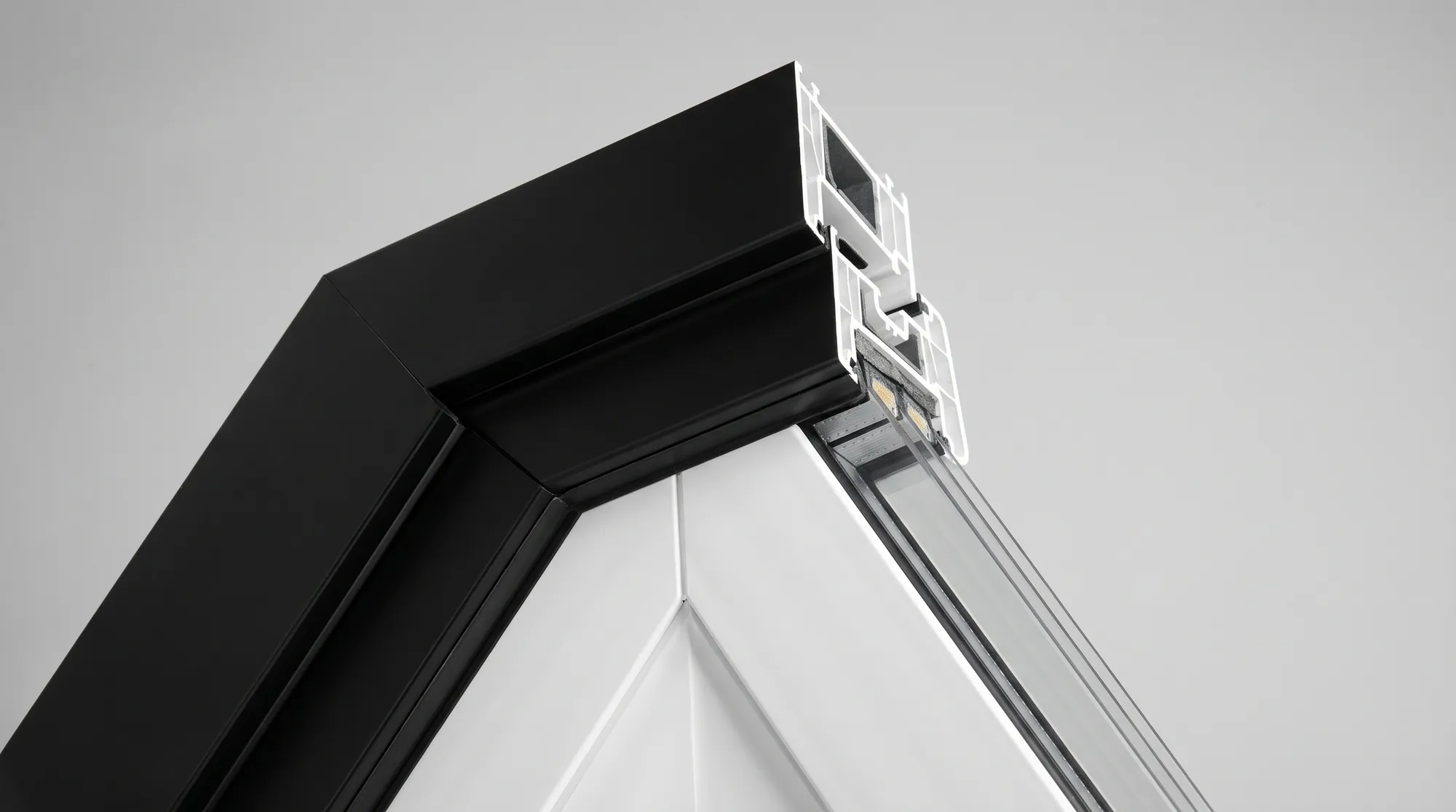
Drive through any new development in Laval, Brossard or Mirabel and you will see the same thing: black and charcoal window frames on nearly every facade. Most of them are not solid aluminum, and they are not painted PVC either — they are hybrids, with an extruded aluminum shell facing the weather and a multi-chamber PVC core facing your living room. Here is how that construction works, what it costs over standard PVC, and why it has become the default premium choice in Quebec.
What a Hybrid Window Actually Is
A hybrid window is built around a standard multi-chamber PVC frame — the same insulating structure you would find in a quality PVC window — with an extruded aluminum cladding mechanically fitted over every exterior surface. The aluminum is what the street, the rain and the July sun see; the PVC is what carries the glazing, holds the hardware and faces your interior. The two materials are joined so that the aluminum shell can expand and contract with temperature swings without stressing the PVC underneath.
This is different from the aluminum-clad wood windows that dominated the premium market twenty years ago. There is no wood to rot, no interior finish to sand and revarnish, and no vulnerability at the sill joints where clad-wood units historically failed. It is also different from cheap "capped" products that glue a thin aluminum foil or painted profile onto PVC — a true hybrid uses extruded aluminum 1.2 to 1.5 mm thick, rigid enough to hold a crisp, square edge that reads as architectural from the curb.
The result is a window that behaves like PVC thermally and like aluminum visually. That combination is precisely what Quebec's climate and current design tastes demand, which explains why nearly every manufacturer in the province — most of them within an hour of Montreal — now runs a hybrid line.
Why Aluminum Holds Its Colour When PVC Cannot
The single biggest argument for hybrid construction is colour. Extruded aluminum takes a baked-on polyester or PVDF (Kynar-type) powder-coat finish applied at the factory under controlled conditions. These finishes meet AAMA 2604 or 2605 standards, which means they are tested for thousands of hours of UV exposure, salt spray and humidity — the top tier warranties chalk and fade resistance for 20 years or more. Black stays black; a deep anthracite stays anthracite through decades of south-facing exposure.
PVC is a different story. The vinyl itself is pigmented white or beige through the material, and dark colours must be applied as a co-extruded acrylic layer or a paint film. Dark surfaces in full sun can reach 70 to 80°C, and PVC begins to soften and distort at temperatures not far above that. Manufacturers manage this with heat-reflective pigments, but warranties on dark PVC are shorter, and warping of dark vinyl sashes on south and west elevations is a known claim category across the industry.
Aluminum has no such ceiling. It shrugs off surface temperatures that would deform vinyl, it does not become brittle at -30°C the way rigid PVC can, and a scratched powder coat can be touched up. If you want black, charcoal, commercial brown or a custom RAL colour on the exterior — and most Quebec buyers now do — aluminum cladding is the durable way to get it.
The PVC Core: Where the Insulation Lives
Aluminum conducts heat roughly a thousand times better than PVC, which is why a solid aluminum residential window is a liability in a Quebec winter unless it has an engineered thermal break. In a hybrid, the problem is solved by geometry: the aluminum never crosses from outside to inside. It is a shell on the cold side only, while the continuous path between exterior and interior runs entirely through PVC chambers filled with still air.
That means a well-made hybrid posts essentially the same thermal numbers as its all-PVC sibling. Expect U-factors of 1.0 to 1.2 W/m²·K with triple glazing and argon — comfortably inside ENERGY STAR territory — and warm interior frame surfaces that resist the condensation streaks common on aluminum commercial frames every January.
Inside the house, you get PVC's practical benefits: a smooth white or laminated interior finish that never needs painting, welded corners that stay airtight, and compatibility with the same multipoint hardware used across the manufacturer's PVC line. Many Quebec makers let you pair a black exterior with a white interior at no design penalty, which is the combination the majority of buyers order.
Hybrid vs Full PVC: What You Gain
Against a standard white PVC window, the hybrid buys you three things: durable dark colours, sharper sightlines, and stiffness. The aluminum shell adds rigidity that lets manufacturers build larger sashes and taller fixed units without the bowing that limits big PVC frames — relevant if your plans call for the oversized glazing that current Quebec architecture favours.
What you do not gain is thermal performance. A white PVC window with identical glazing will insulate just as well and cost meaningfully less. If your frames are white or beige, face north or east, and your priority is maximum efficiency per dollar, full PVC remains the rational choice — there is no durability problem to solve.
The honest framing: hybrid is an aesthetic and longevity upgrade, not an efficiency upgrade. You pay for the exterior finish holding its colour and its edge for 30 years, and for the design flexibility that finish unlocks.
Hybrid vs Full Aluminum: What You Save
Full aluminum windows with proper thermal breaks exist and perform respectably, but they occupy the top of the price ladder — often 50 to 80% above PVC — and even the best thermally broken frames run colder on the interior surface than a PVC core. In a Montreal February, that shows up as condensation at the frame edges and a colder perimeter zone near the glass.
Hybrids deliver the aluminum look for substantially less money and better winter comfort. Unless you need the structural capacity of full aluminum — think floor-to-ceiling commercial-style walls of glass or very large operable units — the hybrid covers the residential use case with fewer compromises.
There is also a maintenance argument. Full aluminum interiors are typically painted metal that can chip and show wear; a PVC interior is colour-through and effectively maintenance-free. For a family home rather than a storefront, that matters over 25 years.
What Hybrids Cost in Quebec
Budget a premium of roughly 15 to 30% over an equivalent PVC window. In practical terms, a mid-size casement that runs $650 to $900 installed in white PVC will land around $800 to $1,150 as a hybrid with a black or charcoal exterior. A whole-house project of 12 to 15 openings typically comes in $2,500 to $5,000 above the all-PVC quote, depending on sizes and glazing options.
Because hybrids qualify for the same ENERGY STAR certifications as PVC when properly glazed, they remain eligible for efficiency incentive programs when those are active — the cladding does not change the tested thermal performance. Get the certification number on your quote, not just the word "hybrid."
As with any window project in the province, verify that your installer holds a valid RBQ licence and includes installation-specific warranty terms in writing. The best cladding in the world will not compensate for a poorly flashed, poorly foamed installation.
- White PVC casement, installed: $650–$900
- Hybrid casement, black exterior, installed: $800–$1,150
- Typical whole-house premium over PVC: $2,500–$5,000
- Full thermally broken aluminum: 50–80% above PVC
Who Should Choose Hybrid
Choose hybrid if you want dark or custom exterior colours, if your elevations take heavy sun, if your design calls for large glazed areas, or if you are renovating a home you intend to keep for decades and want the facade to look unchanged in year 25. It is also the safe specification for resale in markets where the black-frame look has become the expectation, which now includes most of Greater Montreal.
Stay with full PVC if your frames are white, your budget is the binding constraint, or the project is a rental or short-hold property. Step up to full aluminum only for structural glazing needs that hybrids cannot meet.
Whichever way you go, compare quotes on identical glazing packages — frame material is only half the performance story, and a hybrid with basic double glazing will underperform a PVC window with a good triple-glazed, low-E unit every winter of its life.
Frequently Asked Questions
Are hybrid windows worth the extra cost over PVC?
If you want a dark exterior colour, yes — aluminum cladding is the only finish that reliably holds black or charcoal through decades of Quebec sun, while dark PVC carries shorter warranties and a real warping risk on hot elevations. If you are happy with white frames, a quality PVC window performs identically for 15 to 30% less.
Do hybrid windows insulate as well as PVC windows?
Yes. The aluminum is a shell on the exterior only and never bridges to the interior, so the insulating path runs entirely through the multi-chamber PVC core. With the same glazing, a hybrid posts essentially the same U-factor as the equivalent all-PVC unit and qualifies for the same ENERGY STAR certification.
Will the aluminum cladding make the frame cold or cause condensation?
No — condensation forms on interior surfaces, and in a hybrid the interior is PVC, which stays warm. This is a key advantage over full aluminum windows, where even thermally broken frames run cold enough at the edges to streak with condensation during Montreal cold snaps.
Can I have a different colour inside and outside?
Yes, and most buyers do exactly that. The exterior aluminum takes any standard or custom powder-coat colour, while the interior PVC is typically white or a woodgrain laminate. Black outside, white inside is currently the most ordered combination in Quebec.
How long does the exterior finish last?
Powder-coat finishes on extruded aluminum meeting AAMA 2604/2605 standards are warrantied against chalking and fading for 15 to 25 years depending on the manufacturer, and in practice the finish outlasts the warranty. Unlike paint on wood, it never needs recoating — an occasional wash is the entire maintenance program.
Is a hybrid window the same as an aluminum-clad wood window?
No. Clad-wood units have a wood core that requires interior finishing and remains vulnerable to moisture at joints; hybrids replace the wood with welded PVC that is maintenance-free and immune to rot. Hybrids are also typically 20 to 35% less expensive than premium clad-wood lines.