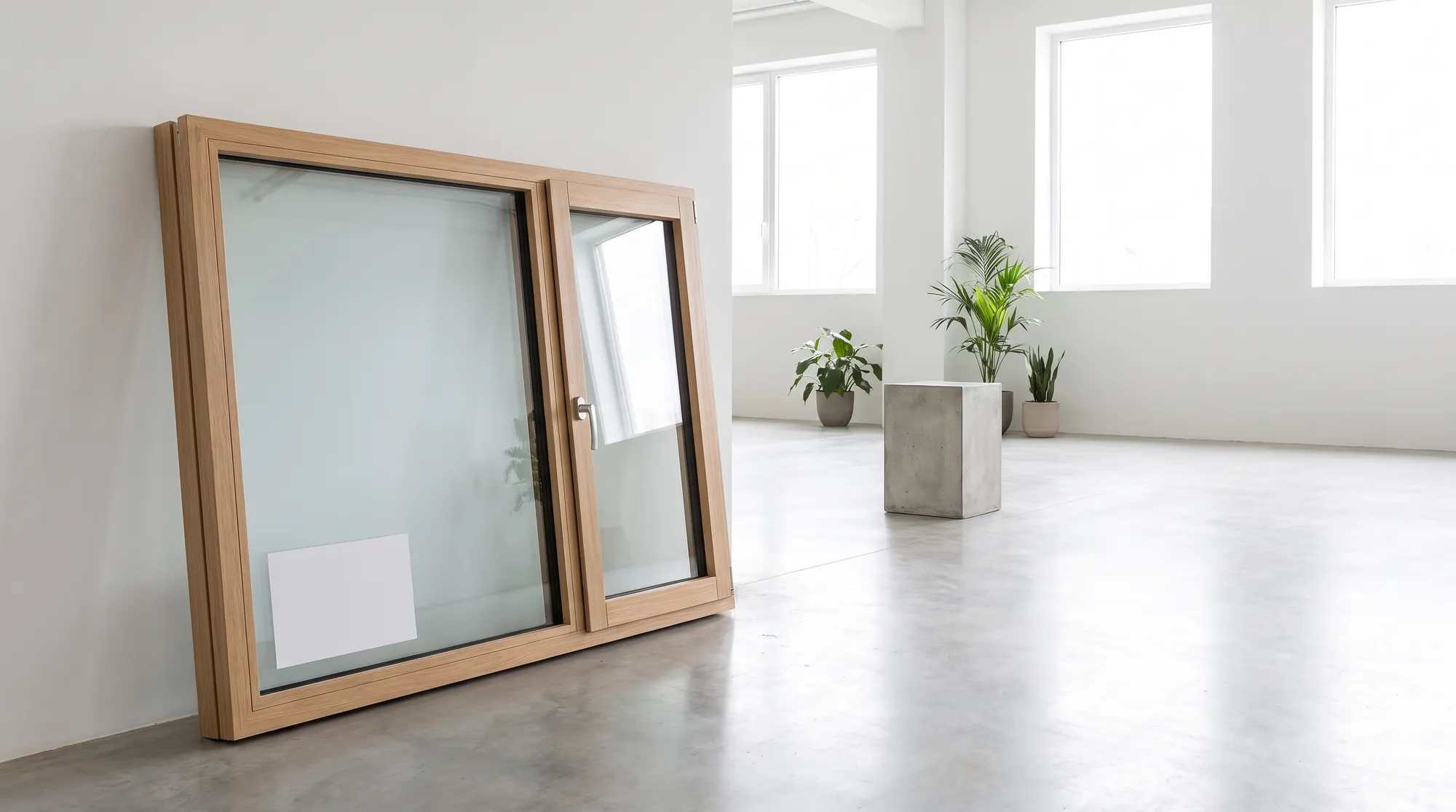
Every certified window sold in Canada arrives wearing a label crowded with acronyms — ER, U-factor, SHGC, VT — and most buyers glance at the blue ENERGY STAR logo and stop reading. That is how people pay premium prices for the wrong glass. The label is actually a complete, laboratory-verified performance report, and ten minutes of fluency with it will do more for your quote comparisons than any sales pitch. Here is what every line means and which ones matter in a Quebec winter.
The Labels on a New Window, and Who Stands Behind Them
A new window in Canada typically carries two stickers. The first is the ENERGY STAR mark, administered by Natural Resources Canada: it certifies that this specific model, tested by an accredited laboratory to the CSA A440.2 standard, meets the program's thresholds for cold-climate performance. The second is the temporary rating label listing the actual numbers — U-factor, ER, SHGC, VT and often an air-leakage class. The logo tells you the window passed; the numbers tell you by how much, and two windows can both wear the logo while performing quite differently.
The numbers are whole-window values, not centre-of-glass values — they include the frame, the spacer and the edge effects, which is exactly what you want, because frames are typically the weakest part of the assembly. Be alert to brochures quoting centre-of-glass figures, which always look better; the label is the honest document, and it describes the exact configuration tested, so a different size, grille pattern or glazing option can shift the real numbers.
Keep the labels until the project is closed out. They are your proof of what was ordered and delivered, they are required documentation for most energy-efficiency subsidy programs, and they let you verify at delivery that the units on the truck match the units on the quote. For a deeper dive into the physics behind each metric, see our guide to understanding energy efficiency.
U-Factor: How Fast Heat Escapes
The U-factor measures the rate of heat transfer through the entire window, in W/m²·K (or BTU/h·ft²·°F in imperial — multiply the metric value by 0.176 to convert). Lower is better. It is the single most consequential number on the label for a heating-dominated climate, because it operates every hour of a Quebec heating season, day and night, sun or no sun.
For orientation: an old double-glazed window with no coating sits around 2.8; ordinary new double glazing around 1.4 to 1.6; certified high-performance double glazing near 1.2; and good triple glazing between 0.8 and 1.1. The current ENERGY STAR threshold for Canada — which since the 2020 specification is one national standard essentially built on the old coldest-zone (Zone D) requirements — is a U-factor of at most 1.22 W/m²·K for windows qualifying by that path.
Do not dismiss small differences. The percentage matters more than the decimals suggest: moving from U-1.4 to U-1.0 cuts conductive losses through the window by nearly 30%, which on a house with 20 m² of glazing is a real and permanent reduction in heating load — and, just as noticeably, a warmer interior glass surface that reduces drafts and condensation.
ER: The Made-for-Canada Balance Number
The Energy Rating (ER) is a Canadian invention designed to answer one question: what is this window's net energy effect on a Canadian home over a heating season? The formula balances three things — heat lost through the window (U-factor), free solar heat gained through it (SHGC), and heat leaked around it (air leakage) — into a single unitless score. Higher is better, and a window can qualify for ENERGY STAR with an ER of 34 or more.
ER's virtue is that it credits solar gain, which U-factor ignores. A window with slightly higher U but generous SHGC can out-score a tighter, darker one because winter sun through south glass genuinely offsets heating. That makes ER an excellent single number for quick comparisons — and the fairest way to compare windows of different operating types, since it also folds in how tightly each design seals.
Its limitation is the flip side of the same coin: ER assumes the solar gain is welcome. For large west-facing glass where summer overheating is the real risk, or for an air-conditioned condo facade, chasing maximum ER can buy you July problems. The practical rule for Quebec: use ER as the headline comparison for typical mixed-orientation replacements, but read U-factor and SHGC individually whenever an elevation has unusual sun exposure.
SHGC and VT: Sun and Light
The Solar Heat Gain Coefficient (SHGC) is a 0-to-1 number describing what fraction of the solar energy striking the window makes it inside. In a heating climate, solar gain is mostly free heat: south-facing glass with SHGC around 0.35 to 0.45 harvests meaningful energy from the low winter sun. West-facing glass is the exception — the low afternoon summer sun blows past roof overhangs, so a lower SHGC (0.25 to 0.35) is the comfort play there. There is no single "good" SHGC; there is a good SHGC per orientation.
Visible Transmittance (VT) is the fraction of visible light passing through, also 0 to 1, whole-window basis — frames and grilles drag it down, which is why a chunky-framed window can feel dimmer than its glass suggests. Higher VT means brighter rooms; anything above roughly 0.40 whole-window reads as clear and generous, while heavily coated or tinted assemblies can dip low enough that rooms need daytime lighting.
Read SHGC and VT together to judge coating quality. Modern low-E coatings are spectrally selective — they can block heat-carrying infrared while passing visible light — so a well-chosen glass keeps VT high while placing SHGC wherever the orientation wants it. A window whose VT is barely higher than its SHGC is using an older or cruder tint; a VT comfortably above SHGC signals a sophisticated coating doing its job.
Air Leakage: The Quiet Draft Number
Air leakage measures how much air passes through the closed, locked assembly under pressure — through the crack between sash and frame, past the weatherstripping, around the hardware. On Canadian labels it appears either folded into the ER calculation, as a tested leakage rate, or as a CSA A440 class (A1 to A3, or "Fixed"), where A3 is the tightest rating and fixed windows are tighter still by construction.
This number separates operating styles more than any other. Compression-seal designs — casements and awnings, where the lock pulls the sash into the weatherstripping — routinely achieve A3. Sliding designs — double-hung and horizontal sliders, where the sash must glide past its seals — are inherently leakier, which is one reason a mid-grade casement often out-performs a premium slider in real winter comfort. Fixed picture windows outperform everything, arguing for using operable units only where you actually ventilate.
Air leakage is also the number that governs how a window feels in wind. U-factor losses are steady and invisible; leakage losses arrive as a perceptible moving draft during a January blow, chill the sill area, and carry noise. If a house sits exposed — hilltop, lakefront, upper floors facing the prevailing northwest — weight this rating heavily, and favour compression-seal or fixed units on the windward face.
What Matters Most for a Quebec Home
Quebec sits in the coldest reaches of the old ENERGY STAR climate map — most of the province was Zone C and D territory, and the current single national specification essentially universalized those old Zone D-calibre thresholds: U-factor at or below 1.22, or ER at 34 and up. Treat those as the floor for any window you buy here, not the target; the best value in the current market usually sits comfortably beyond them, with triple-glazed units around U-0.9 to 1.1 and ER in the high 30s to 40s.
Rank the numbers for a heating-dominated climate in this order: U-factor first — it works against you every hour for six-plus months; ER second, as the balanced sanity check across quotes; air leakage third, and higher if your site is windy; then SHGC tuned by orientation, and VT as the livability check. A salesperson steering the conversation toward whichever single number flatters their product is telling you which number to double-check.
Two honest caveats. First, labels describe the window, not the installation — a U-0.9 unit installed without proper insulation and air-sealing around the frame performs like a much worse one, so the installer's method deserves as much scrutiny as the sticker. Second, thresholds and program details evolve; the numbers above reflect the specification in force in recent years, and the label on the actual unit always governs.
Worked Example: Two Labels Side by Side
Put the method to work on a realistic pair. Window A, a certified double-glazed casement: U 1.20, ER 35, SHGC 0.42, VT 0.55, air leakage A3. Window B, a triple-glazed casement at 12% more money: U 0.95, ER 40, SHGC 0.36, VT 0.48, A3. Both wear the ENERGY STAR logo; the labels say they are not the same window.
Window B loses conducted heat about 20% slower, will hold a warmer interior surface on cold nights (meaning less condensation and a more usable seat by the glass), and its higher ER says the whole-season balance favours it despite the slightly lower solar gain. Window A counters with more winter sun and more daylight — real advantages on a south elevation shaded in summer, and its lower price buys the same certification. For north and west elevations, bedrooms, and any room where comfort at -25°C matters, B is worth its premium; for a sheltered south wall on a tight budget, A is a defensible choice, and that is precisely the kind of per-elevation decision the label exists to enable.
Run every quote through the same five-line comparison before talking price per window. Insist on whole-window label values in writing for the exact configurations quoted — and if two quotes list different sizes or glazing options, note that the numbers are not directly comparable until the configurations match.
- U-factor — lower wins; a 0.2-0.3 gap is significant, not cosmetic
- ER — higher wins for whole-season balance; 34+ certifies, high 30s is strong
- Air leakage — A3 or a fixed unit on windy exposures
- SHGC — match to orientation: higher south, lower west
- VT — comfortably above SHGC signals a quality selective coating
What the Label Does Not Tell You
The label is necessary but not sufficient. It says nothing about frame durability, hardware quality, warranty terms, or how the company behind it handles a failed insulated glass unit in year nine — factors that determine whether the performance you bought persists. A superb label on a poorly built frame is a five-year promise, not a thirty-year one.
It also says nothing about acoustics. Two windows with identical thermal labels can differ audibly on a busy street; if noise matters, ask for the STC or OITC rating as a separate data point, and note that laminated glass and asymmetric panes — not just triple glazing — are what move it.
Use the label for what it does brilliantly: making performance claims comparable and holding suppliers to laboratory-verified numbers. Then complete the picture with the questions a label cannot answer — installation method, warranty, references — and you are buying windows the way the certification system intended: informed, specific, and immune to logo-only sales pitches.
Frequently Asked Questions
What is a good U-factor for windows in Quebec?
At or below 1.22 W/m²·K is the certification floor — aligned with the old coldest-zone (Zone D) requirements — and the practical target for a Quebec home is better still: 0.9 to 1.1, which quality triple glazing delivers. Lower is better, and a 0.2-0.3 difference between quotes is a meaningful performance gap, not a rounding error.
What does the ER number on a window label mean?
The Energy Rating is a Canadian score balancing heat loss (U-factor), free solar gain (SHGC) and air leakage into one number where higher is better; 34 or more qualifies for ENERGY STAR. It is the best single number for quick comparisons, but check U-factor and SHGC individually for elevations with unusual sun exposure.
Is a higher SHGC good or bad in a cold climate?
Both, depending on orientation. On south-facing glass, a higher SHGC (0.35-0.45) harvests free winter heat and improves the whole-season balance; on west-facing glass, low summer evening sun makes a lower SHGC (0.25-0.35) the comfort choice. There is no universally good SHGC — match it to the elevation.
Do two ENERGY STAR windows perform the same?
No — the logo only confirms each passed the thresholds. One certified window can sit right at U-1.22 while another reaches U-0.90 with a higher ER and tighter air-leakage class. That spread is exactly why the rating label with the actual numbers, not the logo, should drive comparisons between quotes.
What air leakage rating should I look for?
On the CSA scale, A3 is the tightest operable class and worth insisting on for exposed sites; fixed windows are tighter still. Compression-seal designs like casements and awnings reach A3 routinely, while sliding designs are inherently leakier — a difference you feel as moving drafts during winter wind, not just on the energy bill.
Why do brochure numbers look better than the label?
Brochures often quote centre-of-glass values, which exclude the frame and edge — always the weakest parts — while the label reports whole-window performance for the exact tested configuration. Compare quotes only on whole-window label values, in writing, for the specific sizes and options you are actually ordering.