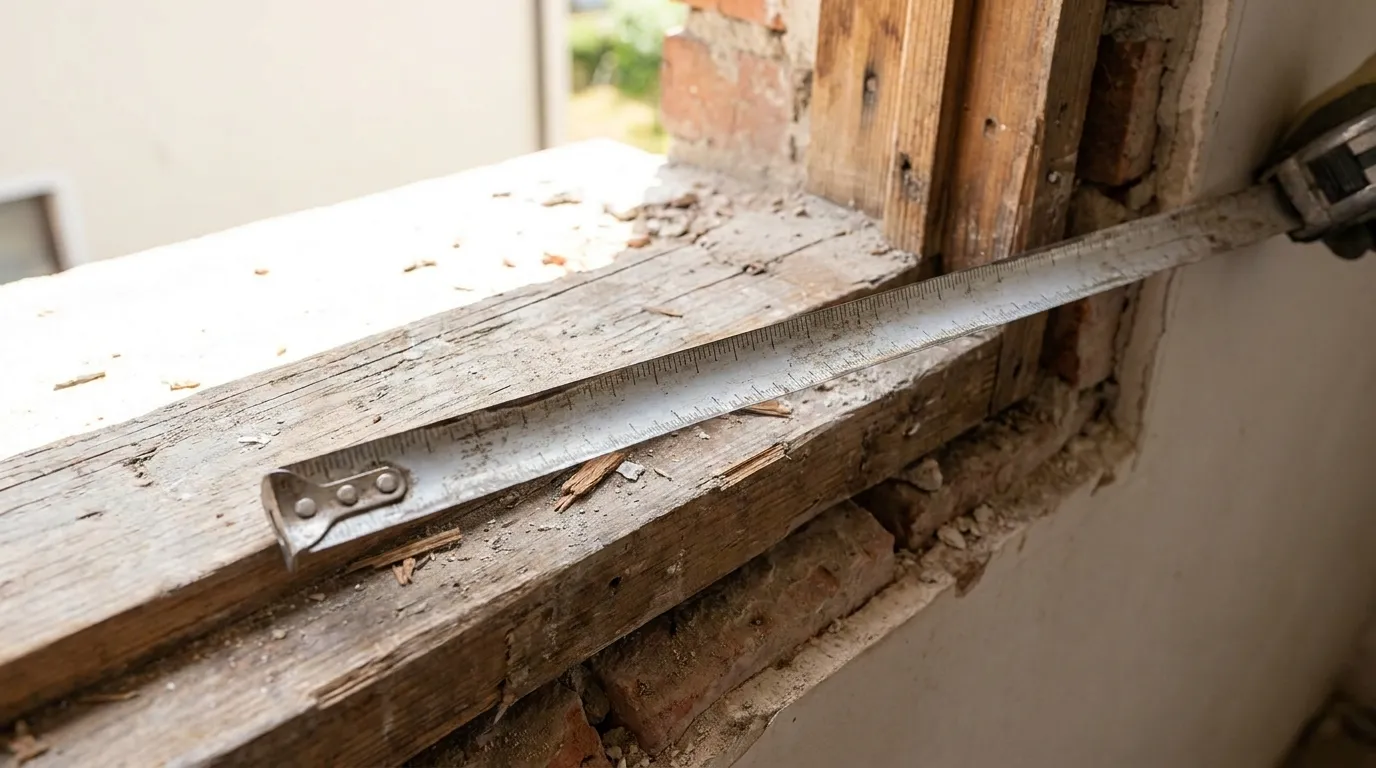
Measuring for replacement windows looks simple until you realize a house is never quite square, and a window ordered a centimetre too big will not go in at all. The good news is that measuring accurately is a skill any careful homeowner can learn, and doing it right first tells you what your project actually involves. This guide walks through the three-point method, the depth and squareness checks, and the difference between insert and full-frame replacement, so you know exactly what you are looking at before you order anything.
Why careful measuring matters
A replacement window is manufactured to the exact size you specify, and unlike a curtain or a shelf, there is no trimming it to fit on installation day. Order it a little too small and you are left filling gaps that leak air and water; order it too big and it simply will not fit the opening. That is why professionals build in a deliberate clearance and why a single confident measurement is never enough.
The core reason houses fool people is that openings are almost never perfectly square. Framing settles, wood moves through decades of Quebec freeze-thaw cycles, and an opening that looks rectangular can be a centimetre wider at the top than the bottom. Measuring in one spot and trusting it is the single most common mistake, and it is exactly what the three-point method exists to prevent.
For most homeowners, the goal of measuring yourself is not to place the final order, it is to understand your project and get an accurate ballpark. A precise measurement lets you compare quotes on equal footing, spot whether you are looking at an insert or a full-frame job, and have an informed conversation with your manufacturer. The final, order-ready measurement should always be confirmed by the professional who will build and install the window.
What you need before you start
You do not need much to measure well, but you do need the right tools. A quality steel tape measure is essential, since a cloth or flexible tape sags and misreads over a window's span. A pencil and paper or a notes app to record every number, a small level to check squareness, and a step stool for the upper measurements round out the kit. Working in millimetres or to the nearest sixteenth of an inch gives you the precision windows demand.
Before you measure, understand that you are measuring the rough opening, the structural framed hole in the wall, not the existing window or its trim. For an insert measurement you will measure the existing frame; for a full-frame measurement you measure the rough opening once the old frame is out or by accounting for it. Knowing which you are after keeps your numbers meaningful, and we cover the difference in detail below.
Finally, measure from inside the house wherever possible, where the structural opening is accessible and you are not fighting exterior cladding, brick mould, or capping. Take your time, measure each dimension more than once, and write down every figure rather than trusting your memory. A few extra minutes of care here prevents an expensive mistake later.
- Steel tape measure: rigid and accurate across the full span.
- Level: to check that the opening is plumb and square.
- Pencil and paper or notes app: record every single number.
- Step stool: to reach and read the top measurements squarely.
Measuring width: three points, use the smallest
Width is where the three-point method earns its keep. Measure the width of the opening in three places, across the top, across the middle, and across the bottom, from one side of the rough opening to the other. Because the opening is rarely perfectly square, these three numbers will often differ by a few millimetres, and occasionally by a centimetre or more in an older Montreal home.
The rule is simple and non-negotiable: use the smallest of the three measurements. The window has to pass through the narrowest point of the opening, so if you ordered to the widest number it would jam and not fit. Taking the smallest width guarantees the unit clears the opening, and the installer then shims and seals the small remaining gaps evenly around the frame.
Record all three numbers, not just the smallest, because the spread between them tells the installer how out-of-square the opening is and how much adjustment the job will need. A large difference between top and bottom is a flag that the framing may need attention, and it is exactly the kind of detail worth noting for the professional who will do the final measure.
- Measure width at the top, middle, and bottom of the opening.
- Always order to the smallest of the three widths.
- Record all three so the installer can see how square the opening is.
Measuring height: same method, top to sill
Height follows exactly the same logic as width. Measure the height of the opening in three places, on the left side, up the middle, and on the right side, from the top of the rough opening down to the sill. As with width, an out-of-square opening will give you three slightly different heights, and again you take the smallest of the three as your measurement.
Measuring to the right reference points is what makes this accurate. You are measuring the structural rough opening from header to sill, not from the top of the existing sash or the interior stool trim. A common error is to measure the visible glass or the old window frame instead of the true opening, which produces a number that is meaningless for ordering a replacement.
Once you have your smallest width and your smallest height, you have the two dimensions that define the window. Write them in a consistent order, width by height, and label them clearly so there is no confusion later. A quick sketch of the opening with all six numbers on it, three widths and three heights, is the most useful single thing you can hand a professional.
- Measure height on the left, middle, and right of the opening.
- Measure the true rough opening, header to sill, not the sash or trim.
- Order to the smallest height, and record the standard width-by-height order.
Depth and squareness: the checks people skip
Width and height get all the attention, but depth matters just as much for a window that actually fits your wall. Measure the depth of the opening from the interior to the exterior, the thickness of the wall the frame has to sit within, because a window frame that is too deep or too shallow for your wall creates real problems with trim, sealing, and the interior finish. Quebec walls vary widely in depth depending on the era and the insulation, so never assume a standard.
Squareness is the check that separates a smooth installation from a fight. Measure the two diagonals of the opening, corner to corner each way, and compare them. If the two diagonals are equal, the opening is square; if they differ, the opening is racked, and the size of that difference tells the installer how much shimming and adjustment the job will take. It is a thirty-second check that prevents surprises.
You should also check that the sill is level and the sides are plumb with your level. None of this changes the size of window you order, since that still comes from the smallest width and height, but it tells you and your installer the true condition of the opening. An opening that is badly out of square or rotting at the sill may point you toward a full-frame replacement rather than an insert.
- Measure wall depth so the frame suits your wall thickness.
- Compare the two diagonals; equal means square, unequal means racked.
- Check the sill is level and the jambs are plumb with a level.
- A badly out-of-square or rotted opening may point to full-frame replacement.
Insert versus full-frame replacement
There are two fundamentally different ways to replace a window, and which one you need changes how you measure. An insert, or pocket, replacement fits a new window inside your existing, sound window frame. You keep the original frame, trim, and exterior capping, and the new unit slips into the pocket. Because the old frame stays, an insert loses a little glass area, and it is only appropriate when that existing frame is solid, square, and free of rot.
A full-frame replacement removes everything down to the rough opening, the old frame, sill, and often the interior and exterior trim, and installs a brand-new complete window. It is the right choice when the existing frame is rotted, badly out of square, or when you want to maximize glass area and inspect the opening for hidden water damage. Full-frame costs more and is more disruptive, but it resets the opening completely and is often the better long-term investment for old or damaged frames.
This distinction directly affects your numbers. For an insert, you measure the inside of the existing frame, since that is the pocket the new unit must fit. For a full-frame, you measure the structural rough opening itself. Identifying which type of job you have, by checking the condition of that existing frame, is one of the most valuable outcomes of measuring carefully, and it is a key thing to confirm with your manufacturer.
- Insert: new window inside a sound existing frame; measure the inside of that frame; loses a little glass.
- Full-frame: everything removed to the rough opening; measure the opening; needed for rot or badly out-of-square frames.
- The frame's condition, sound versus rotted, is what decides which route is right.
Common mistakes and when to call a pro
The mistakes that ruin a window order are predictable and avoidable. Measuring in a single spot instead of three, using the largest measurement instead of the smallest, measuring the glass or old sash instead of the rough opening, forgetting depth entirely, and confusing width with height on the order are the classics. Every one of them traces back to rushing, so the fix is simply to measure each dimension more than once and write everything down.
Even careful homeowners should treat their own measurements as a planning estimate, not the final order. Because the window is built to that number and cannot be trimmed to fit, the person who manufactures and installs it should always take the final, order-ready measurement themselves, and any reputable Quebec company includes this professional measure as part of the process. That measure protects both you and the warranty.
There are also cases where you should not attempt to measure at all: openings you cannot safely reach, upper-floor or hard-to-access windows, any opening that looks rotted or structurally altered, or a full-frame job where the true opening is hidden behind trim. In those situations, and honestly for any final order, let the professional measure. Explore our window installation resources and request a quote to book an on-site measure and get numbers you can order with confidence.
- Do not measure only once, or use the largest figure, always three points and the smallest.
- Do not measure the glass or old sash; measure the rough opening or frame pocket.
- Do not skip depth or mix up width and height on the order.
- Do not risk unsafe, high, or clearly rotted openings, let a professional measure those.
Frequently Asked Questions
Why do I measure a window opening in three places?
Because house openings are almost never perfectly square. Framing settles and wood moves through years of freeze-thaw cycles, so an opening can be wider or taller at one point than another. Measuring the top, middle, and bottom for width, and both sides and the middle for height, reveals those differences so you can order correctly.
Should I use the largest or smallest measurement?
Always the smallest. The window has to pass through the narrowest part of the opening, so ordering to the smallest width and height guarantees it will fit. The installer then shims and seals the small remaining gaps evenly, which is exactly how a replacement is meant to go in.
What is the difference between an insert and a full-frame replacement?
An insert fits a new window inside your existing, sound frame, keeping the original trim and losing a little glass area. A full-frame replacement removes everything down to the rough opening and installs a complete new window, which is needed when the old frame is rotted or badly out of square. The frame's condition decides which you need.
Do I really need to measure the depth of the opening?
Yes. The frame has to sit within your wall's thickness, and a window too deep or too shallow for the wall creates problems with trim, sealing, and the interior finish. Quebec walls vary in depth by era and insulation, so measure it rather than assuming a standard.
Can I just order windows from my own measurements?
Treat your measurements as a planning estimate, not the final order. Because a replacement window is built to size and cannot be trimmed to fit, the manufacturer or installer should always take the final, order-ready measurement, and a reputable Quebec company includes that professional measure in the process to protect you and the warranty.
When should I let a professional do the measuring?
Whenever the opening is unsafe or hard to reach, on an upper floor, looks rotted or structurally altered, or is a full-frame job where the true opening is hidden behind trim. And in truth, for any final order the professional should take the definitive measurement, since that is what the window is built to.