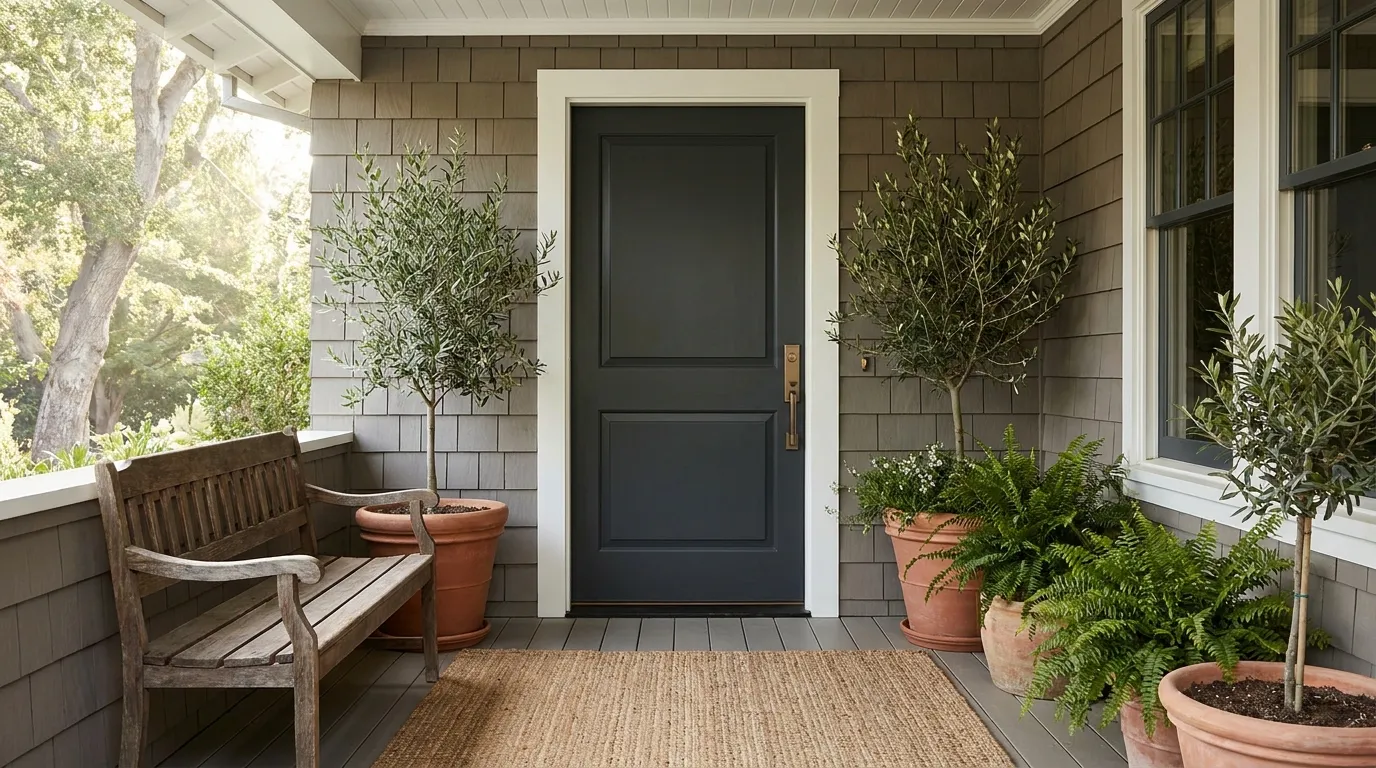
Your front door greets every visitor and fights every storm, and after 15 Quebec winters it usually shows. The good news: many tired doors need a weekend and a few hundred dollars, not a replacement. The trick is knowing which camp yours falls into before you spend money on the wrong one — here is how to tell.
The $300 Question — or the $3,000 One
A quality steel or fiberglass entry door is built to last 30 years or more, but its finish, seals and hardware are not. That mismatch is why so many structurally sound doors look and feel worn out at year 12: the paint has chalked, the weatherstripping has flattened, the handle set has loosened. Renewing those wear items costs a few hundred dollars and transforms the door.
Replacement is a different league — typically $1,500 to $4,500 installed for steel and $2,500 to $6,000 for fiberglass in the Montreal area — and it is the right call when the problem lives in the slab or frame itself rather than on its surface. Spending $600 refreshing a door with a rotted frame is money burned; spending $4,000 replacing a door that needed $80 of weatherstripping is worse. The whole decision comes down to diagnosing which layer has failed.
When a Refresh Is All Your Door Needs
If the door closes squarely, latches without force, and shows no rot, rust-through or daylight around its edges, the slab is healthy and cosmetics are your only real problem. Faded or peeling paint, a dated brass handle, squeaky hinges, a worn sweep dragging on the threshold — all of these are afternoon projects. A fresh colour alone, done properly with exterior enamel over a sanded and primed surface, makes a 15-year-old door look new from the curb.
Comfort complaints often have refresh-level fixes too. A draft along the latch side usually means compressed weatherstripping, replaceable in an hour. A draft under the door means the sweep or the adjustable threshold needs attention — most modern thresholds raise with four screws. Even minor dents in a steel door can be filled with auto-body filler and painted over invisibly.
- Repaint or restain: the single highest-impact refresh, especially in a bold modern colour.
- New handle set and deadbolt: updates style and security in one swap.
- Fresh weatherstripping and door sweep: kills most drafts for under $100 in parts.
- Threshold adjustment: restores the seal at the sill without any parts at all.
- Hinge service: tightening and shimming hinges re-squares a slightly sagging door.
What a Proper Refresh Costs in Quebec
Done yourself, a full refresh — paint, weatherstripping, sweep, new handle set — lands between $250 and $600 in materials. Paying a painter and a handyman moves the total to roughly $700 to $1,200, still a quarter of the cheapest decent replacement. Add $150 to $400 if you also update lighting and house numbers while you are at it, which multiplies the visual effect.
Budget honestly for prep, because that is where refreshes fail. Steel doors need sanding, rust treatment on any chips, and a bonding primer before colour; fiberglass needs a cleaner and the manufacturer's recommended finish; wood needs everything sanded to sound material first. Paint slapped over chalk or rust peels within two Quebec winters, and doing the job twice erases the savings.
Six Signs Your Door Is Past Saving
Some symptoms tell you the door has failed structurally, and no amount of paint will fix them. The clearest is rot or corrosion you can push a screwdriver into — in a wood slab, a wood frame, or rusted-through steel at the door's bottom edge. The second is warping: if you see daylight at a corner, or the door seals at the top but gapes at the bottom, the slab or frame is twisted and every winter will be drafty no matter how much weatherstripping you stack on.
Energy performance is the quieter argument. An older door with a hollow or degraded core, single-pane sidelights, or no thermal break bleeds heat all winter; standing in front of it on a -25°C night, you can feel the cold radiating. Security ages too: a slab that has been kicked, a frame with a splintered strike area, or a lock system decades behind current standards is a genuine vulnerability, not just a cosmetic issue.
- Rot, rust-through or soft spots in the slab or frame.
- Warping — visible daylight or uneven sealing that adjustment cannot cure.
- Persistent drafts after new weatherstripping, meaning the geometry itself is off.
- Water infiltration staining the floor or sill inside after storms.
- Security damage: cracked stiles, a split frame, or a pried strike plate.
- Chronic condensation or frost on the interior face through winter — the core has lost its insulating value.
Replacement Costs and What You Get Back
In the Montreal market, a quality insulated steel entry system — slab, frame, sill, weatherstripping and installation — typically runs $1,500 to $4,500, while fiberglass, which resists dents and mimics wood grain convincingly, runs $2,500 to $6,000. Sidelights, transoms, multi-point locks and decorative glass move the number up from there. Entry door replacement consistently ranks among the best-recovering renovations, with commonly cited resale value recovery in the 65% to 90% range — before counting energy savings.
Those savings are real in our climate. A modern ENERGY STAR certified door with a polyurethane core insulates several times better than a 1990s hollow-core door, and factory-integrated weatherstripping with an adjustable sill seals in ways a retrofit never quite matches. Homeowners replacing a genuinely failed door often notice the difference in the entrance hall the first cold week: no more cold zone, no more frost ring on the inside face.
There is also the option nobody prices: doing both halves at the right time. If your door is healthy today, refresh it now and plan replacement in five years; if it is marginal, put the refresh money toward the replacement instead. Browse our exterior door collection to see current styles and what your budget actually buys.
Rebates, ENERGY STAR and Getting the Paperwork Right
If you replace, certification pays. Doors certified ENERGY STAR for Canada's climate zones — Quebec falls in the coldest tiers, where Zone D level performance applies to the harshest regions — meet insulation and airtightness thresholds that generic imports may not. Through Rénoclimat, replacing an exterior door with a certified model can qualify for a rebate of roughly $150 per opening, provided you complete the program's before-and-after energy evaluations.
Federal support has flowed through the Canada Greener Homes initiative, which offered up to $5,000 total for envelope improvements including doors, windows and insulation. Program terms change, so verify current status before signing — and keep your invoices, certification labels and evaluation reports, because every program requires them. One administrative note that protects you regardless of rebates: in Quebec, exterior door installation is construction work, so insist on an RBQ-licensed contractor with proper liability coverage.
A Simple Decision Checklist
Strip the emotion out and the decision is mechanical. Work through the checklist below with the door open, a flashlight in hand, and a skeptical eye on the frame as well as the slab — homeowners inspect the door they touch every day and forget the frame that holds it. Wherever you land, act before winter: both painting and installation are easier, cheaper and better done in warm weather.
If you check even one structural item, get a replacement quote before spending on cosmetics. If you check none, enjoy the cheapest curb-appeal upgrade in renovation.
- Probe the frame and slab bottom with a screwdriver — any softness means replacement.
- Close the door on a strip of paper at several points; if it slides out freely everywhere, seals are shot but adjustable.
- Look for daylight around the closed door from inside on a bright day.
- Check the door swings and latches without lifting, shoving or slamming.
- Feel the interior face in winter — a cold or frosted slab has a failed core.
- Tally your repairs: if fixes exceed half the cost of a new door, replace.
Frequently Asked Questions
How much does it cost to replace a front door in Quebec?
A quality insulated steel entry system typically costs $1,500 to $4,500 installed in the Montreal area, and fiberglass runs $2,500 to $6,000. Sidelights, custom glass and multi-point locking add to that. Get quotes that include the frame, sill and disposal, not just the slab.
Is painting a steel door worth it, or does it always peel?
Painting is absolutely worth it when the prep is done right: sand, treat any rust spots, apply a bonding primer, then two coats of exterior enamel. Skipping primer on chalked factory finish is what causes peeling. A properly painted steel door holds its colour for eight to ten years even through Quebec winters.
My door is drafty — do I automatically need a new one?
No. Most drafts come from compressed weatherstripping, a worn sweep or a low threshold, all fixable for under $150. Replace those first, then re-test with the paper-strip trick. Only if drafts persist after fresh seals — a sign of a warped slab or frame — is replacement the answer.
What lasts longer in our climate, steel or fiberglass?
Both reach 30-plus years, but they age differently. Steel can dent and will rust wherever the coating is breached and neglected, while fiberglass resists dents and corrosion but costs more upfront. In freeze-thaw conditions with road salt nearby, fiberglass generally keeps its looks longer with less care.
Does a new front door really improve resale value?
Entry door replacement is consistently ranked among the best-recovering renovation projects, with commonly cited recovery of 65% to 90% of cost at resale. It is the first thing buyers touch, and appraisers read the entrance as a proxy for overall maintenance. Add energy savings and the effective return improves further.
Are there rebates for replacing an exterior door?
Yes — through Rénoclimat, replacing a door with an ENERGY STAR certified model can earn roughly $150 per opening after the program's energy evaluations, and the Canada Greener Homes initiative has offered up to $5,000 toward envelope upgrades. Confirm current program rules before you sign, and keep all invoices and labels.