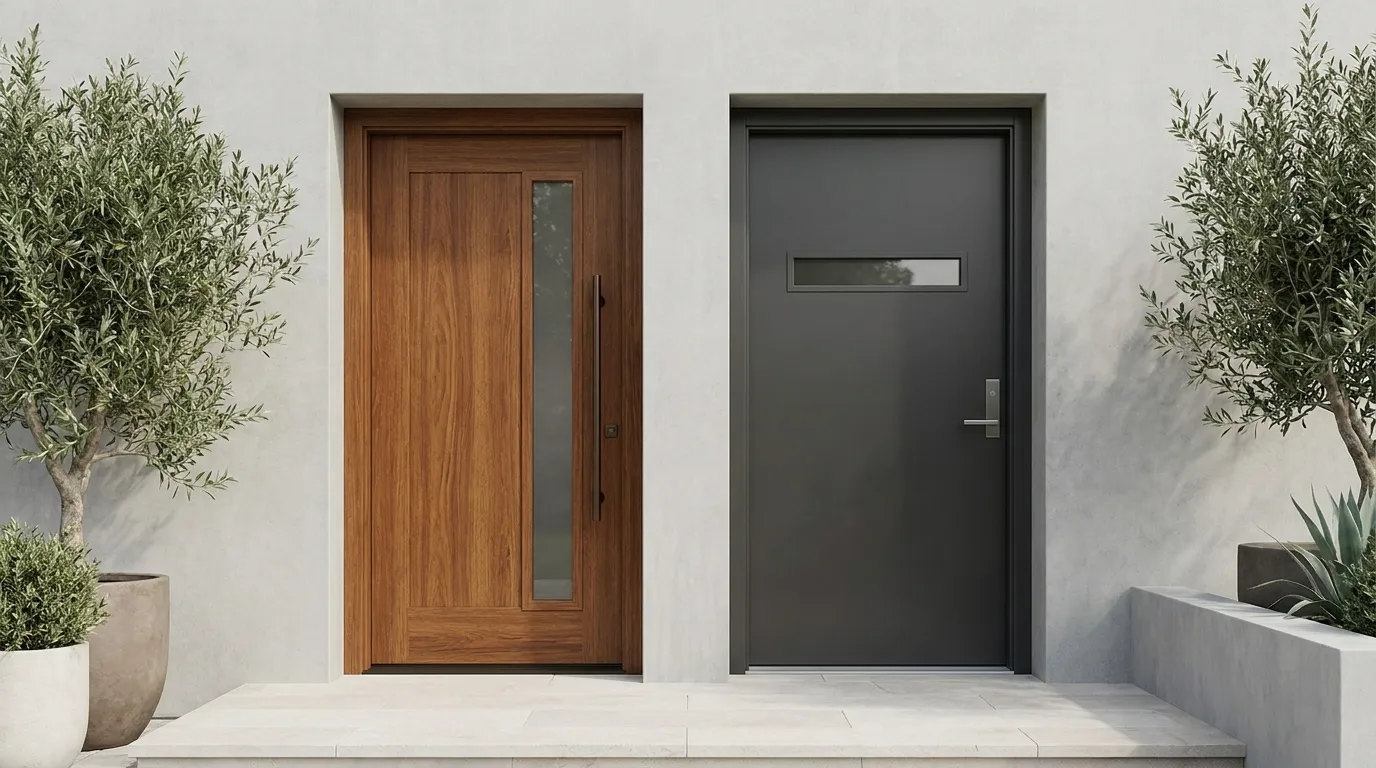
Fiberglass and steel are the two workhorses of the modern entry door, and both leave wood far behind on insulation and durability. But they behave very differently once a Montreal winter, a summer hailstorm and twenty years of freeze-thaw get to work on them. Understanding where each one shines is the difference between a door you forget about and one you fight with every season.
How each door is actually built
A steel entry door is not solid steel. It is a sandwich: two skins of galvanized steel, typically 24 to 20 gauge on quality doors, wrapped around an inner frame of wood or composite and a core of injected polyurethane foam. The steel gives it rigidity and a hard outer shell, while the foam does the actual insulating. The thicker the gauge number is smaller the steel is heavier and more dent-resistant.
A fiberglass door uses the same foam-filled construction but swaps the steel skins for moulded fiberglass-reinforced polymer. That skin can be smooth for a painted look or embossed with a deep woodgrain texture that, once stained, is genuinely hard to tell from oak or mahogany. The polymer does not conduct heat or cold the way metal does, which matters more than most buyers realize in our climate.
Both start from the same idea, a rigid shell around an insulating foam core, but the shell material changes almost everything about how the door performs, looks and ages. That single choice drives insulation, dent and rust behaviour, maintenance, appearance and price.
Insulation and R-value in a Quebec winter
Both door types insulate far better than solid wood, but fiberglass has a real edge. A quality fiberglass door lands around R-5 to R-6, while a foam-core steel door typically sits closer to R-5. The gap looks small on paper, and the foam core is doing most of the work in both cases.
The bigger difference is thermal bridging. Steel is an excellent conductor, so a steel skin can carry cold straight through the door edges and any point where the two skins meet the frame. On a -25°C morning, that is why a steel door can feel icy to the touch and why frost sometimes forms on the interior face near the edges. Fiberglass simply does not conduct that cold, so the interior surface stays warmer and condensation is far less likely.
For a Quebec entry door you want ENERGY STAR certification for climate Zone D, the coldest of the three Canadian zones. Both materials are available with Zone D ratings, but read the full-door U-factor rather than the centre-of-glass number, especially on doors with sidelites or glass inserts, since the glass is usually the weakest link, not the slab.
- Fiberglass: roughly R-5 to R-6, no thermal bridging, warmer interior surface.
- Steel: roughly R-5, but the conductive skin can bridge cold at edges and hardware.
- Both: vastly better than a solid wood door at around R-2 to R-3.
- Look for ENERGY STAR Zone D certification and check the whole-door U-factor, not just the core.
Dents, rust and cracks over time
This is where the two materials diverge most. Steel resists a sharp impact well, but once it dents, that dent is permanent and awkward to repair; body filler and repaint is the usual fix. More importantly, if the paint or galvanizing is scratched through, exposed steel will rust, and a south-facing door taking wind-driven road salt through a Quebec winter is exactly the wrong environment for bare steel.
Fiberglass will not rust, ever, and it shrugs off the dings that dent steel, a stroller wheel, a hockey stick, a kicked-up stone. It flexes and returns. Its weakness is a hard, concentrated blow, which can crack the polymer skin, though this is uncommon in normal residential use. Colour also holds up well because many fiberglass doors are factory-finished and UV-stable.
Freeze-thaw is the quiet stress test our doors face, sometimes dozens of cycles across a single winter as temperatures swing above and below zero. Water that finds a scratch in a steel skin freezes, expands and lifts the finish, accelerating rust. Fiberglass has no finish to lift for that reason and no metal to corrode, which is why it tends to look better after fifteen Quebec winters.
Maintenance and the look you want
Maintenance favours fiberglass. A factory-finished fiberglass door usually needs nothing more than a wash a couple of times a year, and stained woodgrain versions may want a fresh coat of protective topcoat every several years depending on sun exposure. Steel needs to be kept sealed; the moment the paint fails you are on the clock against rust, so periodic inspection and touch-up are part of ownership.
On appearance, fiberglass wins for anyone who wants the warmth of wood without the upkeep. The deep-grain moulds take stain convincingly, so you can get a mahogany or oak look on a maintenance-free door. Steel almost always reads as a painted door, which is clean and modern but rarely mistaken for wood; its smooth skin takes a crisp, uniform paint colour beautifully.
Both accept decorative glass inserts, sidelites and transoms, so design flexibility is comparable. If your heart is set on a rich stained-wood entry facing the street, fiberglass is the practical answer in our climate. If you want a solid painted door in a bold colour and appreciate its heft, steel delivers.
- Fiberglass: low maintenance, convincing stained woodgrain, occasional topcoat.
- Steel: keep the paint intact, inspect for chips, touch up promptly to prevent rust.
- Both take glass inserts, sidelites and transoms for design flexibility.
Security: which is harder to breach
Steel has an intuitive edge here, and it is partly real. A steel skin resists cutting and heavy impact better than polymer, and a 20-gauge steel door in a solid frame is a formidable barrier. For a buyer whose top priority is raw physical resistance at the slab, steel feels reassuring.
In practice, though, entry-door security is decided far more by the frame, the strike plate, the hinges and the lock than by the slab material. A quality fiberglass door with a reinforced lock block, a multipoint locking system and a solid steel frame is every bit as secure as a steel door with a single deadbolt, and usually more so. Most forced entries defeat the strike and frame, not the door face.
Whichever material you choose, spend your security budget on a multipoint lock, a heavy-gauge strike, long screws into the framing and good hinges. Both fiberglass and steel doors are readily available with these features, and it is those details, not the skin, that keep a determined intruder out.
Cost: upfront and over the life of the door
Steel is generally the more affordable entry door up front. A basic foam-core steel door installed often runs less than a comparable fiberglass unit, which makes it the value pick for a rental, a secondary entrance or a budget-conscious project. Expect installed steel entry doors to start in the lower CAD ranges and climb with glass and hardware.
Fiberglass typically costs more initially, with installed premium doors reaching well into the mid-thousands of dollars for stained woodgrain models with sidelites. The offset is lifespan and upkeep: fiberglass commonly outlasts steel in a harsh climate and demands less maintenance, so the higher purchase price is spread over more service years and fewer refinishing headaches.
Both materials can qualify you for efficiency incentives when you meet the requirements. Rénoclimat offers grants tied to your energy evaluation, and the Canada Greener Homes program has offered support of up to $5,000 for eligible upgrades. Choosing an ENERGY STAR Zone D door and keeping your invoices and evaluation documentation is what unlocks those savings, regardless of which material you pick.
- Steel: lower upfront cost, strong value for secondary or budget entrances.
- Fiberglass: higher upfront cost, longer life and lower maintenance in our climate.
- Both can qualify for Rénoclimat and Canada Greener Homes incentives with an ENERGY STAR Zone D door.
Which door to choose, and when
Choose fiberglass for a primary, front-facing entry in Quebec, especially one exposed to sun, salt and weather, and above all if you want a stained-wood look without the maintenance. Its resistance to rust, dents and thermal bridging makes it the low-worry, long-horizon choice for the door your family uses every day.
Choose steel when budget leads the decision, when the door is a secondary or protected entrance under an overhang, or when you specifically want a heavy, painted slab and are willing to keep its finish sealed. Well maintained and out of the worst of the weather, a steel door serves faithfully for decades.
If you are unsure, look at exposure first. A door hammered by wind, sun and road salt leans fiberglass; a sheltered door on a tighter budget leans steel. Our team can walk your openings, confirm the ENERGY STAR Zone D rating you need and match the material to how each entrance actually lives. Explore the full range on our exterior doors page.
Frequently Asked Questions
Which lasts longer in Quebec, fiberglass or steel?
In our climate fiberglass generally lasts longer because it cannot rust and shrugs off dents and freeze-thaw stress. A steel door can serve for decades too, but only if its finish is kept intact, since any breach in the paint invites rust from road salt and moisture.
Do fiberglass doors really look like wood?
Yes, quality fiberglass doors are moulded with a deep woodgrain texture that takes stain convincingly, so a mahogany or oak appearance is very achievable. Up close most people cannot tell a stained fiberglass door from real wood, and it needs a fraction of the maintenance.
Is a steel door more secure than fiberglass?
The steel skin resists cutting and impact slightly better, but real entry security comes from the lock, strike, hinges and frame, not the slab. A fiberglass door with a multipoint lock and reinforced frame is as secure as, or more secure than, a basic steel door.
Will a steel door rust in a Quebec winter?
It can, if the paint or galvanizing is scratched through and bare steel is exposed to moisture and road salt. Keeping the finish sealed and touching up chips promptly prevents it, which is why steel doors need periodic inspection that fiberglass does not.
What R-value should I look for?
Both materials offer roughly R-5 to R-6 with a foam core, which far exceeds solid wood. More important than the number is ENERGY STAR Zone D certification and the whole-door U-factor, since glass inserts and sidelites are usually the weakest point, not the slab.
Can I get a grant for a new entry door?
Yes, if you meet the program requirements. Rénoclimat provides grants based on your energy evaluation, and the Canada Greener Homes program has offered up to $5,000 for eligible upgrades; choosing an ENERGY STAR Zone D door and keeping your documentation is the key to qualifying.