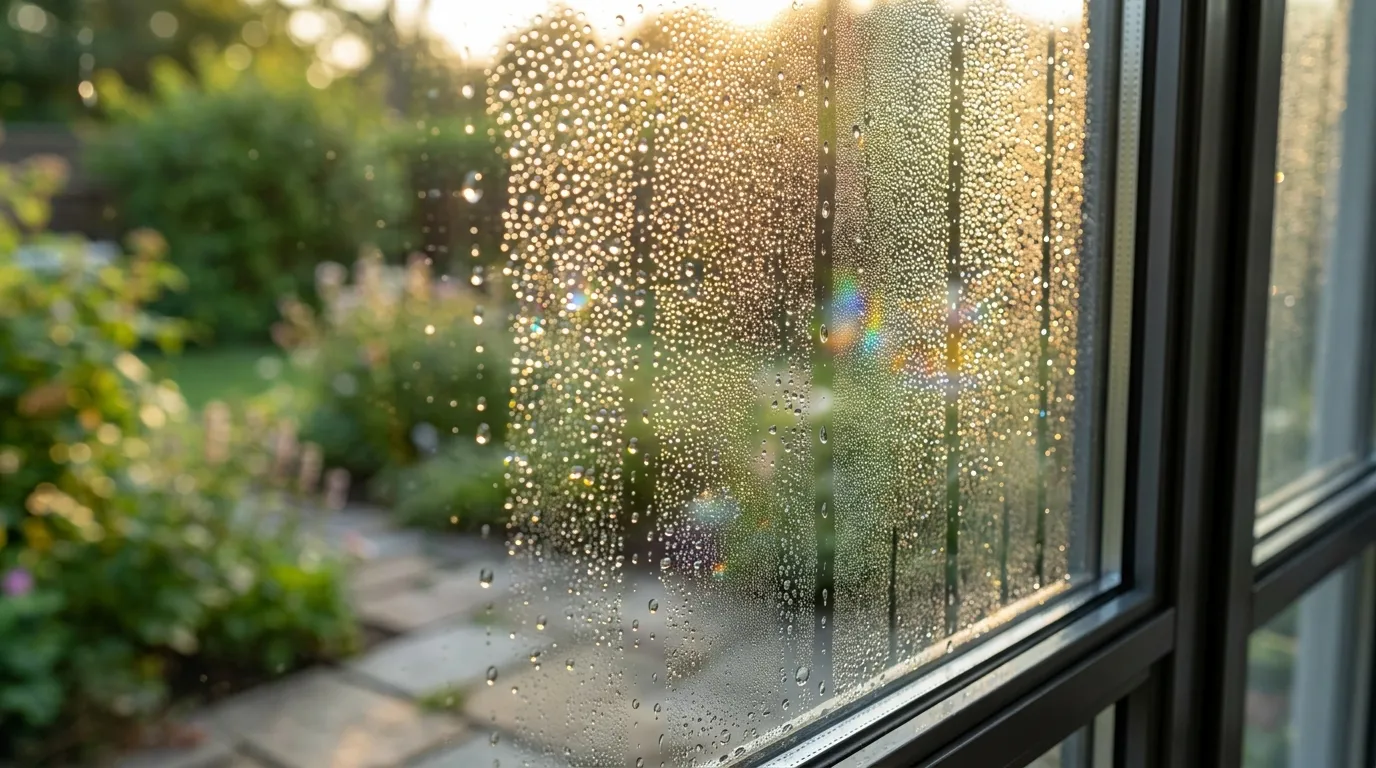
You step out on a muggy July morning in Montreal and your brand-new windows are covered in dew on the outside. Before you call the installer, take a breath: this is almost always evidence that your windows are performing beautifully, not failing. The location of condensation — outside, inside, or trapped between the panes — tells you everything, and only two of the three are problems.
What You Are Actually Seeing
Exterior condensation is ordinary dew, the same moisture that beads on your car windshield and lawn on humid, clear summer mornings. Overnight, the outer pane of an efficient window cools below the dew point of the surrounding air, and water vapour condenses on it exactly as it does on a cold drink. By mid-morning the sun and breeze evaporate it, leaving no trace and no damage.
The key detail is which surface is wet. Run a finger across the glass from outside: if the droplets smear, the moisture is on the exterior face and you are looking at a weather phenomenon, not a window defect. It appears most often in late June through September, after clear calm nights, on windows facing lawns and gardens, and typically on newer or recently upgraded glazing — which is exactly the clue to why it happens.
Why Dew Outside Means Your Low-E Glass Is Working
A modern double- or triple-glazed window with a low-emissivity coating and argon fill is designed to stop heat from crossing the glass. In winter that keeps your heating indoors; on summer nights it means the warmth inside your home never reaches the outer pane. Left thermally isolated, that outer pane radiates its heat to the clear night sky and drops to the temperature of the outdoor air — or a few degrees below it.
When that chilled outer surface meets Montreal's humid summer air, with dew points that regularly sit between 18°C and 22°C in July, condensation is inevitable and correct. An old single-pane or leaky double-pane window rarely shows this dew, and for an unflattering reason: enough of your indoor heat escapes through the glass to keep the exterior surface warm. The old window stays dry by heating the neighbourhood.
Homeowners often notice exterior dew for the first time immediately after replacing their windows and assume the new units are defective. In truth they are witnessing, in droplet form, the insulation they paid for. Some manufacturers even mention exterior condensation in their documentation as an expected behaviour of high-performance glazing.
The 60-Second Science: Dew Point and Radiative Cooling
Air holds an amount of water vapour that depends on its temperature, and the dew point is the temperature at which that vapour must start condensing. Quebec summers are genuinely humid — after a hot day, evening air around Montreal often carries a dew point near 20°C. Any surface that cools below that number gets wet, whether it is grass, a car roof or your outer pane.
Clear nights add a second mechanism: radiative cooling. With no cloud blanket, surfaces beam their heat straight into space and can fall several degrees below the surrounding air temperature — the same physics that frosts a windshield on a 2°C autumn night. A well-insulated outer pane, receiving almost no warmth from indoors, participates fully in this cooling. Cloudy or windy nights suppress the effect, which is why the dew comes and goes from one morning to the next.
- Clear, calm night: maximum radiative cooling, most likely to see morning dew.
- High humidity after a warm day: dew point near 20°C leaves little cooling margin.
- Efficient glazing: outer pane stays cold because indoor heat cannot reach it.
- Sheltered or shaded windows: under eaves and porches, the sky exposure is blocked and dew rarely forms.
Interior Condensation: The One That Signals a Problem
Condensation on the inside face of your windows — the surface you can wipe from your living room — is a different story, and in winter it is a warning. It means the interior glass surface is falling below the dew point of your indoor air, either because the window insulates poorly or because your home's humidity is too high for the season. Persistent interior condensation feeds mould on sashes and sills, stains drywall, and in cold snaps turns to frost.
The fix depends on the cause. If it happens mainly during -20°C to -30°C stretches on older windows, the glass is simply too cold, and better glazing is the durable cure. If it happens on decent windows, look at your habits and equipment: aim for indoor humidity around 30% to 40% in deep winter, run bathroom and kitchen fans, and make sure your air exchanger is actually running — Quebec homes built or renovated to recent codes rely on them. Light fog at the glass edges on the coldest mornings is common; water pooling on sills daily is not.
Fog Between the Panes: A Failed Seal, Full Stop
The third location is the unambiguous one. If you see haze, droplets or white mineral streaks that you cannot wipe from either side, the moisture is trapped inside the sealed unit, and that means its perimeter seal has failed. The insulating argon gas escaped long ago, humid air took its place, and every temperature swing now pumps more moisture in. No cleaning product or ventilation change will help.
A failed unit is not urgent — the window still keeps rain out — but it is permanent, and its insulating value is substantially gone. The cure is replacing the sealed glass unit itself, which typically costs $150 to $400 per window in the Montreal area if the frame and sash remain sound, or replacing the whole window when the frame is also near the end of its life. Quebec's freeze-thaw cycles are hard on perimeter seals, which is why quality units with warm-edge spacers and proper glazing warranties matter here more than in gentler climates.
Living With Summer Dew (You Barely Have To)
Exterior condensation needs no intervention: it evaporates on its own within an hour or two of sunrise and leaves glass spotless, since dew is essentially distilled water. If the morning view bothers you — a legitimate complaint on a picture window facing the sunrise — a few adjustments reduce how often it forms without touching the window's performance.
Think in terms of sky exposure and air movement. Windows under generous eaves, porch roofs or mature trees see far less dew because the structure blocks radiative cooling toward the open sky. Trimming dense shrubs planted tight against the wall improves morning airflow so the glass dries faster. Some premium glazing lines also offer easy-clean or anti-dew exterior coatings that sheet water off rather than letting it bead.
- Do nothing: the dew is gone by mid-morning and harms nothing.
- Check it is truly exterior: smear test from outside once, for peace of mind.
- Improve airflow: trim vegetation crowding the window so it dries sooner.
- Remember the flip side: the same insulation is cutting your heating bill every winter.
The 10-Second Diagnostic, Any Season
Condensation questions come down to one habit: identify the wet surface before worrying. Outside in summer, relax; inside in winter, manage humidity or upgrade glazing; between the panes any time of year, plan a glass unit replacement. That single distinction sorts virtually every foggy-window call we receive.
And if your windows never show summer dew while the neighbour's new ones do, treat it as information rather than luck. It may simply reflect sheltered orientation — or it may be your glazing quietly conducting heat outward all year. A hand on the inside glass during the next cold snap, or a Rénoclimat energy evaluation, will tell you which.
- Outside, summer morning, wipes off from outdoors: efficient glass doing its job.
- Inside, winter, wipes off from indoors: humidity too high or glazing too cold — investigate.
- Between panes, cannot wipe either side: failed seal — replace the sealed unit.
- White permanent streaks between panes: long-failed seal with mineral deposits — same verdict, older failure.
Frequently Asked Questions
Is condensation on the outside of new windows a defect?
No — the opposite. It shows the low-E coating and gas fill are blocking heat transfer, so the outer pane cools to the night air temperature and collects dew like any cold surface. Manufacturers consider it normal behaviour of high-performance glazing, and it evaporates without a trace by mid-morning.
Why do my old windows never get dew but my new ones do?
Because your old windows leak heat. Enough indoor warmth passes through inefficient glass to keep the outer surface warm and dry overnight. The new windows keep that heat inside, so their outer pane cools with the night air and reaches the dew point on humid mornings.
When should exterior moisture worry me?
Almost never in droplet form on the glass. Worry instead if you see water infiltrating around the frame, staining the wall below the window, or moisture that persists all day in the shade — those point to caulking or flashing issues, not dew. Condensation trapped between the panes is also a real fault.
What indoor humidity should I keep in a Quebec winter?
Aim for roughly 30% to 40% relative humidity in deep winter, dropping toward 30% during -25°C cold snaps to keep interior condensation off the glass. Use bathroom and kitchen exhaust fans, and run your air exchanger consistently. If windows still stream with water at those levels, the glazing itself is the weak point.
Can I fix a window that is foggy between the panes?
The sealed unit must be replaced; the moisture is locked inside a failed assembly and cannot be dried in place — de-fogging drilling services offer cosmetic, usually temporary results. If the frame and hardware are sound, a new sealed unit at $150 to $400 restores full performance without replacing the window.
Does triple glazing show more exterior dew than double?
Often yes, and it is a compliment to the glass. A triple-glazed unit with two low-E coatings insulates so well that its outer pane tracks the night air temperature almost exactly, making dew slightly more frequent on humid mornings. The payback is superior comfort and lower heating costs through the other nine months.