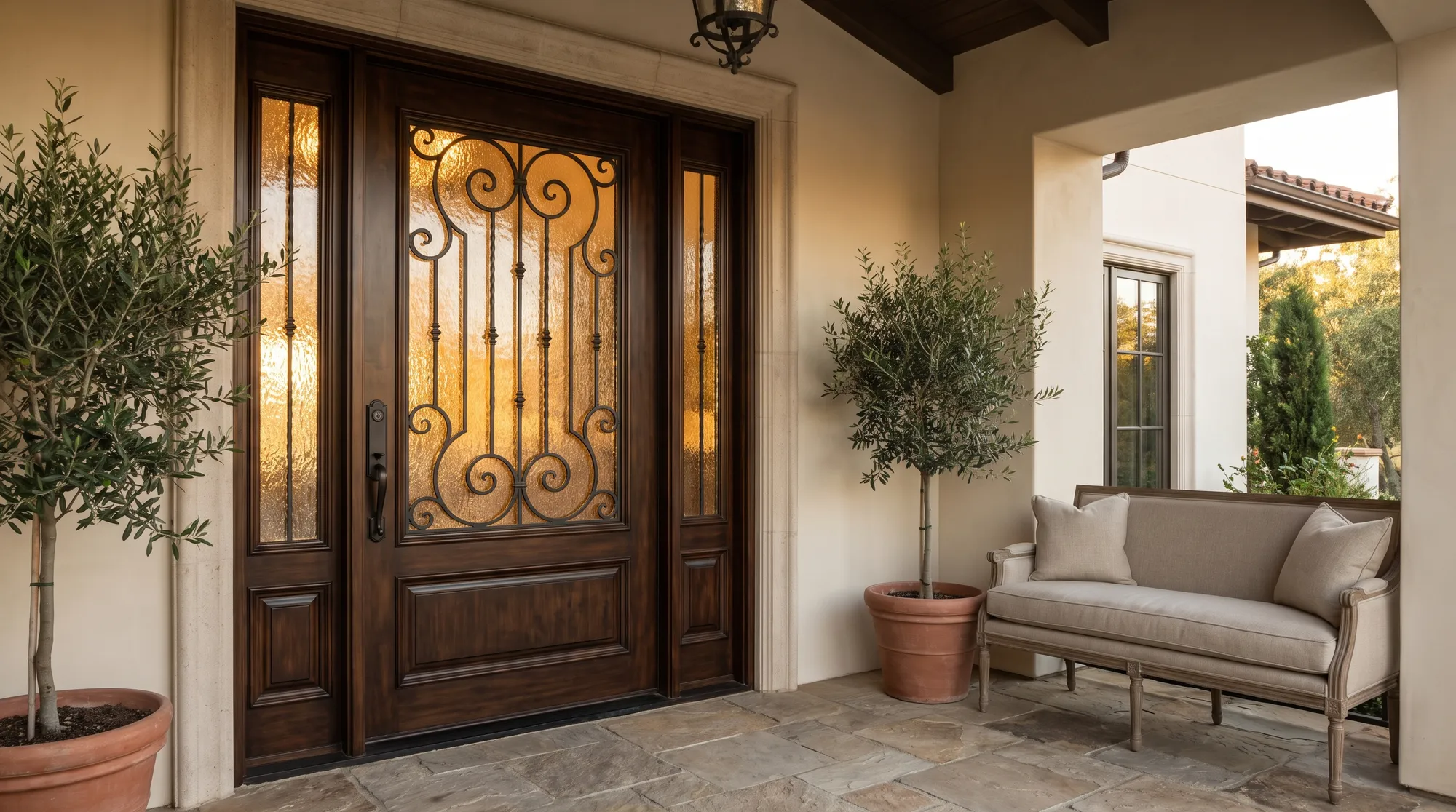
A glass insert is the single biggest style decision on an entry door — and the one homeowners most often regret, because the showroom never mentions that the gorgeous clear-glass design puts your front hallway on display for the whole street. Here is how to read privacy ratings, weigh light against exposure, match the insert to your home's architecture, and make sure the glass performs at -30°C instead of just looking good in July.
Why the Insert Decides How Your Door Lives
An entry door insert does three jobs at once: it pours natural light into a front hall that usually has no other window, it defines the door's character more than colour or hardware ever will, and it sets how much of your home's interior is visible from the sidewalk. Those three jobs pull against each other, which is why choosing an insert is a genuine design decision rather than a checkbox on the order form.
The insert itself is a factory-sealed glass unit mounted in a frame that sits in a routed opening in the door slab. On quality steel and fibreglass doors sold in Quebec, that unit is double- or triple-glazed with low-E coatings and argon fill — a miniature high-performance window, not a single decorative pane. The frame, usually a UV-stable polymer, clamps the sealed unit from both faces and carries its own weatherseal against the slab.
Sizes range from small speakeasy-style lites of a few hundred square centimetres to three-quarter and full-lite designs where glass dominates the slab. As a rule of thumb, the larger the glass, the more the privacy and energy questions in the next sections matter.
The Four Families: Clear, Textured, Wrought Iron, Stained
Clear glass is exactly what it sounds like: maximum light, maximum view, zero privacy. It suits modern architecture, flanks a door beautifully as sidelites, and works where the entry faces a private courtyard rather than the street. Bevelled and clustered clear designs add sparkle by refracting light through angled edges while remaining essentially transparent.
Textured and patterned glass — glue chip, rain, reed, pinhead, satin-etched — obscures the view while transmitting nearly all the light. The texture is rolled or etched into the glass itself, so it never peels or fades the way a privacy film does. This family covers the broadest range of privacy levels and is the workhorse choice for street-facing Quebec entries.
Wrought-iron inserts place a decorative metal grille between the sealed panes, typically over lightly textured glass. The iron is inside the sealed unit, so it never rusts and never needs dusting. The look leans European — Mediterranean, château, Old Montreal — and the dark metalwork adds a moderate privacy boost by breaking up sightlines.
Stained and decorative-leaded glass combines coloured, bevelled and textured elements with zinc, brass or patina caming. Modern versions seal the decorative layer inside a triple-glazed unit, so the artistry is protected from weather and cleaning is a flat outer pane. These inserts read as traditional or Victorian and are the natural match for Montreal's century homes.
Reading the 1-to-10 Privacy Scale
Most manufacturers rate each glass design on a 1-to-10 privacy scale, where 1 is fully transparent and 10 means even close-up silhouettes are indistinct. The rating reflects how much the texture scatters transmitted light: a level 3 rain glass shows moving figures clearly, a level 6 glue chip reduces people to soft shapes, and a level 9 satin-etch shows little more than light and shadow. Two details the scale does not capture: privacy drops at night when interior lights are on and the viewer is in the dark, and distance matters — every glass is more private from the sidewalk than from your porch.
Match the rating to the door's exposure rather than to the catalogue photo:
- Levels 1-3 (clear, bevels, light rain): entries facing a private yard, rural properties, or doors shielded by a closed porch. Full light, real visibility both ways.
- Levels 4-6 (glue chip, reed, heavier rain): the sweet spot for most suburban street-facing doors — daylight floods in, but visitors see shapes, not faces or belongings.
- Levels 7-8 (pinhead, frosted patterns): urban entries close to the sidewalk, doors beside the lock where a breach view matters, homes on busy Montreal streets.
- Levels 9-10 (satin-etch, dense textures, internal blinds): maximum discretion — you gain glowing diffuse light and give up any view out; plan a peephole or smart doorbell for seeing visitors.
The Light-Versus-Privacy Trade-Off, Room by Room
Light and privacy are a strict trade-off in a single pane, but you rarely need to solve the whole problem with one piece of glass. A high-privacy insert in the door combined with clear or lightly textured sidelites set back from the sightline delivers both a bright hall and a discreet one. A transom above the door is the cheat code: it sits above eye level, so even level 1 clear glass up there is effectively private while adding daylight all day.
Think about orientation the way you would for a window. A north-facing Montreal entry gets no direct sun and benefits from the lightest texture you can accept, because every lumen counts in December when daylight runs barely eight and a half hours. A south- or west-facing door can afford dense, high-privacy textures — and its glass should carry a low-E coating regardless, both to keep July heat out and to protect hallway floors from UV fading.
Consider the interior sightline too. Stand at your open front door and note what a visitor would see: a staircase and a coat closet are one thing, a direct line to the living room television and laptop is another. The longer and more revealing the sightline, the higher the privacy rating the door glass deserves.
Matching the Insert to Your Home's Architecture
Glass style is the fastest way to make a new door look native to the house — or bolted on. Montreal-area plexes and century homes with brick facades and vertical proportions carry stained, leaded and wrought-iron designs naturally; a minimalist four-square modern lite on a 1910 duplex looks like a renovation compromise. Conversely, post-war bungalows in Saint-Laurent or Laval and contemporary builds ask for clean geometry: narrow vertical lites, off-centre rectangles, reed or satin textures in simple frames.
A few pairings that consistently work: Victorian and Queen Anne homes with oval decorative-leaded inserts; craftsman-style entries with three- or four-lite top rows over a solid lower panel; Mediterranean-influenced facades with arched wrought-iron designs; farmhouse renovations with clear or seeded glass in simple two- or four-lite patterns.
Match the caming and frame finishes to your exterior hardware — brushed nickel with cool-toned brick and black aluminum windows, patina or brass with warm brick and wood tones. And photograph your facade before visiting a showroom: an insert chosen against the actual house, even on a phone screen, beats one chosen against a white display wall. Browse the combinations on our exterior doors page to see how slab colour, glass and sidelites interact.
Energy Performance: Glass That Survives a Quebec Winter
Every square centimetre of glass in a door is a hole in the insulation. A steel or fibreglass slab with polyurethane foam core insulates around R-15; even excellent triple glazing manages roughly R-5 to R-7. That is not a reason to skip glass — it is a reason to specify it properly. In our climate that means a triple-glazed insert with two low-E coatings and argon fill, warm-edge spacers, and an insert frame with a thermal break so the clamping hardware does not become a frost bridge.
The failure mode to design against is condensation and frost on the interior face during cold snaps. Double-glazed decorative inserts routinely frost at -25°C in a normally humidified home; triple-glazed units keep the interior surface warm enough to stay clear down to design temperatures. Wrought-iron and stained designs are available in triple-glazed configurations from quality manufacturers — insist on them, because retrofitting performance later means replacing the whole insert.
If the door is part of a larger renovation, note that exterior doors meeting ENERGY STAR certification can count toward Rénoclimat rebates of roughly $150 per opening when the program's pre- and post-work evaluations are done. The certified rating applies to the door-and-glass combination as tested, so ask your supplier for the rating of the exact slab-plus-insert configuration on your quote, not the solid-slab number.
Changing Your Mind: Swapping Inserts Later
Here is the good news hiding in the fine print: on most steel and fibreglass doors, the glass insert is a serviceable component. The polymer frame unscrews from the interior side, the old sealed unit lifts out, and a new insert of the same cutout size drops in — typically an hour of work. That means a fogged sealed unit, a cracked pane from a slammed door, or simply a style you have tired of does not condemn the whole door.
The constraint is the cutout. Swaps are straightforward when the new insert matches the existing routed opening's dimensions and shape; going from a small lite to a three-quarter lite means cutting the slab, which is a job for a professional and not worth doing on a steel door where the cut edge must be resealed against corrosion. Standard cutout sizes (22x36, 22x48 inches and similar) give you the widest future selection, which is itself a quiet argument for choosing common sizes now.
Budget-wise, replacement decorative inserts run roughly $250 to $900 CAD depending on size and design complexity, plus modest installation if you do not do it yourself. Compare that to $1,800 to $4,000+ for a full door replacement and the swap route is an economical mid-life refresh — new glass style, new privacy level, restored energy performance, same door.
Frequently Asked Questions
What privacy level should I choose for a street-facing door?
For most suburban entries, levels 4 to 6 — textures like glue chip or rain — hit the balance: abundant daylight with figures reduced to soft shapes. Urban doors within a few metres of the sidewalk warrant 7 or 8. Remember that privacy drops after dark with interior lights on, so err one level higher if your hallway is lit every evening.
Does glass in an entry door hurt energy efficiency?
Glass always insulates less than an insulated slab — roughly R-5 to R-7 for excellent triple glazing versus about R-15 for a foam-core door. The practical answer is specification: a triple-glazed, dual low-E, argon-filled insert with warm-edge spacers keeps the penalty small and the interior pane frost-free at Quebec design temperatures.
Do wrought-iron inserts rust or need maintenance?
No. The decorative ironwork is sealed between the glass panes inside the insulated unit, so it never sees moisture, never rusts, and never collects dust. Cleaning is a flat exterior pane and a flat interior pane, exactly like plain glass. The same applies to modern stained and leaded designs sealed within triple glazing.
Can I replace just the glass insert without replacing the door?
Usually yes, on steel and fibreglass doors: the insert frame unscrews from the interior, the old unit lifts out, and a matching-size unit drops in — about an hour of work. Replacement inserts run roughly $250 to $900 CAD. Enlarging the opening, however, means cutting the slab and is rarely worth it on steel doors.
Is a door with glass less secure?
Quality inserts use tempered glass that resists impact and breaks into blunt granules rather than shards, and multi-point locks matter far more to real-world security than the presence of glass. If the glass sits within reach of the deadbolt thumb-turn, choose a high-privacy texture and a double-cylinder or smart lock configuration, and consider laminated glass options.
Will a decorative insert fog up over time?
Any sealed unit can eventually lose its seal — quality inserts are typically warrantied 10 to 20 years against seal failure. Fogging between panes means the unit, not the door, has failed; because inserts are replaceable components, the fix is a new insert in the existing cutout rather than a new door. Keep your paperwork: fogging is a standard warranty claim.