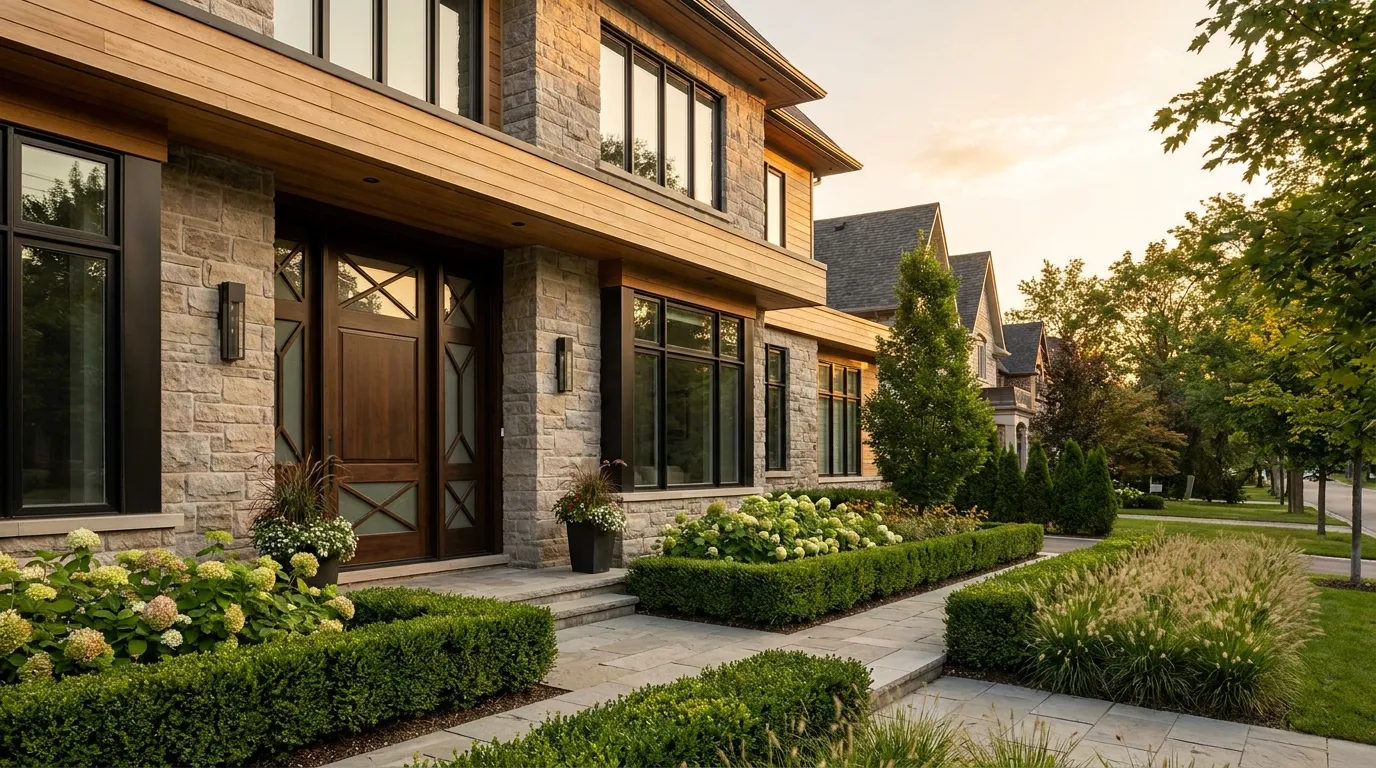
Real estate agents in Montreal will tell you the sale starts on the sidewalk: buyers form an opinion of a house in the first eight seconds, long before they see the renovated kitchen. Doors and windows dominate that first impression because they are the eyes and mouth of a façade, and they are also among the few exterior upgrades that reliably return most of their cost at resale. Here is what the data says, what buyers actually notice, and how to use doors and windows strategically if a sale is in your future.
The eight-second first impression
Behavioural research on home buying consistently shows that people decide whether they are interested in a property within seconds of arriving, and everything they see afterward gets filtered through that snap judgment. A crisp front entrance and clean, uniform windows signal a maintained house; peeling door paint and foggy sealed units whisper deferred maintenance, and buyers immediately start a mental tally of what else has been neglected.
That psychology has hard financial consequences. Studies of listing photos and sale outcomes have found homes with strong curb appeal sell for roughly 7 percent more on average than comparable homes with a neglected exterior, and the gap widens in slower markets where buyers can afford to be picky. In a city like Montreal, where a typical single-family home trades well above $600,000, even a few percentage points represent tens of thousands of dollars.
Curb appeal also determines whether buyers show up at all. Most Quebec buyers now shortlist properties from Centris photos before booking a single visit, and the façade shot is almost always the primary listing image. A house whose windows and entry door photograph well earns more visits, and more visits mean more competing offers.
The entry door: small project, outsized return
Year after year, cost-versus-value studies place entry door replacement among the highest-return renovation projects in North America, with typical cost recovery in the range of 75 to 100 percent of the project price at resale, and some years topping the list outright. The Appraisal Institute of Canada likewise ranks exterior door and window upgrades among renovations with strong recovery, alongside kitchens and bathrooms but at a fraction of their cost.
The math is friendly because the project is small. A quality insulated steel entry door installed in Quebec typically runs $1,800 to $4,000 CAD, and a fibreglass door with sidelites $3,500 to $8,000, versus $30,000 or more for even a modest kitchen. Recovering three-quarters of a $3,000 door is a far safer bet than recovering half of a $50,000 kitchen, and the door improves every listing photo instantly.
Beyond resale value, a new exterior door answers questions buyers silently ask at the threshold: does it swing smoothly, does the multi-point lock feel solid, is there a draft? An entrance that feels secure and airtight in a February showing does more persuasion than any brochure.
What buyers actually notice about windows
Buyers are not window experts, but they are excellent flaw detectors. Fogged or milky glass, condensation trapped between panes, is the number one tell, because it broadcasts failed seals even to a first-time buyer, and inspectors flag it in every report. Cracked or yellowed vinyl, rotted wooden brickmoulds, mismatched replacement units on the same façade, and painted-shut sashes all register within the first minute of a visit.
Inside, buyers walk to the window in nearly every room, and they touch. A casement that cranks open smoothly and locks with one motion reads as quality; a stiff, rattling slider reads as a future expense. During winter showings, buyers linger near windows precisely because they can feel drafts and cold radiating from poor glazing, and Quebec buyers, conditioned by heating bills, are quick to ask about window age and energy ratings.
New windows also answer the inspection question before it is asked. A pre-sale inspection that lists ten failed sealed units becomes a negotiating lever against you, often at inflated replacement estimates; documented recent windows with transferable warranties remove that lever entirely.
- Instant red flags: fog between panes, condensation stains, rotted sills, peeling exterior paint.
- Touch tests: smooth cranks and locks, sashes that stay open, screens present and intact.
- Paper trail: invoices, ENERGY STAR ratings and transferable warranties reassure buyers and inspectors.
Matching styles to your home's architecture
The highest-value door or window is the one that looks like it belongs. On a century brick duplex in Rosemont or Villeray, that means hung windows with traditional proportions, transom details and a panelled entry door; a frameless modern pivot door on that façade would read as a mistake, not an upgrade. On a 1990s suburban cottage in Laval or Brossard, cleaner casements and a contemporary door with a vertical lite are exactly right.
Consistency across the façade matters as much as the style itself. Buyers may not articulate why a house looks off, but a façade mixing white vinyl on one floor and beige aluminum on another, or three different grille patterns, creates visual noise that photographs badly. If you can only replace some windows before selling, prioritize completing the street-facing façade so it presents as one coherent design.
Colour is the cheapest style decision with the biggest impact. Black and dark charcoal window frames remain the dominant trend in Quebec and dramatically sharpen a light brick or grey façade, while classic white stays the safe choice on traditional homes. For the entry door, a confident accent, deep blue, oxblood red, matte black, is a proven listing-photo standout, and paint is a weekend fix on a door that is otherwise sound.
Staging the entrance and windows for showings
If a full replacement is not in the cards before listing, staging can still recover much of the lost impression. Wash every pane inside and out, including screens, since clean glass alone measurably brightens interior photos; re-caulk stained or cracked exterior joints; lubricate hinges and cranks so nothing squeaks during a visit; and touch up chipped paint on the door slab and frames.
Dress the threshold like a stage set: a new mat, matching planters, updated house numbers and a modern exterior light fixture cost a few hundred dollars combined and photograph beautifully. Replace tarnished door hardware, the handleset is the one piece of the house every single visitor touches, and a solid new gripset in black or brushed nickel is a $150 upgrade that punches far above its price.
During showings, open the curtains and blinds fully in every room. Agents consistently report that natural light ranks among the top three features buyers say they want, and windows are the delivery mechanism; a bright room makes the windows themselves look better, whatever their age.
The Montreal market angle: timing and buyer expectations
Montreal's resale market rewards move-in-ready homes with a visible premium because so much of the island's housing stock dates from before 1980, and buyers are wary of inheriting a renovation backlog. When a buyer compares two similar Rosemont duplexes and one has documented new windows, the mental discount applied to the other is usually larger than the actual cost of the windows, which is exactly the asymmetry a seller wants to exploit.
Timing matters too. Spring remains the heavy listing season in Quebec, so exterior projects completed the previous summer or fall are photographed in good weather and fully settled by listing day. Window manufacturing lead times of 4 to 8 weeks plus installation mean a seller planning a spring listing should be signing a window or door contract by late summer, not in February.
Energy performance is increasingly part of the conversation: with Hydro-Québec rates rising and heating a poorly glazed home costing hundreds more each winter, ENERGY STAR certified windows rated for Canada's cold zones are a concrete selling point agents can print in the listing. Keep every invoice and warranty certificate in a folder for the buyer; transferable manufacturer warranties, like those on Unisson Groupe products, carry real weight in negotiation.
Frequently Asked Questions
How much value do new windows add when selling?
Cost-versus-value research consistently shows window replacement recovering roughly 70 to 85 percent of its cost at resale, before counting energy savings while you still occupy the home. Just as important, new windows prevent the inspection-driven price reductions that failed sealed units routinely trigger, which often exceed the real cost of the repairs.
Is an entry door really the best renovation ROI?
It is consistently at or near the top of North American cost-versus-value rankings, with 75 to 100 percent of cost typically recouped. The project is inexpensive relative to kitchens or bathrooms, transforms the primary listing photo, and directly addresses buyer concerns about security and drafts.
Should I replace windows before listing or discount the price instead?
If several sealed units have failed or frames are visibly deteriorated, replacing before listing usually nets more, because buyers overestimate repair costs and inspectors give them a written justification to demand credits. If windows are merely dated but functional, deep cleaning, fresh caulking and good staging may be the smarter spend, and your listing agent can advise which side of the line you are on.
What door colour helps a house sell in Quebec?
Dark, confident tones photograph best against Montreal's brick and stone: matte black, deep navy, charcoal and oxblood red are consistent performers. The safest strategy is strong contrast with the façade colour while staying harmonious with the roof and window frames; save the truly bold hue for the door alone.
Do buyers actually care about ENERGY STAR ratings?
Increasingly, yes. Quebec buyers pay their own heating bills and Hydro-Québec rates keep climbing, so ENERGY STAR certification for Canada's cold climate zones gives agents a concrete, printable claim, and documented efficiency helps at inspection and appraisal alike. Keep certificates and invoices to hand over at the promise to purchase.
How long before listing should I start a door or window project?
Work backward from a spring listing: 4 to 8 weeks of manufacturing lead time plus scheduling and installation means signing in late summer or early fall is comfortable. That timing also lets caulking cure, lets you photograph the façade in good light, and gives you a winter of energy savings before the sale.