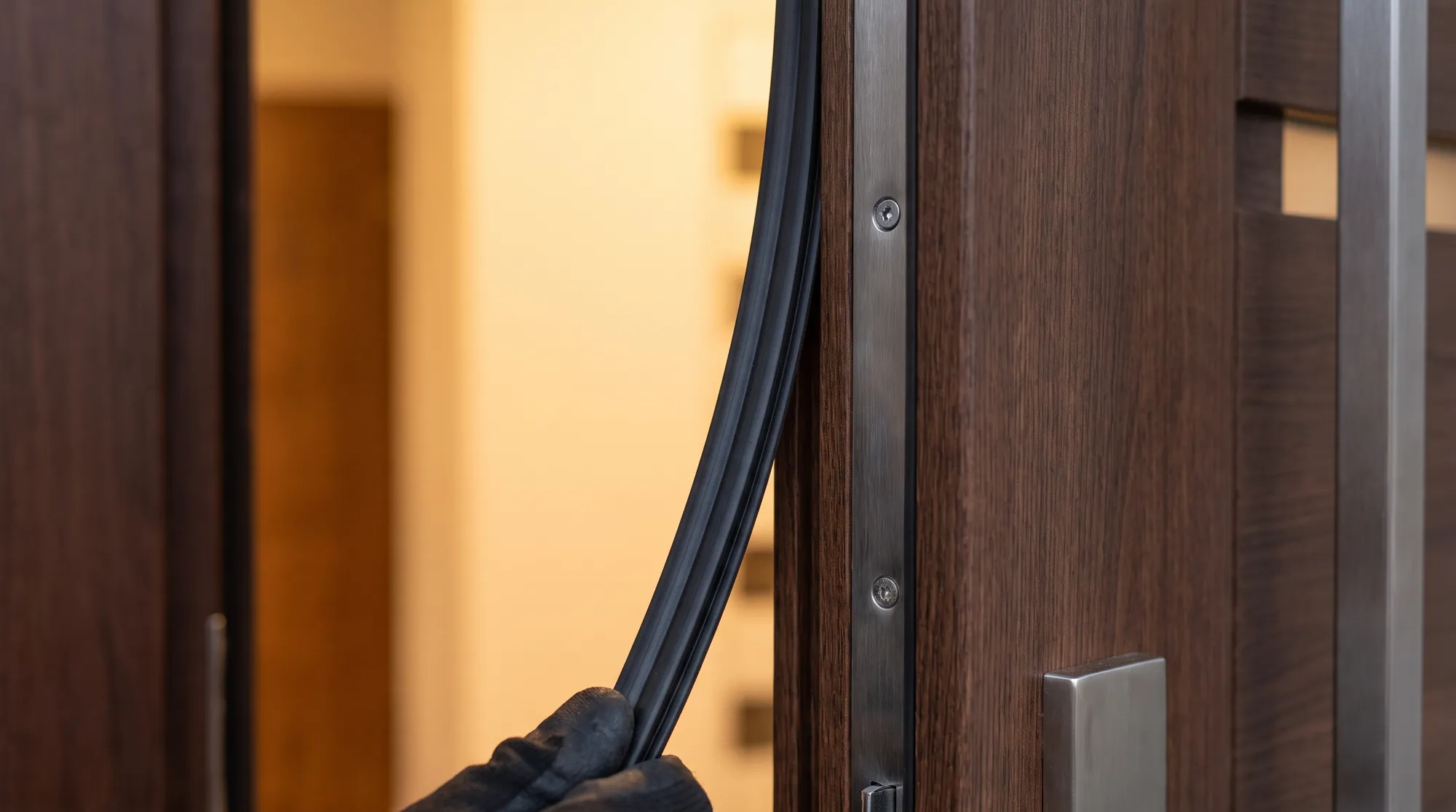
A few dollars of foam and rubber stand between your heated living room and a Quebec winter — and when that thin line fails, you feel it as a draft, hear it as whistling, and pay for it on every hydro bill. This guide walks through the four main weatherstripping families, the one-dollar-bill test that diagnoses your doors in minutes, and why late summer is exactly the right time to replace worn seals.
A Small Part With an Outsized Job
Air leakage, not conduction through the panel, is the biggest energy weakness of most entry doors. Natural Resources Canada attributes up to 25% of a typical home's heat loss to uncontrolled air leakage, and the perimeter of an exterior door is one of its longest, most-used leak paths — roughly five linear metres of joint that opens and closes a dozen times a day. The only thing sealing that joint is the weatherstripping.
The stakes are higher in Quebec than almost anywhere. At -30 °C, the pressure difference between a heated house and the outdoors drives cold air through any gap; a 3 mm gap along a standard door leaks roughly as much air as a fist-sized hole in the wall. Beyond the heating dollars, leaking joints frost up, drip as they thaw, and soak the door bottom and jamb — the start of rot on wood components and corrosion on steel.
Weatherstripping is also a consumable. It gets compressed thousands of times a year, scraped by boots and paws, baked in summer and frozen stiff in winter. Foam types last 3 to 5 years; quality rubber and magnetic types, 10 or more. The material costs $10 to $50 CAD per door and the replacement is genuinely DIY — which makes worn weatherstripping the cheapest significant energy fix a Quebec homeowner can make.
The Four Families of Door Weatherstripping
Compression seals are the workhorses: a foam, EPDM rubber or silicone bulb mounted on the door stop, squeezed as the door closes. Quality compression seals stay flexible in deep cold and recover their shape between closings. This is what most modern steel and fibreglass entry doors use around the sides and top, because a bulb accommodates the small seasonal movements of the door slab.
V-strip (also called tension seal) is a folded V of vinyl or bronze that springs open inside the gap, sealing as the two legs press against door and jamb. Bronze V-strip is the traditional choice on heritage wood doors — it lasts decades and handles the uneven gaps of an old door better than anything else. Vinyl V-strip is the budget version, easy to cut with scissors and stick in place.
Magnetic seals work like a refrigerator door: a magnet embedded in the vinyl bulb pulls the strip tight against the steel door skin, achieving a positive seal that does not depend on how firmly the door was closed. They are standard equipment on quality steel doors and one of the best answers to Quebec wind pressure — more on them below.
Kerf-mounted seals describe an attachment style rather than a material: the strip's barbed fin presses into a thin slot (the kerf) cut into the door frame. Nearly all doors manufactured since the 1990s use kerf mounting because replacement is tool-free — pull the old strip out of the slot, press the new one in. If your door frame shows a fine groove behind the seal, you have kerf mounting, and replacement will take fifteen minutes.
- Compression bulb: foam, EPDM or silicone; the standard on modern doors; 5-10 years of service
- V-strip: vinyl or bronze tension seal; best for older wood doors with uneven gaps
- Magnetic: fridge-style positive seal; steel doors only; excellent against wind pressure
- Kerf-mounted: press-in attachment used on most post-1990 frames; tool-free replacement
- Door sweep / bottom seal: the fifth element — seals the threshold gap and wears fastest of all
The Dollar-Bill Test: Diagnose Every Door in Five Minutes
You do not need a thermal camera to audit your weatherstripping — a banknote will do (a Canadian polymer bill is perfect and survives the job). Open the door, lay the bill across the seal, and close the door on it. Now pull. If the bill slides out with little or no resistance, the seal is not gripping at that spot and winter air will pass exactly where the paper did.
The method matters: test every 30 cm around the full perimeter — hinge side, lock side, top, and along the threshold. Doors rarely fail everywhere at once; they fail at the top corner where the slab has sagged, or along the bottom where the sweep has worn. Mark the failing spots with painter's tape as you go, and you will have a precise map of what needs attention instead of a vague sense of draftiness.
Back the test up with your senses on the next cold snap. A candle or incense stick moved slowly around the closed door will flicker at leak points; frost or condensation lines on the inside face in January are a finished diagnosis in themselves. And check the seal visually: cracked, flattened, torn or permanently compressed weatherstripping fails the eye test before it fails the bill test — foam that does not spring back within a few seconds of a finger press is done.
Replace Before Fall: Timing Is Half the Job
The right moment to replace weatherstripping in Quebec is late August through October — before the first sustained cold, while sealants cure properly and adhesive-backed products still stick. Self-adhesive foams and vinyls need surfaces above roughly 5 °C to bond; try installing them in a November cold snap and they will peel off by Christmas. Hardware stores also still have full stock in September; by the first -20 °C week, the weatherstripping aisle empties fast.
Plan on the task roughly every fall as an inspection, and expect actual replacement on this cadence: adhesive foam every 3 to 5 years, vinyl V-strip and bulb seals every 5 to 10, bronze and magnetic seals at 10 to 20. The door sweep at the bottom wears fastest of all — it drags across the threshold at every use — and often needs renewal twice as often as the perimeter seals.
While you are at it, service the whole seal system, not just the strip. Tighten hinge screws (a sagging slab defeats a perfect seal), adjust the strike plate so the door pulls snug against the compression bulb, and check the adjustable threshold — most modern thresholds raise or lower on four or five screws to meet the door sweep. Ten extra minutes here often recovers a seal you were about to replace.
Replacing a Kerf Seal: The Fifteen-Minute Fix
If your door was made in the last thirty years, replacement is almost embarrassingly easy. Grip the old seal at a corner and pull steadily — the barbed fin slides out of the kerf slot without tools. Clean the slot with a vacuum and a damp cloth, since grit in the kerf keeps the new fin from seating fully. Note the profile of the old seal (bulb size and fin shape) or bring a cut-off to the store; kerf seals are standardized enough that matching is straightforward.
Install the new seal starting at the top corner, pressing the fin into the kerf with your thumb every few centimetres — no adhesive, no fasteners. Cut the ends at 45 degrees where top and side strips meet so the corners seal tight. Close the door and check the reveal: you want visible, even compression of the bulb all around, but the door should still latch without a shoulder check. If latching becomes hard, the bulb is too large; one size down will seal fine.
For doors without a kerf — typically pre-1990 wood doors — you will be working with screw-mounted metal-and-vinyl stops or adhesive products. Screw-on stop strips are the durable choice: they install over the existing stop with the door closed, pressed lightly against the slab, and can be re-adjusted as the door moves with the seasons. Reserve stick-on foam for storm doors and low-stakes gaps; it is a one-season bandage, not a repair.
Magnetic Seals on Steel Doors: The Quebec Advantage
Steel entry doors dominate the Quebec market for good reasons — security, price, fire ratings — and they enable a seal no other door can use: the magnetic weatherstrip. Because the door skin is ferrous, a magnet strip embedded in the seal snaps against it as the door closes, exactly like a refrigerator gasket. The seal force comes from the magnet, not from how hard the door was shut, so the seal is equally tight whether the door was closed gently or slammed.
That property matters most in wind. A conventional compression bulb can be pushed off the slab momentarily by gusting pressure differentials — the flutter you hear as whistling during a February blizzard. A magnetic seal resists that flutter because the magnetic attraction increases as the gap tries to open. On exposed facades and in wind corridors along the St. Lawrence, the difference is audible.
Magnetic seals are typically fitted on the lock side and top of steel doors, with a conventional compression seal on the hinge side where the door geometry rotates rather than closes flat. When replacing, you must match magnetic with magnetic — substituting a plain bulb where a magnet strip was designed to sit leaves the door under-sealed. Kerf-mounted magnetic replacements are stocked by Quebec building suppliers for around $20 to $40 per door set; check polarity orientation (the strip should snap toward the door, not away) before trimming to length.
When New Seals Aren't Enough
Weatherstripping seals the joint between a straight slab and a square frame. If the slab is warped, the frame racked by foundation movement, or the gap visibly wedge-shaped — 2 mm at one corner and 8 mm at the other — no strip profile can seal both extremes, and each replacement will disappoint slightly faster than the last. The same is true when the door bottom has rusted, the threshold is cracked, or a wood slab has swollen so it binds in summer and gaps in winter.
There is also a thermal ceiling on what seals can fix. An uninsulated 1980s steel slab or a solid wood door has an insulating value around R-2; a modern polyurethane-core steel or fibreglass door reaches R-12 to R-16 before the weatherstripping is even counted, and an ENERGY STAR certified door assembly is tested for both conduction and air leakage as a system. If you are re-stripping the same door for the third time while the panel itself radiates cold, the seals are no longer the problem.
The honest arithmetic: $10 to $50 in seals per door, per few years, versus a replacement entry door professionally installed. When the slab and frame are sound, seals win every time. When they are not, an exterior door built for Quebec winters — insulated core, magnetic weatherstripping, thermally broken threshold and RBQ-licensed installation — fixes draft, condensation and security in one intervention, and Rénoclimat's incentive of roughly $150 per opening applies to qualifying replacements.
Frequently Asked Questions
How do I know if my door weatherstripping needs replacing?
Run the dollar-bill test: close the door on a banknote every 30 cm around the perimeter and pull. If it slides out without resistance anywhere, that section is not sealing. Visually, cracked, torn, flattened or permanently compressed strips — foam that does not spring back — are due for replacement.
What type of weatherstripping is best for a front door?
For modern steel and fibreglass doors, kerf-mounted compression bulbs in EPDM or silicone, with magnetic strips on steel doors' lock side. For older wood doors with uneven gaps, bronze or vinyl V-strip handles irregularity best. Match the existing type when in doubt — the frame was designed around it.
When should I replace weatherstripping in Quebec?
Between late August and October. Adhesives and sealants need temperatures above about 5 °C to bond and cure, and you want the seal working before the first sustained cold. An annual fall inspection with the dollar-bill test tells you whether this is a replacement year.
How long does door weatherstripping last?
Adhesive foam lasts 3 to 5 years, vinyl V-strip and compression bulbs 5 to 10, and bronze or magnetic seals 10 to 20. Door sweeps wear roughly twice as fast as perimeter seals because they drag on the threshold with every opening.
Why do steel doors use magnetic weatherstripping?
Because the steel skin lets a magnet in the seal pull itself tight against the door, like a refrigerator gasket. The seal force is independent of how firmly the door was closed and increases as wind pressure tries to open a gap — which is why magnetic seals stay quiet in Quebec blizzards where bulb seals whistle.
Can weatherstripping fix a warped or drafty old door?
Only partly. Seals close uniform gaps of a few millimetres; they cannot bridge a wedge-shaped gap from a warped slab or racked frame, and they add nothing to an uninsulated panel's R-2 thermal value. If you are re-sealing the same door repeatedly, evaluate replacing it with an insulated ENERGY STAR unit.