Slide a hand along the bottom of your entry door on a windy day and you will likely feel it: a ribbon of cold air sneaking in under the slab. A 6 mm gap under a standard 36-inch door leaks about as much air as a 14 cm² hole punched straight through the wall. A door sweep costs $15 to $60, installs in under an hour, and is the single cheapest draft fix you can make before a Quebec winter — here is how to choose, measure and install one properly.
Why the Gap Under Your Door Matters
Every exterior door needs clearance under the slab to swing freely over flooring and mats — but that clearance is also a permanent, full-width air channel. Because cold air is denser, it pools at floor level and pushes inward through the lowest opening in the building envelope, which is almost always the door bottom. That is why the draft you feel at your ankles in January is stronger than anything coming through the window sashes upstairs.
The stack effect makes it worse. As your heating system warms indoor air, that air rises and escapes through the attic and upper leaks, creating negative pressure at ground level that actively sucks outdoor air under the door. On a -20°C night with wind, an unsealed 6 mm gap can admit tens of cubic metres of freezing air per hour — air your electric baseboards or heat pump then have to reheat at Hydro-Québec rates.
Beyond comfort and cost, that gap admits fine snow during blowing storms, road dust, insects in late summer, and noise year-round. A properly fitted sweep addresses all of it with a part small enough to fit in a coat pocket.
The Three Main Types of Door Sweeps
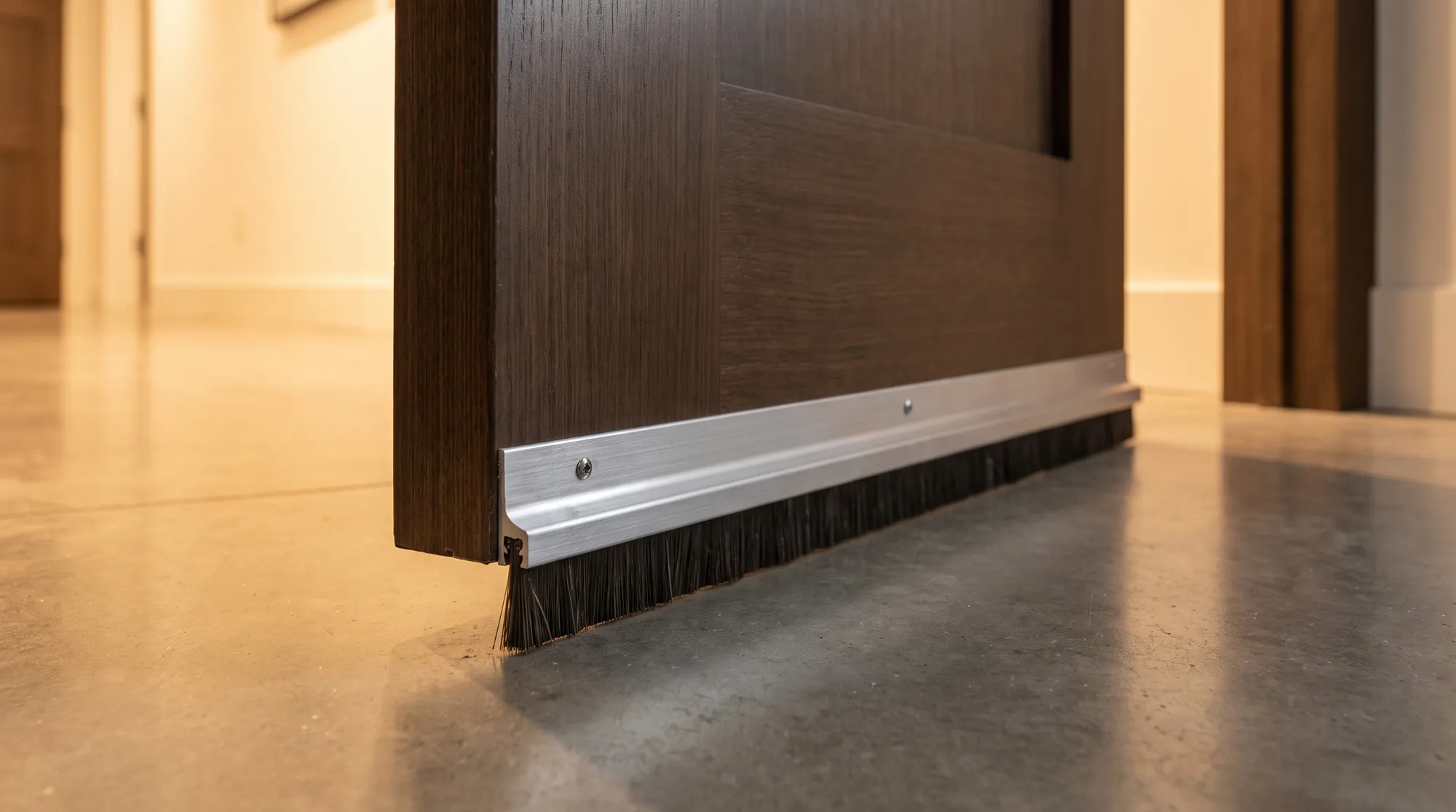
A brush sweep uses a dense strip of nylon or polypropylene bristles held in an aluminum carrier. Bristles conform to slightly irregular thresholds, tolerate grit and ice better than any other type, and slide over interior rugs without snagging. Their weakness is airtightness: a brush blocks perhaps 85 to 90% of airflow rather than sealing it outright, so it is the pragmatic choice for busy family entries and back doors, not the tightest one.
A vinyl or rubber fin sweep presses one or two flexible blades against the threshold. When the threshold is flat and true, fins seal essentially airtight — better than brush — and they cost the least, often under $20. The trade-off is wear: fins stiffen in deep cold, drag on high-pile mats, and a fin that is set too low folds under the door and tears within a season.
An automatic drop-down sweep (also called an automatic door bottom) is the premium option at $40 to $120. A spring-loaded mechanism holds the seal retracted while the door moves; a plunger strikes the hinge-side jamb as the door closes and drops the seal firmly onto the threshold. You get an airtight seal with zero drag — the best answer for uneven floors, heritage doors with generous clearances, and doors opening over thick rugs.
- Brush sweep — most durable, forgiving on rough or icy thresholds, ~85-90% draft reduction, $15-$35
- Vinyl/rubber fin — tightest seal on a flat threshold, cheapest, wears fastest, $10-$25
- Automatic drop-down — airtight with no floor drag, ideal for uneven surfaces, $40-$120
Measuring Your Door and Gap Correctly
Start with the width: measure the door slab itself, not the frame opening, at the bottom edge. Most Quebec entry doors are 32, 34 or 36 inches; sweeps are sold in 36- and 48-inch lengths and cut down with a hacksaw, so buy the next size up. Cut the metal carrier first, then trim the brush or vinyl insert flush with sharp scissors.
Next, measure the gap. Close the door and stack coins or use a feeler gauge under the slab at the latch side, the middle, and the hinge side — record all three, because doors and thresholds are rarely parallel. A consistent 6 to 12 mm gap suits any surface-mount sweep. A gap that varies more than 5 mm across the width, or exceeds 15 mm anywhere, points you toward a drop-down model or a threshold repair before you install anything.
Finally, check what the sweep will land on. An aluminum sill with a raised vinyl insert wants light fin contact only; a flat hardwood or tile landing accepts firmer pressure. Note the swing direction too — the sweep mounts on the interior face of an inswing door and the exterior face of an outswing door, and an exterior-mounted sweep should be aluminum-carried and rated for weather exposure.
Installing a Sweep Step by Step
Installation needs only a drill, a hacksaw, a tape measure and ten minutes of patience — and the door can stay on its hinges. The most common mistake is setting the sweep too low so it seals beautifully but the door drags, wears out the insert and eventually racks the hinges. Aim for firm, even contact, not compression.
Work with the door closed. Hold the cut-to-width sweep against the interior face, drop it until the bristles or fins just touch the threshold along the full width, then have someone open and close the door while you check the drag: it should whisper, not scrape. Most carriers have vertically slotted screw holes precisely so you can fine-tune the height after the screws are in.
- Cut the sweep to the exact slab width; file the cut end smooth
- With the door closed, position the sweep so the seal lightly contacts the threshold across its full length
- Mark screw locations through the slots, drill 2 mm pilot holes (essential on steel and fibreglass doors)
- Screw in loosely, test the swing, slide the carrier up or down in its slots, then tighten fully
- Swing the door through its full arc over any mats — adjust up slightly if it drags, down if you see daylight
Adjusting for Uneven and Settled Thresholds
Plenty of Montreal and Quebec homes — especially plexes from the 1950s-70s — have settled enough that the threshold is no longer parallel to the door bottom. If your three gap measurements differ by only 3 to 5 mm, a brush sweep set to the tightest point usually bridges the difference, since bristles compress where the gap is small and still reach where it is large.
Beyond 5 mm of variation, stop fighting it with a fixed sweep. Either correct the threshold — many aluminum sills built since the 1990s have adjustment screws under the vinyl cap that raise or lower the sill in minutes — or install an automatic drop-down sweep, which presses down until it meets resistance and therefore conforms to a sloped or wavy surface by design.
If the door has sagged rather than the sill, fix the sag first: tighten the hinge screws, replacing one screw per hinge with a 3-inch screw driven into the stud if they spin freely. A door that drags at the latch corner and gapes at the hinge corner will chew through any sweep you put on it. When the slab itself is twisted or rotted at the bottom rail, no sweep will save it — that is the point where a new insulated exterior door with a factory-integrated bottom seal becomes the honest recommendation.
Pairing the Sweep With Perimeter Weatherstripping
A sweep seals one edge of four. If the compression weatherstrip around the jambs and head is flattened, cracked or painted over, the door still leaks on three sides — and sealing only the bottom can even make the remaining leaks feel faster, since the same pressure now drives through fewer openings. Before the first frost, do the full perimeter in one afternoon.
Run the classic tests: close the door on a strip of paper at a dozen points around the frame — if it slides out without tearing, the seal is not compressing there. After dark, have someone shine a flashlight around the closed door from outside; any light you see indoors is a leak. Kerf-style magnetic or compression weatherstrip for a steel door costs $15 to $30 per side and presses into the existing slot without tools.
Done together, a sweep plus fresh perimeter weatherstripping typically cuts a leaky door's air infiltration by 80 to 95% — measurable on a blower-door test and, more to the point, felt immediately in the entryway. Total parts cost: under $100 for materials most homeowners install themselves in two hours.
What It Saves: The Energy Payback in Quebec
Natural Resources Canada attributes roughly 5 to 10% of a typical home's heat loss to uncontrolled air leakage through doors and windows, and a gapped entry door is usually the single worst offender. For an average electrically heated Quebec home spending $1,800 to $2,500 a year on heating, sealing one badly leaking door realistically saves $30 to $80 per winter — modest in isolation, but against a $20 to $60 part, the payback is measured in months, not years.
The comfort return is larger than the dollar figure suggests. Eliminating the cold-air river across the entry floor lets you lower the thermostat a degree without anyone noticing, keeps the vestibule usable as real living space, and stops the fine snow infiltration that leaves puddles inside the door after a nor'easter.
Plan the work for September or early October. Vinyl and adhesive products install best above 10°C, you will find full stock at hardware stores before the first cold snap empties the shelves, and you will have the whole heating season — typically late October through April in southern Quebec — to collect the savings.
Maintenance, Lifespan and When to Replace
Door sweeps are consumables. Brush inserts last 5 to 10 years on a family entry; vinyl fins more like 2 to 5, less if the door crosses an abrasive aluminum sill daily. Each fall, wipe the insert clean, check for gaps with the flashlight test, and confirm the carrier screws are snug — a loose sweep wears itself out against the threshold.
Most aluminum carriers accept replacement inserts: the old brush or fin slides out of the channel end-wise and a new one slides in for $8 to $15, no drilling. Keep the receipt or note the model, because matching the channel profile is easier than measuring it two years later. In winter, knock ice off the threshold before it shears the fins, and never force a door frozen to its sweep — pour warm water on the sill instead.
If you are replacing the sweep for the third time on the same aging door, run the math on the door itself. A modern insulated steel or fibreglass door arrives with a thermally broken sill and factory-matched bottom seal engineered as a system, and it fixes the leaks a retrofit sweep can only patch.
Frequently Asked Questions
Which door sweep type is best for a Quebec winter?
For most entries, a brush sweep is the best all-round choice: bristles tolerate ice, grit and slightly uneven thresholds that crack vinyl fins in deep cold. If your threshold is flat and true and you want maximum airtightness, a vinyl fin seals tighter; for uneven floors or doors over thick rugs, an automatic drop-down is worth its $40-$120 price.
How big a gap under the door is too big?
Anything you can see daylight through deserves a sweep, and 6 to 12 mm is the normal range a surface-mount sweep handles well. If the gap exceeds 15 mm or varies more than 5 mm across the width, adjust the threshold or door first, or choose an automatic drop-down sweep that conforms to the surface.
Can I install a door sweep without removing the door?
Yes — surface-mounted sweeps, which are what most homeowners should buy, install with the door on its hinges in 15 to 30 minutes. Only U-shaped slide-on sweeps and some drop-down models mortised into the door bottom require pulling the slab off its hinges.
Will a door sweep scratch my floor or catch on rugs?
A correctly adjusted sweep should touch the threshold with light, even pressure and clear interior flooring once the door swings past the sill. If it drags on a mat, raise the carrier in its slotted screw holes a millimetre or two, or switch to an automatic drop-down, which retracts completely while the door is moving.
How much energy does sealing a door actually save?
Sealing one leaky entry door — sweep plus perimeter weatherstripping — typically saves $30 to $80 per heating season on an electrically heated Quebec home, and noticeably more on older, draftier houses. Since the materials cost under $100, the payback usually lands within the first winter.
When is a sweep not enough and the door itself the problem?
If the bottom rail is rotted or delaminating, the slab is warped so the gap changes as the door closes, or you are replacing torn sweeps yearly, the door has reached the end of its service life. A modern insulated exterior door with an integrated sill seal will outperform any retrofit and stop the cycle of patches.