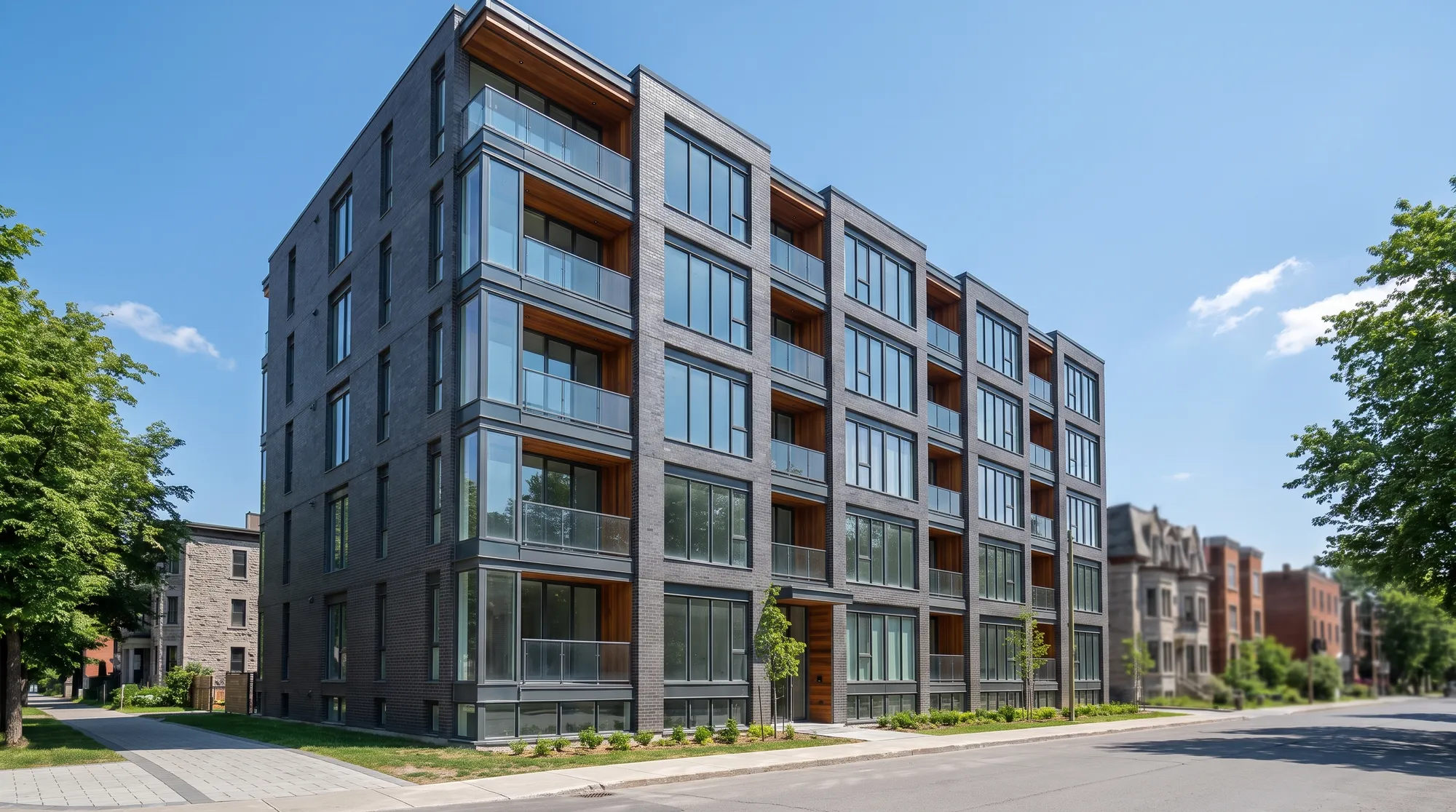
In a Quebec condo, the window you look through every day is probably not entirely yours. Divided co-ownership law decides who owns it, who approves its replacement and who pays the bill, and the answers surprise most owners. Here is how the rules actually work, and how to get new windows without a fight with your syndicate.
How Divided Co-Ownership Works in Quebec
Most Quebec condos are divided co-ownerships governed by the Civil Code of Québec and by each building's own declaration of co-ownership, the notarized contract every buyer accepts at purchase. The building is split into private portions, your unit, and common portions, everything shared: structure, roof, facades, hallways and, in most buildings, the windows. The syndicate of co-owners, a legal person run by an elected board of directors, is responsible for preserving the building and administering the common portions.
This structure means window decisions are rarely individual decisions. Even when a window serves only your unit, the law and the declaration usually treat it as part of the building envelope, which the syndicate must maintain and protect. Understanding that framework before you request a quote saves weeks of back-and-forth later.
The good news is that the rules exist to protect your investment too: they guarantee the facade stays uniform, the envelope stays watertight and no neighbour installs a bargain window that leaks into your ceiling.
Windows: Common or Private Portion?
The single most important document is your declaration of co-ownership, because it defines exactly where your private portion ends. In the large majority of Quebec declarations, windows, exterior doors and balcony doors are classified as common portions for restricted use: they belong to all co-owners collectively, but only you have the use of the ones enclosing your unit. Some older or atypical declarations instead make windows fully private, so never assume, read the definitions section.
The classification drives everything downstream. If windows are common portions, the syndicate controls maintenance and replacement and the work generally must be decided and contracted at the syndicate level. If they are private portions, you have more autonomy, but the declaration and by-laws will still impose uniformity of appearance because the facade itself remains common.
When the declaration is ambiguous, and many pre-1994 declarations are, the syndicate's lawyer or a notary can issue an interpretation. Getting that clarity once, in writing, prevents every future dispute about who repairs, who replaces and who pays.
Syndicate Approval and Uniformity Rules
Whatever the classification, no Quebec co-owner can unilaterally change the exterior appearance of the building. The Civil Code requires that work respect the destination of the immovable, and declarations reinforce this with explicit harmony clauses: replacement windows must match the approved model, colour, grid pattern and sightlines. In practice, you submit your project to the board of directors with the product specifications, and the board authorizes it, often against a pre-approved technical standard the syndicate has adopted.
Expect the board to require a certified installer, proof of liability insurance, an RBQ licence number and sometimes a small deposit against damage to common areas. For work on common portions decided collectively, the co-owners' meeting votes: routine maintenance follows ordinary majority rules under article 1096, while more substantial alterations to common portions require the enhanced double majority of article 1097, owners representing three-quarters of the votes of those present. Boards that plan window projects well ahead of failure rarely need contested votes.
Skipping approval is the costliest shortcut in condo life: the syndicate can demand removal of non-conforming windows at the owner's expense, and courts routinely side with declarations on questions of uniformity. Ten days of paperwork beats ten thousand dollars of redo.
Who Pays? Read Your Declaration
Payment follows the declaration, not intuition. Since the 2020 reforms, the Civil Code's default rule is that costs for common portions for restricted use, the category covering most condo windows, are shared by the co-owners who use them, but only for maintenance and ordinary repairs; structural replacement typically remains a syndicate expense funded by all owners according to the relative value of their fractions. Your declaration can and often does modify this split, which is why two neighbouring buildings can allocate the same window bill completely differently.
Concretely, three patterns dominate Quebec declarations: everything on the syndicate, everything on the using owner, or a hybrid where owners handle caulking, hardware and glass while the syndicate funds full replacement. Before budgeting a single dollar, ask the board for the clauses covering windows and for any resolutions or by-laws adopted since the original declaration. If you are buying a condo, your notary should flag these clauses, along with any planned window project, before you sign.
One more nuance: improvements you added yourself, an upgraded acoustic window, for example, usually become your responsibility even when standard windows are the syndicate's. Keep invoices and board authorizations forever; they define the boundary.
Coordinating a Building-Wide Replacement
When windows across the building approach end of life, a coordinated project beats unit-by-unit replacement on every metric. Volume pricing on identical units typically saves 10 to 20 percent per opening, a single manufacturer means one warranty, one installer and one point of accountability, and the facade gets a uniform result impossible to achieve piecemeal over fifteen years. Scaffolding, lifts and permits are also mobilized once instead of a dozen times.
A well-run project follows a predictable sequence: an envelope assessment by a building professional, a technical specification adopted by the board, tenders from two or three manufacturers, the required vote at the co-owners' meeting, then installation phased by facade or by stack with clear notice to occupants. Owners need to plan interior access, clear window areas, and expect a few hours without windows per room, in a season chosen to be neither January nor construction-holiday July.
Manufacturers experienced with co-ownerships, including our team working with syndicates across greater Montreal, will attend board meetings, supply the technical sheets the vote requires, and sequence installation so each unit is weathertight the same day it is opened. Ask for condo references specifically; installing two hundred identical windows on occupied floors is a different trade from renovating a bungalow.
The Contingency Fund and Bill 16
Major window replacement is precisely what the contingency fund exists for. Every Quebec syndicate must maintain this fund, fed by at least five percent of common expenses, reserved for major repairs and replacement of common portions. Bill 16, adopted in 2019 and phased in since, tightens the regime: syndicates must obtain a contingency fund study every five years establishing the amounts truly needed, and maintain a maintenance logbook documenting the building's components and their condition, windows included.
For owners, the practical consequence is visibility: a building that has done its study knows roughly when its windows reach end of life and what the project will cost, and its fund contributions reflect that. Where the fund falls short, the syndicate votes a special assessment, a one-time contribution divided according to the relative value of each fraction, which can reach thousands of dollars per unit for a full window project. Buyers should always review the fund balance, the study and the logbook before purchasing; a healthy fund is worth more than granite counters.
Boards, for their part, should not wait for failures: sealed-unit fogging, sash hardware breakage and water infiltration complaints tend to cluster in the same years across a building, and reactive one-off replacements are the most expensive way to buy windows.
Your Checklist Before Signing a Contract
Whether the project is yours alone or building-wide, the same due diligence applies. Confirm in writing what the declaration says about windows, obtain the board's authorization with the approved specifications attached, and verify the contractor's RBQ licence, liability insurance and CNESST compliance. On the product side, match or exceed the syndicate's technical standard: in most Quebec condos that means ENERGY STAR certified windows with the approved exterior colour and profile.
Keep every document, quote, authorization, contract, warranty, in your unit file; in co-ownership, paper is protection. If you are starting the conversation with your board, our window lineup includes the technical documentation, NAFS performance ratings and condo project references syndicates ask for, and we can prepare uniform specifications for buildings from six to two hundred units.
- Written confirmation of the window clauses in your declaration
- Board authorization with approved model, colour and specifications
- RBQ licence, insurance and CNESST compliance for the installer
- ENERGY STAR certification matching the syndicate standard
- Warranty documents filed with both the owner and the syndicate
- Photos of the openings before and after installation
Frequently Asked Questions
Can I replace my condo windows without the syndicate's permission?
Almost never. In most Quebec declarations windows are common portions for restricted use, and even where they are private, uniformity clauses require board approval of the model and colour. Unauthorized windows can legally be ordered removed at your expense.
Who pays for window replacement in a Quebec condo?
Your declaration of co-ownership decides. A frequent arrangement puts maintenance on the owner who uses the windows and full replacement on the syndicate through the contingency fund, but declarations vary widely. Ask the board for the exact clauses before budgeting anything.
Can the syndicate force me to replace my windows?
Yes, if the windows are common portions or if their condition threatens the building envelope, the syndicate can carry out or require the work as part of its duty to preserve the immovable. Owners are consulted through the meeting and votes, but a duly adopted decision binds everyone. Refusing access for necessary work can expose an owner to legal action.
Do all units have to get the same windows?
Exterior uniformity is the rule: same model, colour and sightlines, as defined by the declaration or a board-adopted standard. Interior finish options, such as a white versus wood-look interior, are often left to each owner. Any deviation visible from outside needs explicit authorization.
What is a special assessment and when is one needed for windows?
A special assessment is a one-time contribution voted when the contingency fund cannot cover a major project. It is divided among owners according to the relative value of their fractions. Buildings that follow Bill 16 with a current fund study rarely need large surprise assessments, because contributions were adjusted years in advance.
I found condensation and rot around my condo window. Who do I call?
Notify the board in writing immediately, since infiltration through a common portion is the syndicate's responsibility and delays can shift liability. Document with photos and dates. The syndicate should have the envelope inspected; if replacement is needed, the process above determines approval and payment.