A $15,000 set of premium windows installed badly performs worse than a $9,000 set installed well — and the failure shows up as drafts, water stains and voided warranties two winters after the truck leaves. The good news: ten direct questions, asked before you sign, filter out almost every bad contractor in Quebec. Here they are, with the answers you should expect and the ones that should end the conversation.
Why the Installer Matters as Much as the Window
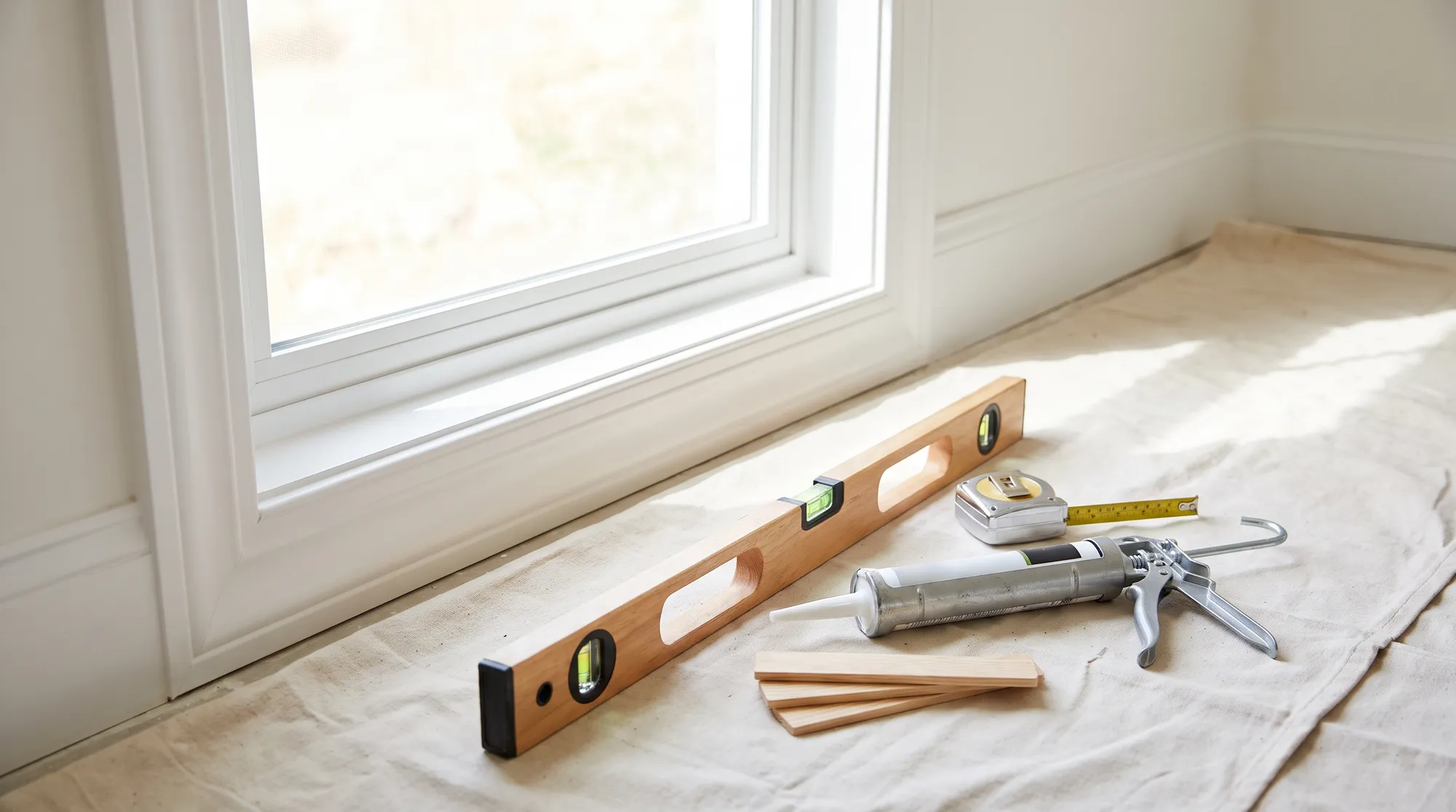
A modern window is a sealed, engineered unit, but it depends entirely on its connection to the wall: shimming that keeps the frame square, low-expansion foam that insulates the gap, flashing and caulking that manage water, and interior sealing that stops humid indoor air from reaching cold surfaces. Every one of those steps is invisible once the trim goes on. Industry studies consistently attribute the majority of premature window failures — drafts, water infiltration, fogging, hard operation — to installation defects rather than product defects.
Quebec raises the stakes further. Our freeze-thaw cycles turn any water trapped in a wall assembly into an expanding wedge, and a 70°C annual temperature swing works every joint relentlessly. An installer who does not understand drainage planes and vapour management can create rot inside your wall that stays hidden for years.
That is why the questions below focus on verifiable facts — licences, insurance, documents — rather than impressions. A confident handshake is not a credential. For the technical details of what a proper installation involves, see our windows installation guide.
The 10 Questions at a Glance
Print this list and ask every question of every bidder. Legitimate professionals answer all ten easily — they are asked constantly and have the paperwork ready. Hesitation, vagueness or irritation on any of them tells you more than the answer itself.
- 1. What is your RBQ licence number, and is it in good standing?
- 2. Do you carry liability insurance, and can I see the certificate?
- 3. Who actually does the work — your employees or subcontractors?
- 4. Are your installers certified by the window manufacturer?
- 5. How many installations like mine have you done, and can I see recent local projects?
- 6. Can you provide references from the last twelve months?
- 7. What warranty covers the labour, separate from the product warranty, and is it in writing?
- 8. What exactly does the written quote include — removal, disposal, interior finishing, caulking?
- 9. What is the payment schedule, and how large is the deposit?
- 10. What is the realistic timeline, and what happens if weather delays the work?
Questions 1-3: Licence, Insurance and Who Holds the Hammer
In Quebec, window installation is regulated work: the contractor must hold a licence from the Régie du bâtiment du Québec (RBQ) with the appropriate subcategory. Do not just accept a number on a business card — enter it in the RBQ's online Registre des détenteurs de licence, which takes thirty seconds and shows whether the licence is active, restricted or has a history of complaints. Hiring an unlicensed installer is not a bargain; it can void your home insurance coverage for any resulting damage and leaves you without recourse to the RBQ's financial guarantees.
Insurance is the second non-negotiable. Ask for proof of commercial general liability coverage (typically $2 million) and confirm the workers on your property are covered by the CNESST for workplace injuries. If an uninsured worker falls from a ladder at your house, or a dropped window damages your neighbour's car, you may be the one paying.
The third question exposes a common surprise: the company you sign with may not be the crew that shows up. Subcontracting is not inherently bad, but you need to know whether the subcontractors hold their own licences and insurance, and who is contractually responsible when something goes wrong. Get the answer in writing in the contract.
Questions 4-6: Manufacturer Certification, Experience and Proof
Major window manufacturers run certification programs that train installers on their specific products — frame tolerances, fastening schedules, approved sealants — and many product warranties are only fully valid when a certified installer does the work. Ask directly: are you certified by the manufacturer of the windows you are quoting me? A factory-trained crew also means installation problems cannot dissolve into finger-pointing between the maker and the installer, because they answer to the same standard. This is the core argument for manufacturer-direct installation, where the company that built your windows also stands behind their fit.
Experience should be specific to your project type. Two hundred new-construction installs do not prepare a crew for replacement work in a 1950s Montreal duplex with plaster walls, out-of-square masonry openings and hidden knob-and-tube wiring. Ask how many projects like yours — same era of house, same installation method — they completed in the last year.
Then verify. Ask for three references from the past twelve months, and actually call one: ask whether the site was left clean, whether the schedule held, and whether the contractor returned for adjustments after the first winter. That last question is the revealing one — anyone can install in July; service in February is what separates professionals.
Question 7: Labour Warranty vs Product Warranty
Homeowners hear "lifetime warranty" and relax; that is usually a mistake. The product warranty from the manufacturer covers the window itself — seal failure, hardware defects, vinyl discolouration. It does not cover the installation, and most product warranties explicitly exclude damage caused by improper installation. If a badly foamed jamb lets air whistle through, the manufacturer will point at the installer.
So ask precisely: what warranty covers the labour, for how long, and in writing? In Quebec, the Civil Code already gives you baseline protections — one year on workmanship and five years against serious defects — but a serious installer offers a written labour warranty of five to ten years on top, because their work will not need it. A verbal "we always take care of our customers" is worth exactly what it costs to say.
Also ask what the warranty process looks like in practice: who do you call, how fast do they come, and does a service visit cost anything during the warranty period? A warranty you cannot execute is decoration.
- Product warranty: from the manufacturer — glass seal, hardware, frame; often 10-25 years or lifetime, but excludes installation faults.
- Labour warranty: from the installer — air and water sealing, squareness, operation; demand 5-10 years in writing.
- Legal baseline (Quebec Civil Code): 1 year on workmanship, 5 years against major defects — applies even if nothing is signed.
- Best case: manufacturer and installer are the same company, so one signature covers everything with no finger-pointing.
Questions 8-10: The Quote, the Money and the Calendar
A professional quote is itemized: model numbers and certified performance ratings of each window, installation method (full-frame or insert), removal and disposal of old units, exterior caulking, interior finishing, and taxes. Vague one-line quotes — "12 windows installed: $13,500" — are where surprise extras breed. If interior trim or disposal is not written down, assume it is not included and ask.
Payment schedule is a risk-sharing negotiation. A reasonable structure in Quebec is a deposit of 10-25% at signing (custom-manufactured windows justify the higher end since they are made for your openings), possibly a progress payment on delivery of materials, and the balance on satisfactory completion. Never pay a majority of the contract before work begins, and never pay cash for a discount — no invoice means no warranty, no recourse and likely no licence.
Finally, get a realistic timeline in writing: manufacturing lead time (typically four to eight weeks for custom windows), installation window, and the number of days on site. Ask what happens when a -20°C snap or freezing rain hits during the job — a good answer involves installing one opening at a time so the house is never left exposed, and rescheduling criteria you both agree on.
Red Flags That Should End the Conversation
Some warning signs deserve an immediate, polite exit regardless of price. A demand for a large cash deposit — 50% or more, especially in cash — is the classic setup for a contractor who disappears or endlessly postpones. The refusal to produce a written quote, a licence number or an insurance certificate has no innocent explanation in a regulated industry.
Watch also for door-to-door pressure tactics: the "crew already in your neighbourhood," the "price valid today only," the quote given in fifteen minutes without measuring every opening. Custom windows require precise measurement of each opening; anyone quoting without a tape measure is guessing with your money. And a price dramatically below every other bid is not luck — it is missing scope, missing insurance or missing intent to finish.
None of these flags is about being cynical. Quebec's renovation industry includes excellent professionals who welcome scrutiny precisely because it eliminates the competitors who cannot survive it. The ten questions cost you thirty minutes; a bad installation costs thousands and years of frustration. Ask them all, every time.
- Demands a deposit over 30%, or any large amount in cash without an invoice.
- No RBQ licence number, or a licence that does not check out in the registry.
- No written, itemized quote — or a quote produced without measuring your openings.
- "Today only" pricing pressure or unsolicited door-to-door urgency.
- Vague or verbal-only answers about labour warranty and insurance.
- A price far below every competitor with no explanation of scope.
Frequently Asked Questions
How do I verify an RBQ licence?
Ask for the contractor's licence number and enter it in the free online Registre des détenteurs de licence on the RBQ website. It shows in seconds whether the licence is active, which subcategories it covers, and whether restrictions apply. No legitimate contractor hesitates to provide the number.
What deposit is normal for a window installation in Quebec?
Between 10% and 25% at signing is typical, with the higher end justified for custom-manufactured windows built to your openings' measurements. Be very wary of anyone demanding 50% or more up front, or offering a discount for cash — that discount usually costs you your invoice, your warranty and your recourse.
Does a manufacturer warranty cover bad installation?
No — product warranties cover the window itself and almost always exclude damage from improper installation. That is why you need a separate written labour warranty from the installer (ask for 5-10 years), or better, a manufacturer-direct installation where one company stands behind both the product and the workmanship.
Is it better if the manufacturer installs the windows?
Generally yes: factory-employed or factory-certified crews know the product's exact tolerances, the full warranty remains intact, and there is no finger-pointing between maker and installer when something needs adjusting. One contract, one responsible party, one phone number.
What legal protection do I have if the installation is defective?
The Quebec Civil Code provides a one-year warranty on workmanship and five years against serious defects, even without a written contract. But enforcement through courts is slow, so prevention — RBQ verification, written itemized quote, written labour warranty, staged payments — is worth far more than remedies. Our installation guide details what a correct installation looks like.
How long does a window replacement project take?
Plan four to eight weeks of manufacturing lead time for custom windows, then one to three days on site for a typical house of 10-15 openings. Good crews complete one opening at a time — remove, install, seal — so your home is never left open to the weather, even in winter installations.