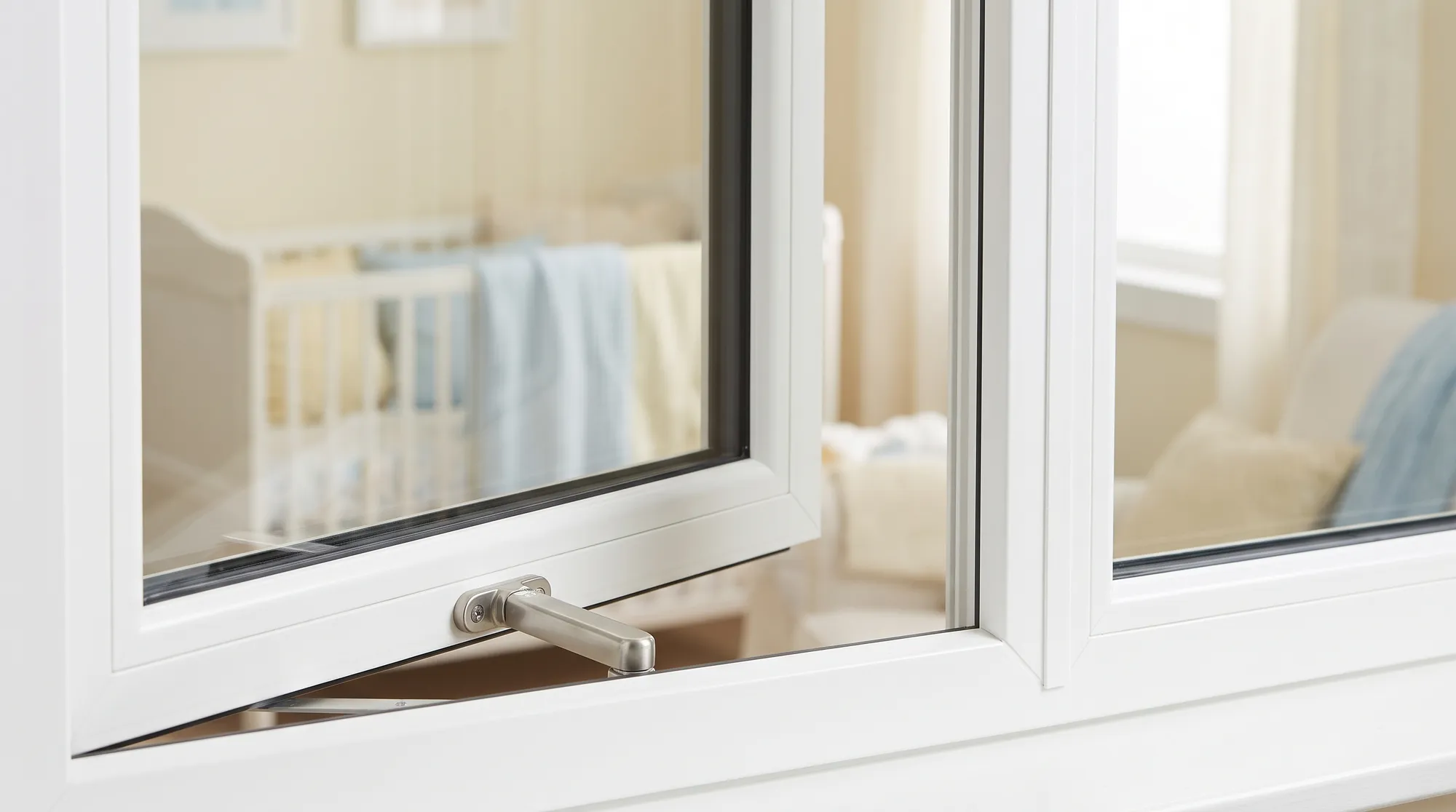
Every year, Canadian hospitals treat hundreds of children injured in falls from windows and balconies, most of them under five, and most of the falls happen at home during warm months when windows stand open. Nearly all of these incidents are preventable with hardware that costs less than a pizza and habits that cost nothing. Here is a practical, room-by-room approach to window and door safety for Quebec families.
Understanding the Risk: When and Where Falls Happen
The pattern in Canadian injury data is remarkably consistent: children aged one to four are at highest risk, falls cluster between May and September when windows are open, and second-storey bedroom and living-room windows are the most common launch points. Toddlers are top-heavy — their heads account for a far larger share of body weight than an adult's — so once a child leans past a sill, gravity finishes the sequence in under a second. Parachute Canada and the CHU Sainte-Justine trauma team in Montreal both flag window falls as one of the most preventable categories of serious childhood injury.
The dangerous height threshold is lower than most parents assume. A fall from a second-storey window — roughly 4 to 5 metres — routinely produces head injuries and fractures, and even ground-floor windows over basement stairwells or paved side passages, common in Montreal duplexes, can deliver a serious drop. Any operable window with a sill below about 90 cm from the floor, on any storey above grade, deserves hardware.
The good news is that this is a solved problem. Between opening limiters, guards and layout habits, a family can make every window in the house safe in a single Saturday for under 200 $. None of it requires renovation, and almost none of it is visible.
Opening Limiters: The 10 cm Rule
The core principle, used in building codes and pediatric guidance across North America, is that an opening a sphere of 10 cm cannot pass through is an opening a small child cannot fall through. Opening restrictors — also called vent limiters or window opening control devices (WOCDs) — enforce that limit mechanically: the window opens freely to about 10 cm for ventilation and stops. Devices meeting the ASTM F2090 standard release with a deliberate two-action motion so an adult can still open the window fully for cleaning or emergency escape, then reset automatically when the window closes.
The right device depends on your window style. Casement and awning windows accept folding or cable-style restrictors on the hinge side, and many modern crank operators have a factory limiter that your installer can activate. Hung and sliding windows take track-mounted vent locks or pin stops that block the sash at the chosen gap; the classic Charley bar on a patio slider does the same job horizontally. Expect 10 $ to 30 $ per window at any Quebec hardware store, and five to ten minutes of installation with a screwdriver.
Two placement rules make the hardware trustworthy. First, install the restrictor so the limited opening is at the bottom of hung windows — a child cannot reach an opening at the top, so top-down ventilation on a double-hung window is inherently safer. Second, check the limiter engages by pulling hard on the sash yourself: hardware that pops out under adult force will not survive a determined six-year-old.
- Casement/awning: hinge-side folding restrictor or factory crank limiter
- Single/double hung: track vent lock or pin stop; ventilate from the top sash when possible
- Sliders and patio doors: track stop or security bar set to a 10 cm gap
- All types: choose ASTM F2090-compliant devices that adults can release for escape
Window Guards: For Openings That Must Open Wide
Sometimes you genuinely need a window fully open — a bedroom without air conditioning during a July heat wave, for instance. For those openings, a window guard is the answer: a grille of horizontal bars, spaced 10 cm or less apart, mounted across the lower portion of the opening and anchored into the frame or studs with screws. Quality guards withstand over 65 kg of force, far beyond what any child can apply, and adjustable models fit standard openings for 40 $ to 90 $ each.
The non-negotiable feature is an emergency release. In a bedroom, at least one window must remain usable as a fire escape, so choose guards with a quick-release mechanism that an adult can operate without tools, and teach every caregiver in the house how it works. Fixed, screwed-shut guards belong only on windows that are not part of an escape route, and painting a guard into immobility is the same mistake as nailing a window shut.
Do not confuse safety guards with decorative security bars. Guards for child safety are engineered with correct spacing, tested anchoring and a release; improvised solutions — a baby gate wedged in the frame, a plank of wood, furniture pushed against the sash — fail exactly when they are needed. If your building has specific rules (many Quebec condo declarations restrict exterior modifications), interior-mounted guards keep you compliant.
Screens Are Not Fall Protection — Not Even Close
This is the single most dangerous misconception in window safety. An insect screen is fibreglass thread held in a groove by a rubber spline, engineered to stop mosquitoes; it will let go under the weight of a house cat, never mind a 12 kg toddler leaning on it. In fall-injury case series, a large share of incidents involve a child who pushed against a screen that looked, to the child and sometimes to the parents, like a solid barrier.
The screen's presence actually adds risk in one subtle way: it makes an open window look closed. A child sees a surface, not a void, and treats the windowsill like any other perch. Teach children explicitly that screens are 'like paper' and never to touch or lean on them, and enforce the same rule you would for an unscreened opening.
Even so-called pet screens and heavy-duty meshes, which resist claws, are not rated to arrest a falling child, and no screen manufacturer claims otherwise. The only devices that count as fall protection are limiters that keep the gap under 10 cm and guards anchored to the structure. Everything else is insect control.
Furniture Placement and Family Habits
Hardware handles the window; layout handles the child. Keep beds, cribs, sofas, toy chests, desks and any climbable furniture at least a metre away from operable windows — a bed pushed under a window is effectively a staircase to the sill. In small Montreal bedrooms where the bed must sit near the window, that window is the one that gets a guard or stays limited to 10 cm at all times.
Habits cost nothing and catch the cases hardware misses. Open windows from the top when the style allows it. Close and lock windows in kids' rooms before naps and bedtime. Never leave a toddler unattended in a room with a window open beyond the limiter, including 'just for a minute' — the injury data is full of one-minute absences. And lock the crank handles or remove them entirely on casements in young children's rooms; a removed handle on a high shelf is a perfectly good restrictor.
Supervision rules deserve one honest caveat: adults cannot watch a mobile toddler continuously, which is precisely why the passive protections — limiters and guards — come first. Habits are the second layer, not the substitute. When grandparents or a new babysitter take over, walk them through which windows open, which are limited, and where the guard releases are.
Casement vs Hung: Does Window Style Matter for Safety?
Yes, meaningfully. A double-hung window lets you ventilate through the top sash only, keeping the reachable bottom sash closed and locked — the safest passive configuration for a child's room, and a genuine argument for hung or tilt-and-turn styles when replacing bedroom windows. Sliders share this logic horizontally but their reachable opening is at child height by default, so they lean harder on vent locks.
Casement windows cut both ways. Their crank mechanism is slow and hard for small hands to operate, and removing or locking the fold-down handle disables the window completely — excellent passive safety. But a casement that is open swings the entire sash clear of the frame, leaving a full-height, full-width opening with no intermediate sash to interrupt a fall, so an unrestricted open casement is the least safe open window in the house. The factory-set opening limiter, standard or optional on most quality casements, resolves this completely.
If you are choosing replacement windows for a family home, raise child safety in the specification conversation: sill heights (the Quebec Construction Code requires guarding considerations when operable windows sit low above a drop), factory-installed limiters, and hardware options by room. Browse the window lineup with an eye to which styles will be in children's rooms — the safest window is the one whose safety features are built in rather than added after.
Balcony and Patio Doors: The Other Opening
Montreal's housing stock — duplexes and triplexes with rear balconies, condo towers with terraces — puts a lot of children behind sliding doors, and those doors deserve the same rigour as windows. A patio slider's standard latch is at adult height, but many toddlers learn to open an unlocked slider by age three by leaning into it. Add a foot-operated auxiliary lock or a track security bar, and use the two-position feature many quality doors offer: locked fully closed, or locked at a 10 cm ventilation gap.
The balcony beyond the door has its own rules: Quebec's Construction Code requires guards at least 1,07 m high where the drop exceeds 1,8 m, with openings that stop a 10 cm sphere and no climbable horizontal elements. Keep planters, patio chairs and barbecues away from the railing — a chair against a code-compliant guard converts it into a ladder. A door alarm chime, standard on many home security systems, tells you the instant a door to a balcony opens.
Glass matters here too: patio doors are tempered by standard, but verify that any older sidelights or low glazing near doors are safety glass, and apply a few decals at child eye level so running children register the closed pane. A well-specified patio door — solid auxiliary lock, ventilation stop, tempered glass, smooth low threshold that does not trip small feet — is safety equipment as much as it is architecture.
Frequently Asked Questions
What is the 10 cm rule for window openings?
An opening that a 10 cm sphere cannot pass through is one a small child cannot fall through — the threshold used in building codes and pediatric guidance. Opening restrictors enforce it mechanically while still allowing ventilation, and ASTM F2090 devices release with a deliberate adult motion for emergency escape.
Will a window screen stop my child from falling?
No — never. Insect screen is designed to stop mosquitoes and detaches under a few kilograms of pressure, far less than a leaning toddler applies. Worse, a screen makes an open window look closed. Only limiters keeping the gap under 10 cm and anchored window guards count as fall protection.
Do window guards trap my family in a fire?
Properly chosen guards do not: models with quick-release mechanisms open without tools so bedroom windows remain usable escapes. At least one window per bedroom must keep a working release, every caregiver should practise it, and fixed screwed-in guards belong only on windows outside escape routes.
Which window style is safest for a child's bedroom?
Double-hung windows ventilated through the top sash keep the reachable opening closed, and casements with locked or removed crank handles are effectively childproof when shut. An open, unrestricted casement is the least safe configuration, so factory opening limiters matter most on that style.
How much does it cost to childproof the windows of a house?
Very little relative to the risk: vent limiters run 10 $ to 30 $ per window, quality guards 40 $ to 90 $ per opening, and patio-door auxiliary locks under 40 $. A typical house is fully protected for under 200 $ and one Saturday of screwdriver work.
At what age can I relax window safety measures?
Fall risk peaks between ages one and four but remains significant to about age nine, and hardware should stay until children reliably follow window rules. Since limiters and guards are invisible in daily life and release for adults, most families simply leave them in place permanently.