A casement window is only as good as the little gearbox that opens it. When the crank turns hard, spins uselessly, or the sash refuses to close that last centimetre before a January cold snap, the culprit is almost always one of four components — and three of them cost under $80 CAD to fix. Here is how to diagnose a misbehaving crank, what you can repair yourself, and how to tell a $30 hardware fix from a problem with the sash itself.
How a Casement Operator Actually Works
The crank handle you turn drives a small gearbox — the operator — screwed to the bottom of the window frame under a snap-on cover. Inside, a worm gear converts the handle's rotation into the sweep of one or two operator arms, whose free ends slide in a track riveted to the underside of the sash. As the arms swing, they push the sash out on its hinges — usually concealed scissor-style hinges at top and bottom that also guide the sash slightly sideways as it opens, which is what lets you reach the exterior glass for cleaning.
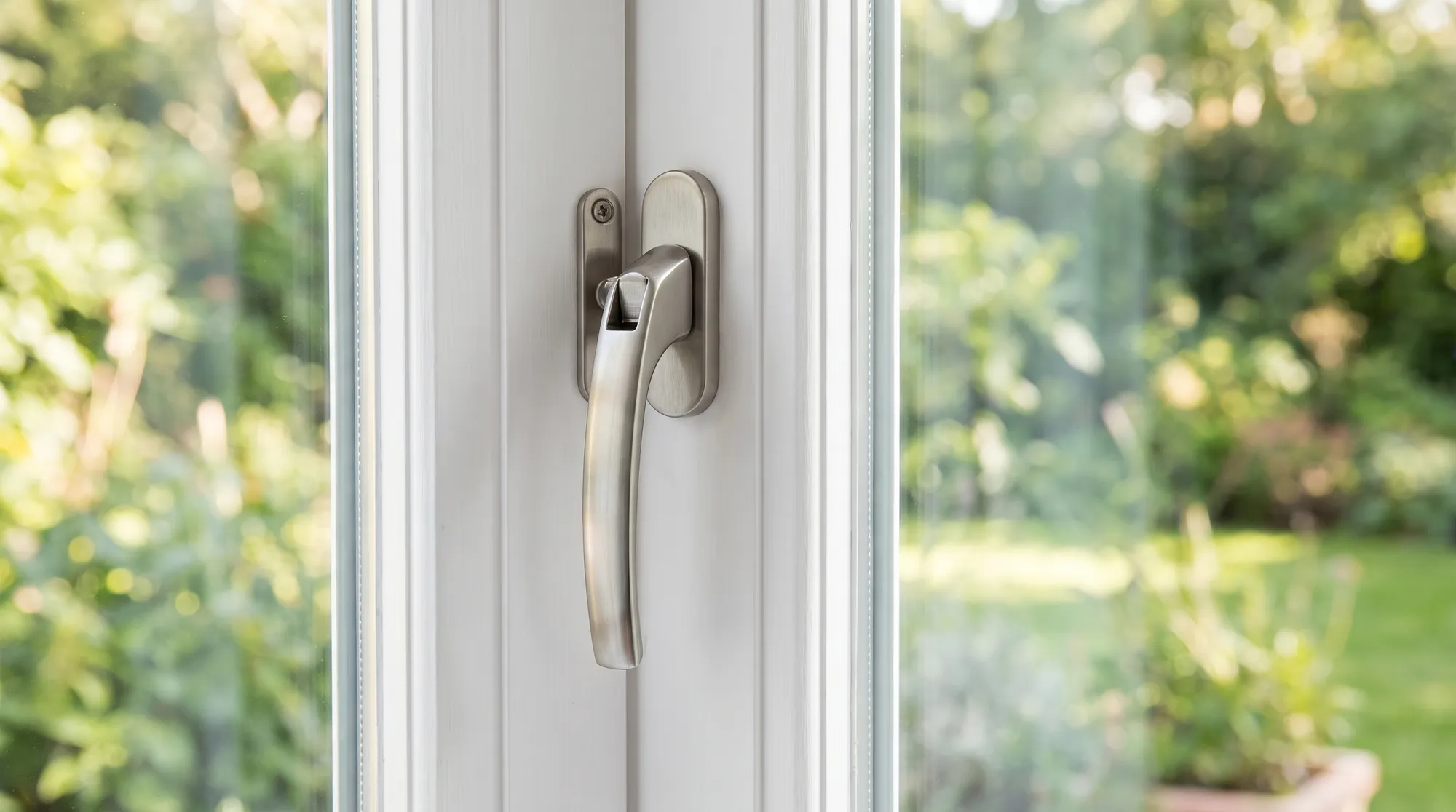
Every symptom traces to one link in that chain: the handle on its splined shaft, the gears in the operator body, the arms and their track, or the hinges carrying the sash weight. The locking system — the handle or lever that pulls the sash tight against the weatherstrip — is a separate mechanism with its own failure modes, so distinguish an opening problem from a locking problem before ordering anything.
One habit prevents half of all operator failures: never crank against a locked window. Turning the handle while the lock is engaged pits stripped gears against a multi-point lock, and the gears always lose. It sounds obvious; it is also the single most common cause of a stripped operator in the first five years of a window's life.
Stiff, Grinding Crank: Diagnose Before You Force
A crank that turns hard is telling you where the friction lives. If resistance is constant through the whole swing, suspect the operator's internal gears running dry or contaminated with hardened grease and grit. If the handle turns freely at first and stiffens as the window opens wider, the problem is usually in the arm track or hinges — dirt packed into the sash track, or hinge pivots that have never seen lubricant fighting the increasing leverage of the wide-open sash. And if stiffness arrived suddenly with cold weather, ice at the weatherstrip or in the track is the likely offender; forcing it tears weatherstripping and bends arms.
Work through the gentle fixes in order:
- Open the window partway, vacuum the sill track and the sash's arm track, and scrub packed grime out of the track channel with a nylon brush.
- Spray silicone lubricant (never oil-based products that gum up and trap dust) into the arm track, on the arm's slider shoe, and on hinge pivots at top and bottom; work the window through several full cycles.
- Pop the operator cover, and if the gears are visible, apply a small amount of white lithium grease to the worm gear; cycle again.
- If a frozen sash is the issue, warm it from inside and free it gently — never crank through ice.
- If resistance persists after cleaning and lubrication, stop forcing: measure and order parts, because continued force converts a $30 problem into an $80 one.
Handle Spins Freely: Stripped Splines or Stripped Gears
A crank that spins without moving the sash means teeth have given up somewhere, and there are exactly two candidates. First, pull the handle off (a set screw or clip holds it) and inspect its socket: if the splines inside the handle are rounded out but the operator's shaft splines look crisp, you are in luck — a universal replacement handle costs $10 to $25 CAD and installs in one minute. This is the most common failure on windows from the 1990s and 2000s with pot-metal handles.
If the shaft itself is rounded, or the handle grips fine but the arms still do not move, the worm gear inside the operator has stripped — usually the legacy of years of cranking against the lock or muscling a frozen sash. The operator must be replaced as a unit; the gears are not sold separately. There is no safe workaround: a partially stripped operator will slip under wind load, and a casement that cannot be cranked fully shut cannot compress its weatherstripping, which you will feel all winter.
Before ordering, note that a spinning handle with intact splines and intact gears occasionally signals a sheared roll pin connecting shaft to gear on certain older operators — a repair a window technician can assess quickly. When in doubt, remove the operator (four to six screws) and bring it to the counter; matching the casting is faster than describing it.
Worn Operator Arms, Shoes and Tracks
Even with healthy gears, the arm system wears at three points: the plastic or brass shoe that slides in the sash track, the rivets at the arm's elbow joints, and the track itself. Symptoms are distinctive — the sash chatters or jerks as it moves, closes crooked with one corner landing before the other, or rattles in gusts because the worn joints let it float. Look for metal filings or grey smear in the track (aluminum wear), an elbow rivet with visible play, or a shoe worn to half its original width.
Shoes and clips are cheap and often replaceable on their own; elongated rivet holes or a bent arm mean replacing the arm assembly, which usually comes as part of the operator unit anyway. Bent arms deserve a special note for Quebec homes: they are the classic aftermath of a wind gust catching a wide-open sash — our autumn storms routinely gust past 70 km/h — or of someone pushing the sash by hand to "help" a stiff crank. If a gust has grabbed the window, inspect the arms before winter; a slightly bent arm still works in October and jams in February when tolerances tighten in the cold.
When replacing, take the old operator with you or photograph its casting marks. Operators vary by hand (left or right), arm length, sash travel and mounting hole pattern; the major hardware families (Truth, Roto, Maxim and interchange equivalents) cover most Canadian-made windows, and a matching unit typically runs $40 to $80 CAD.
The Ten-Minute Fall Lubrication Routine
Casement hardware in Quebec lives a hard life: humidity swings, road salt aerosols near busy streets, and a 60-degree annual temperature range from +30°C to -30°C that thickens greases and shrinks tolerances. An annual ten-minute routine each fall — before the hardware has to perform at -20°C — reliably doubles operator life and keeps handles turning with two fingers instead of two hands.
The routine per window: vacuum the tracks; wipe weatherstripping clean and treat it with a silicone-based conditioner so the sash does not freeze to it; spray dry silicone into the arm track and slider; grease the operator's worm gear lightly through the cover; put a drop on each hinge pivot and on the lock's cams and keepers; then cycle the window fully five times and close it locked. Use silicone or dry PTFE products and white lithium on gears — never cooking sprays or general-purpose oils, which oxidize into exactly the gum you were removing.
Fall is also the inspection moment. With the sash wide open you can see arm wear, hinge play and weatherstrip damage in thirty seconds per window — and October is when you want to discover a failing operator, because parts arrive and install easily before the deep cold, not during it.
Replacing Operators and Handles: A Realistic DIY Job
Swapping an operator is among the most DIY-friendly window repairs. The sequence: open the sash about halfway, disconnect the arm shoes from the sash track (most unclip or slide out through a notch in the track), unscrew the operator cover and the four to six frame screws, and lift the unit out. Reverse with the new unit, reconnect the shoes, and test the full swing before reinstalling the cover. Budget 20 to 40 minutes for the first window and half that for each subsequent one.
Two cautions. First, support the sash while the arms are disconnected — on a windy day a freed sash swings on its hinges like a door, and this is how glass meets brick. Pick a calm day or have a helper steady it. Second, match the operator's hand and arm geometry exactly; a mirror-image unit will bolt on and then bind at half-travel. If your window is a discontinued model and no interchange matches, a window hardware specialist can usually cross-reference it — full-service window companies keep interchange charts going back decades.
While you are at it, consider upgrading folding handles: they tuck flat against the frame, stop clanking against blinds, and clear roller shades — a $15 quality-of-life improvement per window that also removes the temptation to leave handles half-engaged.
When It Is Not the Crank: Sash, Hinge and Seal Problems
Some symptoms masquerade as crank trouble but live elsewhere. A sash that drags on the frame at one corner, visible daylight at one edge of closed weatherstripping, or a lock that needs force to engage all point to sash alignment — usually worn hinges letting the sash sag, occasionally frame movement in the wall. New operators will not fix geometry; hinge replacement or a hinge adjustment (many scissor hinges have an adjustable channel screw) is the actual cure, and it is still a hardware-level repair, not a window replacement.
Escalate your thinking when hardware repairs stop sticking. If you are replacing the same operator every few years, if the sash has twisted so it cannot compress the weatherstrip evenly, if the frame is racked out of square, or if the sealed unit has fogged — the window itself is at end of life, and money spent on hardware is chasing a moving target. A 25-to-30-year-old casement with multiple failing systems is a candidate for replacement, not repair, and modern casement windows pair multi-point locks and stainless hardware with triple glazing that meets ENERGY STAR thresholds for Canada's coldest zone.
The honest decision rule: one failed component on an otherwise tight window — repair, always. Multiple failed components on a window that also leaks air or shows fogged glass — get a replacement quote before sinking another $150 in parts. And if replacement is the answer for several windows, remember that ENERGY STAR models installed by an RBQ-licensed contractor may qualify for Rénoclimat rebates of roughly $150 per opening under the program's evaluation conditions.
Frequently Asked Questions
Why does my casement crank click but the window will not open?
Clicking under load usually means the worm gear is stripped in one section of its travel — the teeth engage, slip, and re-engage. The operator needs replacement as a unit ($40 to $80 CAD plus 30 minutes of work). Before condemning it, confirm the window is fully unlocked: cranking against an engaged multi-point lock produces the same click and is what strips gears in the first place.
What lubricant should I use on window cranks?
Dry silicone or PTFE spray for tracks, slider shoes and hinge pivots; a light application of white lithium grease on the operator's worm gear; silicone conditioner on weatherstripping. Avoid WD-40 as a lubricant and any cooking or general-purpose oil — they attract dust and oxidize into gum that makes cranks stiffer within a season.
Can I buy just a new crank handle?
Yes — if the handle's internal splines are stripped but the operator shaft is intact, a universal or brand-matched handle costs $10 to $25 CAD and installs in a minute via a set screw or clip. Folding models are worth the small premium: they clear blinds and shades and are less likely to be bumped and damaged.
My window is stiff only in winter. Is that normal?
Some added resistance in deep cold is normal — greases thicken and tolerances shrink — but a window that needs two hands at -20°C is overdue for its fall cleaning and lubrication. If stiffness appears suddenly during a cold snap, suspect ice bonding the sash to the weatherstrip: warm and free it gently, never crank through it, and treat the weatherstrip with silicone conditioner to prevent recurrence.
How long should a casement operator last?
Quality operators on Canadian-made windows routinely last 15 to 25 years with annual lubrication — often the life of the window. Neglected or abused hardware (cranking against the lock, wind-slammed sashes, never lubricated) can fail inside 5 to 10 years. The hardware is replaceable, so a failed operator on a sound window is a repair, not a replacement trigger.
When is it time to replace the window instead of the hardware?
When failures multiply: repeated operator replacements, a sagging or twisted sash that will not seal evenly, a racked frame, fogging between panes, or drafts that persist after new weatherstripping. At that point hardware money is chasing a failing window — get a replacement quote and compare it honestly against the accumulating repair bills and heating losses.