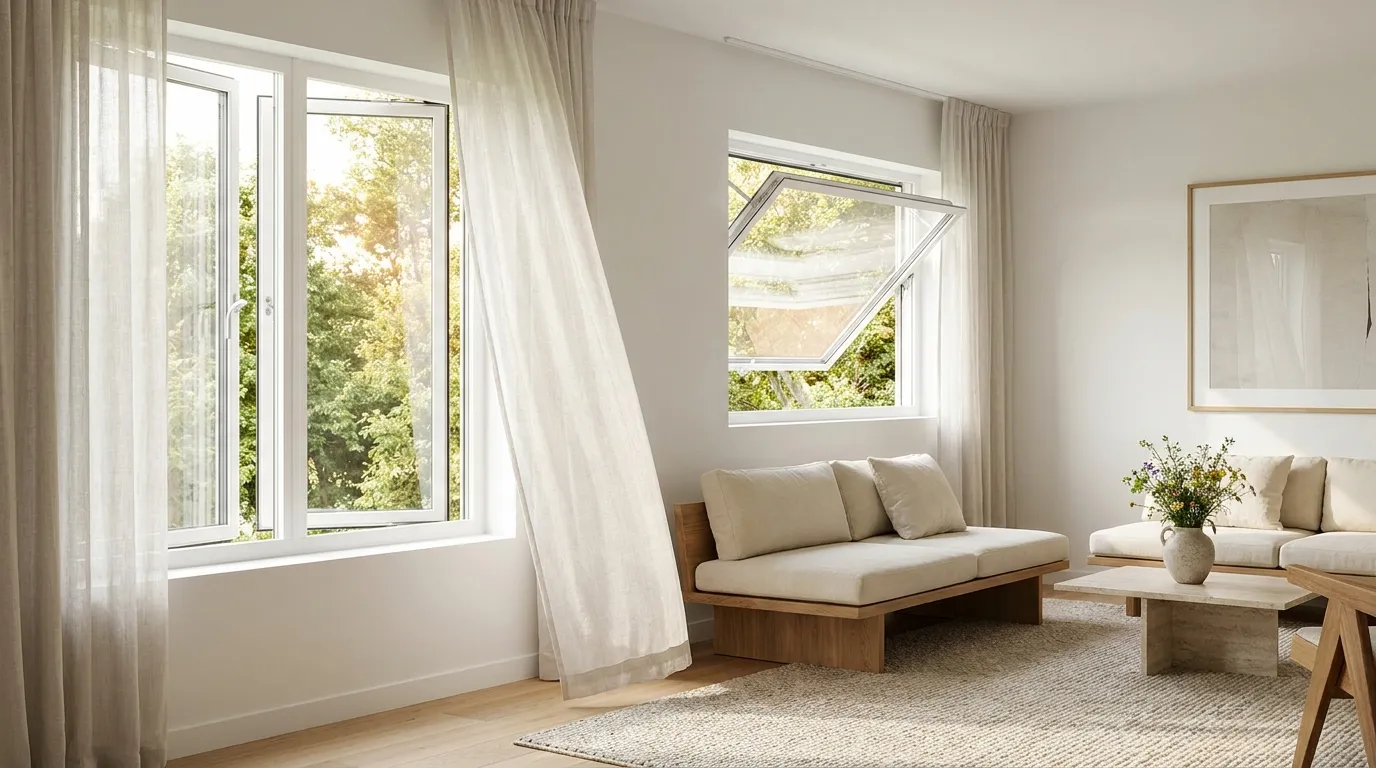
When you want fresh air without the compromises of an old slider, two window styles rise to the top: the casement and the awning. Both crank open with a solid seal that outperforms sliding windows, but they hinge in different directions and suit very different situations. This guide compares how each opens, how much air it moves, how it handles a Quebec rainstorm, and where each one belongs in your home.
How each window opens
A casement window is hinged on the side and swings outward like a door, driven by a hand crank. When you turn the crank, the entire sash pivots open, so the whole opening becomes clear air space. That full-pane operation is the defining feature of a casement and the reason it moves so much air.
An awning window is hinged at the top and swings outward from the bottom, again on a crank. Because the sash tilts out and up, it forms a small protective roof, or awning, over the opening — hence the name. Awnings are typically wider than they are tall, and are often installed higher on a wall or above and below other windows.
The crank operation both styles share is a real advantage in Quebec. It lets you open the window fully with one hand, even over a sink or behind furniture, and it pulls the sash tight against the frame when closed. That compression seal is why casements and awnings consistently outperform sliding and single-hung windows on air tightness and energy efficiency.
Ventilation: which one moves more air
For raw airflow, the casement is the champion. Because the sash swings fully clear of the opening, close to 100% of the window area becomes ventilation. Angle the open sash and it can act like a scoop, catching a breeze blowing across the wall and directing it into the room — something no sliding window can do.
An awning ventilates well too, but by design it opens only partway; the sash tilts out rather than swinging fully clear, so the effective opening is smaller than a comparable casement. What it gives up in maximum airflow it makes up in versatility, because it can stay open in conditions where you would have to close a casement.
The two styles also pair beautifully. A common Quebec strategy is a large casement or picture window flanked or topped by awnings: open the casement for a strong cross-breeze on a fine day, and rely on the awnings for gentle, weather-proof ventilation the rest of the time. Combining them gives you both maximum airflow and all-weather flexibility.
- Casement: up to ~100% of the opening ventilates; can scoop side breezes.
- Awning: partial opening, gentler airflow, but usable in rain.
- Together: casement for peak airflow, awning for continuous all-weather venting.
Rain performance: the awning’s big advantage
Here is where the awning earns its keep. Because it is hinged at the top and opens outward from the bottom, the open sash forms a sloped cover that sheds water away from the opening. You can leave an awning window cracked open during a Quebec summer rain shower and keep the fresh air flowing while the rain runs off the glass instead of into the room.
A casement cannot do this. When it swings open, the pane stands out in the weather with the opening fully exposed, so rain blows straight in. On a stormy day you generally have to close a casement, which means giving up ventilation exactly when a cool, rain-freshened breeze is most welcome.
This single difference drives a lot of placement decisions. In rooms where you want to keep air moving through unpredictable summer weather — bedrooms overnight, a basement, a home office — the awning’s ability to stay open in the rain is often worth more than the casement’s higher peak airflow.
Where casement windows fit best
Casements shine wherever you want maximum light, a clear view, and strong ventilation on demand. Over a kitchen sink is a classic spot: the crank lets you open a window you cannot easily reach, and the full opening clears cooking odours and steam quickly. Living rooms and dining rooms benefit from the unobstructed glass and the big gulp of air a casement provides.
They are also excellent for catching a prevailing breeze. If summer wind tends to come from a particular direction — often the southwest across much of the Montreal region — a casement angled into that wind scoops it indoors far more effectively than any other operable window. Pair casements on opposite walls and you create a powerful cross-ventilation path.
The main things to plan around are the outward swing and reach. A casement should not open over a busy walkway, deck traffic path, or right against a neighbouring wall, and the crank needs to be reachable. Where those conditions are met, the casement is usually the best all-around choice for a bright, well-ventilated room.
- Kitchens over the sink — easy crank reach and fast odour clearing.
- Living and dining rooms — unobstructed glass and big airflow.
- Walls facing the prevailing summer breeze — scoop air indoors.
- Avoid where the sash would swing over a walkway, deck path, or tight against a wall.
Where awning windows fit best
Awnings excel in the spots a casement struggles with. Because they are wide and short and can be placed high on a wall, they suit bathrooms and kitchens where you want ventilation and daylight without sacrificing privacy or wall space — mounted above eye level, they let air and light in while keeping the room private.
Basements are another natural fit. A short awning window set high in a basement wall provides ventilation and an egress-friendly opening while shedding rain and staying above splash and snow at grade — important through a Quebec winter. They also work well positioned above or below a large fixed picture window to add ventilation without breaking up the view.
The rain-shedding shape makes awnings the go-to wherever a window must ventilate through changeable weather or sits where an outward-swinging casement would be awkward. Their smaller opening is a fair trade for the freedom to leave them open in almost any conditions.
- Bathrooms and kitchens — mount high for privacy plus ventilation.
- Basements — ventilation and egress while shedding rain and snow.
- Above or below picture windows — add airflow without blocking the view.
- Any room that needs to vent through unpredictable Quebec summer weather.
Energy efficiency and sealing in the Quebec climate
Both styles are among the most energy-efficient operable windows you can buy, and for the same reason: the crank pulls the sash into a compression seal against the frame, squeezing the weatherstripping tight all the way around. Sliding and single-hung windows rely on brushes that slide past each other and leak more air by comparison, which matters a great deal during a -30°C Montreal cold snap.
That tight seal, combined with low-E, argon-filled double or triple glazing, is what lets casement and awning windows meet ENERGY STAR requirements for Zone D, the coldest Canadian climate zone. Quality units reach U-factors around 0.14 to 0.20 (roughly R-5 to R-7), keeping heat in during winter and cutting the freeze-thaw drafts and condensation that plague looser windows.
One practical note for our climate: the crank hardware and hinges do the sealing work, so keeping them clean and lightly lubricated matters, and outward-opening sashes should be checked so ice and snow do not interfere with operation. Well specified and maintained, both styles hold their seal for decades through Quebec winters.
Casement vs awning: side-by-side
Neither window is simply better; they solve different problems, and the right pick depends on the room, the weather you want to ventilate through, and how the sash can swing. Use the comparison below to match the style to each opening, and remember that mixing both across a home is often the smartest approach.
As an RBQ-licensed manufacturer in Saint-Laurent, we build both casement and awning windows to ENERGY STAR Zone D standards and help you choose the right style for each room. Expect installed pricing in the range of roughly $700 to $1,500 per window depending on size, frame and glazing, and remember these units can qualify for Rénoclimat support of up to $150 per rough opening and up to $5000 through Canada Greener Homes.
- Airflow: casement up to ~100% of opening; awning partial but steady.
- Rain: casement must close; awning stays open and sheds water.
- Best rooms: casement for kitchens/living rooms; awning for baths/basements.
- Sealing: both crank to a tight compression seal — excellent for Zone D.
- Placement: casement needs clear outward swing; awning suits high or tight spots.
Frequently Asked Questions
Which window gives the best ventilation, casement or awning?
The casement moves more air because the sash swings fully clear of the opening, ventilating close to 100% of the window area and even scooping side breezes indoors. An awning ventilates well but opens only partway, so it moves somewhat less air in the same size.
Can I leave an awning window open in the rain?
Yes, that is its signature advantage. Hinged at the top and opening from the bottom, an awning forms a small sloped cover that sheds rain away from the opening, so you can keep fresh air flowing during a summer shower. A casement, by contrast, must be closed in the rain.
Are casement and awning windows good for Quebec winters?
Very. The crank pulls the sash into a tight compression seal against the frame, so both styles are among the most airtight operable windows and easily meet ENERGY STAR Zone D requirements. With low-E, argon-filled glazing they reach U-factors around 0.14 to 0.20 and resist -30°C drafts.
Which is better for a bathroom or basement?
Usually the awning. Its wide, short shape mounts high for privacy in a bathroom, and in a basement it ventilates and sheds rain and snow while sitting above grade-level splash. Casements are better suited to kitchens, living rooms and walls facing the prevailing breeze.
Do casement or awning windows cost more than sliders?
Typically a little more, because the crank hardware and tighter seal add cost, with installed pricing often in the range of roughly $700 to $1,500 per window. The better air tightness lowers heating and cooling bills over time, and both styles can qualify for Rénoclimat and Canada Greener Homes rebates.
Can I use both styles in the same house?
Absolutely, and it is often the best approach. Use casements where you want maximum light and airflow, such as kitchens and living rooms, and awnings where you need rain-proof ventilation or high placement, such as bathrooms and basements. Combining a picture window with awnings is a popular Quebec configuration.