By mid-July in Quebec, the mosquitos have had two months of wet spring breeding grounds, the wasps are building nests under every eave, and your house has become the most interesting destination in the neighbourhood. Insects do not wander in randomly: they follow air currents, light and scent through very specific openings, most of them around your windows and doors. The good news is that bug-proofing a home is mostly a matter of screens, seals and sweeps, a weekend of methodical work that also happens to improve your energy efficiency.
Why July is peak bug season in Quebec
Quebec is home to over fifty mosquito species, and the humid heat of July puts several of them at peak activity simultaneously, especially at dawn and dusk when households are most likely to have windows open. Mosquitos hunt by following carbon dioxide plumes and heat gradients, which is why they find the one torn corner of a screen with such uncanny reliability: your house is literally exhaling an invitation through every gap.
Wasps and hornets follow a different calendar but arrive at the same conclusion. By July, colonies founded in spring have grown into the hundreds, and workers scout constantly for food and for sheltered cavities, wall voids behind loose trim, gaps under aluminum capping, the space behind a weep hole, to expand into. An opening of 6 mm is ample for a wasp, and 2 mm is enough for the cluster flies and lady beetles that will later use the same routes to overwinter in your walls in September.
The practical insight is that insect-proofing is perimeter work. Rather than fighting bugs room by room with swatters and sprays, you audit the building envelope at its weakest points, screens, door bottoms, frame joints and drainage holes, and close each route once. The same audit catches air leaks that cost you heating money in January, which makes this one of the highest-payoff maintenance routines a Quebec homeowner can do.
Screen mesh types: what actually stops what
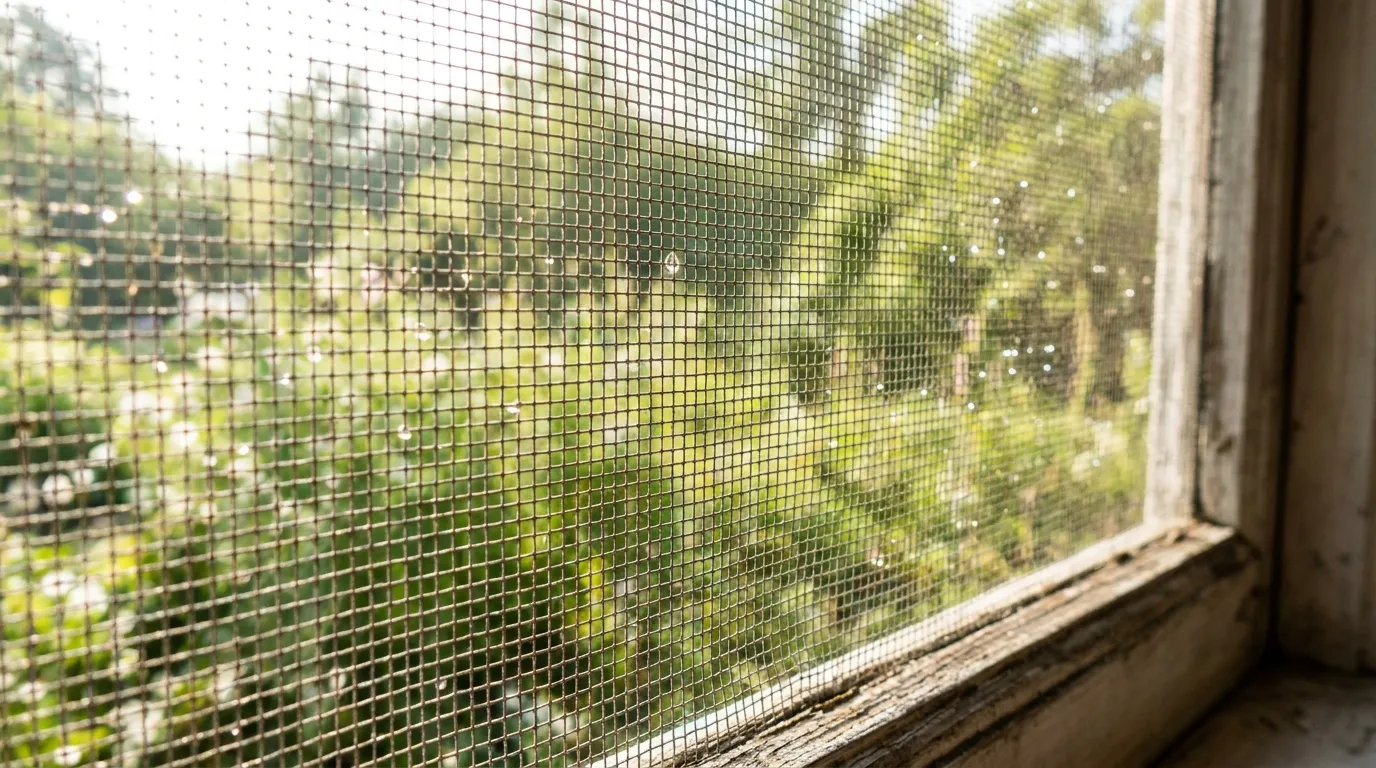
Standard window screening in Canada is fibreglass mesh in an 18-by-16 weave, meaning 18 strands per inch one way and 16 the other. It stops mosquitos, flies and wasps, resists corrosion, and is cheap and easy to work with, which is why it ships on most new windows. Its weaknesses are punctures and pets: a cat's claw or a ladder bumped against it will tear it, and tears are how bugs get in.
Where standard mesh falls short, specialty weaves take over. Fine-mesh screening, often called no-see-um mesh at 20-by-20 or tighter, blocks the biting midges and tiny gnats that sail straight through standard weave, a real consideration near the water in Lachine, Verdun or the Laurentians. Aluminum mesh holds its shape better and resists small punctures, and heavy polyester pet screens are roughly seven times stronger than standard fibreglass, worth every dollar on a patio door where a dog leans daily.
Mesh choice does involve one trade-off: the tighter the weave, the more it reduces airflow and visibility, by roughly 10 to 25 percent for fine mesh compared to standard. For most Montreal homes the sensible strategy is standard fibreglass everywhere, fine mesh on bedroom windows near standing water, and pet-grade screen on the doors and low windows animals can reach.
- Standard fibreglass (18x16): stops mosquitos, flies, wasps; inexpensive; tears under claws and impacts.
- Fine / no-see-um mesh (20x20+): blocks midges and gnats; slightly less airflow; best near water.
- Aluminum mesh: holds shape, puncture-resistant; can dent and oxidize over time.
- Pet screen (heavy polyester): about 7x stronger; ideal for patio doors and ground-floor windows.
- Solar mesh: blocks a share of solar heat as well as insects; useful on hot west exposures.
Inspecting and repairing your screens
Once a season, take ten minutes and run your hand over every screen in the house, feeling for tears, punctures and lifted edges, then check that each screen sits tight in its frame with no gap at the corners. Pinholes up to a few millimetres can be sealed instantly with a dab of clear silicone or a screen-patch sticker; anything larger, or any mesh that has gone brittle and chalky from UV exposure, deserves re-screening.
Re-screening is one of the most satisfying DIY jobs there is: a roll of mesh, a spline roller and new rubber spline cost under $30 at any hardware store, and the process, pry out the old spline, lay the new mesh, roll the spline back into its channel, trim the excess, takes about fifteen minutes per screen. Cut the mesh 5 cm oversize on all edges, keep modest tension while rolling, and always replace the spline rather than reusing the old one, since flattened spline is the main cause of mesh that pops out the following spring.
While each screen is out of its opening, check the hardware around it: the plunger pins or tension springs that hold it in place, and the felt or brush pile along sliding-window tracks. A screen that rattles in its track leaves a bug-sized gap along its whole edge; bent frames can often be gently straightened, but a badly twisted frame should be replaced, and Unisson Groupe supplies replacement screens sized to its windows for exactly this reason.
Door sweeps, thresholds and weatherstripping
Look at your entry door from inside a darkened hallway on a sunny day: if you can see daylight under it, you have an insect superhighway. A 6 mm gap under a standard 91 cm door is equivalent to a hole the size of a fist in your wall, invisible only because it is stretched thin. The fix is a door sweep, a strip of vinyl, silicone or brush pile screwed or slid onto the door bottom, that costs $15 to $40 and installs in twenty minutes.
Choose the sweep to match the door's behaviour. A fixed vinyl-fin sweep suits a door with an even threshold gap; a brush sweep handles slightly uneven floors and drags less; an automatic drop-down sweep, which lowers only when the door closes, is the premium answer for doors over finished floors. While you are there, check the adjustable threshold itself, most modern thresholds raise or lower with four or five screws, and the corner pads where the door meets the frame at the sill, a favourite wasp entry point.
Around the sides and top of the door, compression weatherstripping does the sealing. If a strip is flattened, torn or has pulled out of its kerf, replace it; magnetic or bulb-style seals should grip a sheet of paper firmly at every point around the frame. The same test applies to patio doors, where worn pile weatherstrip along the sliding panel edges is the most common insect entry on the whole house, and where the screen panel's own rollers and latch deserve an annual adjustment so the screen actually closes flush.
Sealing gaps around window and door frames
The joint where a window or door frame meets the wall cladding is sealed with a bead of caulking, and that bead has a service life of roughly 10 to 20 years depending on exposure. Walk the exterior with a notepad and inspect every joint: cracked, shrunken or peeling caulk, or caulk that has pulled away leaving a shadow line, is an open door for ants, earwigs, spiders and wasps scouting cavity nesting sites.
Redoing a joint properly means removing the old bead first, cut it out with a caulk removal tool or utility knife, clean and dry the surface, rather than smearing new product over old. Use an exterior-grade sealant that stays flexible through Quebec's freeze-thaw swings: polyurethane or a quality hybrid polymer handles joints up to about 10 mm, backed with foam backer rod for anything deeper. Tool the bead smooth so water sheds off it, and do the work in dry weather above 5 degrees.
Do not forget the penetrations that are not windows: dryer vents with broken flappers, gaps around exterior taps, cable and gas-line entries, and the joint between foundation and siding are all standard insect routes. A can of exterior-rated low-expansion foam and a few dollars of stainless or copper mesh, stuffed into larger cavities before foaming, close them permanently, and copper mesh has the bonus of deterring mice, which use the very same openings each fall.
Weep holes: drain water, block bugs
Those small slots at the bottom edge of your window frames and along the lower course of brick veneer are weep holes, and they are supposed to be there: they drain rainwater out of the frame's sill cavity and the air space behind the brick. Blocking them with caulk is one of the most damaging mistakes a homeowner can make, since trapped water in a frame rots wood, corrodes hardware and, behind brick, feeds efflorescence and frost damage.
The problem is that a weep hole is also a furnished apartment listing for insects: wasps, ants and spiders all use brick weeps as nest entrances, and window-frame weeps as shelter. The correct answer is a cover that passes water but not bugs, snap-in louvered weep hole covers with a hanging flap for window frames, and stainless mesh or corrugated plastic inserts for brick weeps, all of which cost a dollar or two per opening and install by hand.
Twice a year, spring and fall, pop the covers and clear the weeps themselves with a plastic zip tie or pipe cleaner, never a screwdriver that could damage the seal inside. If you see water sitting in a sliding window's bottom track after rain, clogged weeps are the usual culprit, and clearing them protects both the window and your bug defences.
How to ventilate all summer without inviting bugs in
The whole point of bug-proofing is to let you open the house in July with confidence. A few habits multiply the effectiveness of good screens: ventilate in the early morning and late evening when the air is cool but keep bedroom windows screened and closed during the dusk mosquito rush hour if you are near water; and cross-ventilate through two screened openings on opposite façades rather than one wide-open unscreened door.
Light management matters more than most people realize. Insects navigate to light, so a bright interior lamp beside an open unscreened window after dark is an active lure; switch exterior fixtures to warm-toned or yellow LED bulbs, which attract measurably fewer insects than cool white, and keep the fixture away from the door itself where possible.
Finally, audit the habits that defeat the hardware: the patio-door screen left half open behind a barbecue chef, the herb pots and standing water in saucers right under the kitchen window, the vine touching a second-floor screen that gives ants a bridge. Casement windows deserve a special mention here, because their screens sit on the interior side with the sash cranked outward, they are inherently harder for insects to breach than sliding formats, one more reason they are so popular in Quebec.
Frequently Asked Questions
What size gap can mosquitos actually get through?
A mosquito can pass through an opening of about 3 mm, and standard 18x16 screen mesh is woven precisely to stop them. Biting midges and no-see-ums are smaller and require fine 20x20 or tighter mesh, which is worth installing on bedroom windows if you live near water.
How do I fix a small tear in a window screen?
For pinholes and tears under a centimetre, a dab of clear silicone or an adhesive screen patch is an instant, durable fix. Larger tears call for re-screening, a 15-minute DIY job with mesh, a spline roller and new spline costing under $30, always with fresh spline so the mesh stays tensioned.
Why is there a gap under my entry door and what fills it?
Doors need clearance to swing over flooring, but the seal is supposed to come from a door sweep on the slab plus an adjustable threshold underneath. If you see daylight, install or replace the sweep ($15 to $40) and raise the threshold with its adjustment screws; an automatic drop-down sweep is the premium option over finished floors.
Should I caulk the little holes at the bottom of my windows?
No, never. Those are weep holes that drain rainwater out of the frame; sealing them traps water that rots and corrodes the window from inside. Use snap-in louvered weep covers or stainless mesh, which let water out while keeping wasps and ants from moving in.
Do bug problems mean my windows need replacing?
Not necessarily; screens, weatherstripping and caulking handle most infiltration on sound windows. But if frames are warped so sashes no longer close square, if pile weatherstrip is worn flat on a slider you use daily, or if the frame joints have opened, insect entry is a symptom of a window at end of life, and the same gaps are leaking heated air all winter.
What attracts wasps to my window frames specifically?
Wasps scout for sheltered cavities to nest in, and window assemblies offer several: open weep holes, gaps behind aluminum capping, and joints where caulking has failed. Covering weeps with louvered covers, re-caulking failed joints and sealing capping gaps in spring, before colonies establish, is far easier than removing an active nest in August.