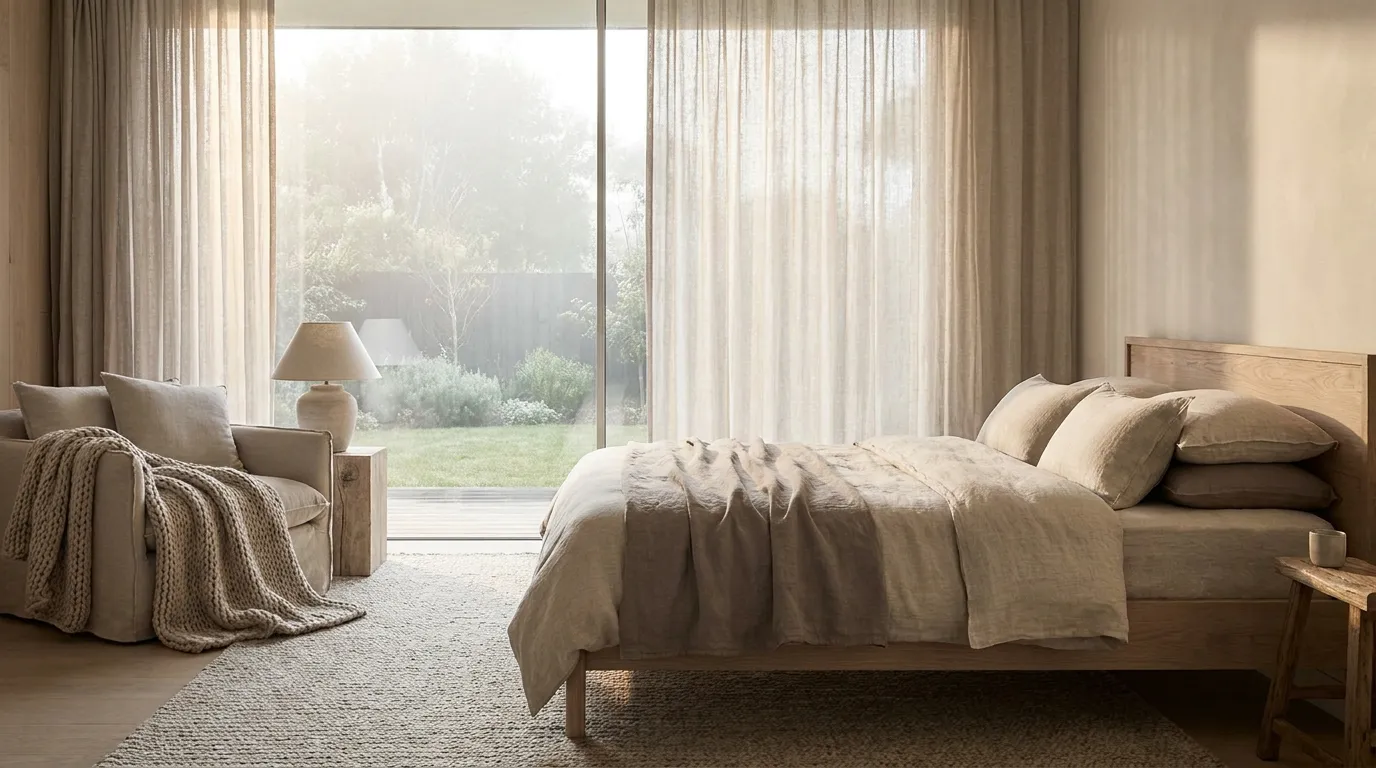
A bedroom window has one job the rest of the house never asks of a window: help you sleep. That means blocking streetlight and headlights, muffling traffic and neighbours, holding a steady temperature through a -25 °C night, and still opening wide enough to cool the room in July, and to get you out in an emergency. Here is how glass, style, and placement choices add up to quiet, dark, private Quebec bedrooms.
What your window has to do with how you sleep
Sleep researchers keep coming back to three environmental levers: darkness, quiet, and a cool room, ideally around 16 to 19 °C. Every one of those levers runs straight through the bedroom window. It is the brightest surface at night, the weakest acoustic link in the wall, and the biggest source of both unwanted heat gain in July and cold drafts in January. Upgrade the window and you move all three levers at once.
The stakes are higher in the city. A bedroom facing a Montreal arterial street can see nighttime noise of 55 to 65 decibels outside the glass, while sleep guidelines suggest keeping the room around 30 decibels. Streetlights and passing headlights sweep the ceiling all night through an ordinary pane and curtain. None of this is solved by one magic product; it is solved by picking the right glass package, the right operating style, and the right coverings together.
The good news is that the fixes stack. Laminated acoustic glass also improves security; triple glazing that quiets the room also warms the glass surface and cuts condensation; a casement that seals tightly against sound also seals against drafts. A bedroom window done right is simply a well-specified window, aimed at the one room where comfort is measured in hours of sleep.
Quieting street noise: laminated and acoustic glass
Sound gets through a window in two ways: through the glass itself, which vibrates like a drumhead, and through air leaks around the sash. Acoustic glazing attacks the first path with two tricks. Laminated glass bonds two sheets of glass around a plastic PVB interlayer that damps vibration the way a hand on a cymbal kills its ring. Asymmetric glazing uses panes of different thicknesses, say 3 mm and 5 mm, so that the frequency one pane transmits readily, the other resists.
The difference is audible, not subtle. A standard double-glazed window achieves roughly STC 28 to 30, a sound transmission class at which you clearly hear traffic and conversation. A well-built unit with one laminated pane and asymmetric glass reaches STC 34 to 38 and can go higher, and because decibels are logarithmic, those few points cut the perceived loudness of traffic roughly in half. Buses, motorcycles, and the neighbour's air conditioner drop from intrusive to background.
The second path, air leaks, is why the operating style matters as much as the glass. A compression-sealed casement window closes like a refrigerator door and lets very little sound sneak around the sash, while brush-sealed sliders leak both air and noise. If your bedroom faces the street, the honest recipe is a casement or fixed window with laminated asymmetric glazing, professionally installed with the perimeter fully insulated and sealed, because a hairline gap around the frame can undo an expensive glass upgrade.
- Laminated pane: a PVB interlayer damps vibration and also makes the glass tougher to break through, a security bonus
- Asymmetric thicknesses: panes of different thickness block a wider range of frequencies than twins
- Wider air space: more distance between panes improves low-frequency performance, where traffic rumble lives
- Compression seals: casement and awning styles close tightest, so less noise flanks around the glass
Triple glazing: the comfort upgrade you feel at night
Triple glazing earns its keep in a bedroom three ways. First, warmth: with three panes, two low-E coatings, and argon-filled cavities, the interior glass surface on a -25 °C Montreal night stays several degrees warmer than a double-glazed unit's. That kills the cold-radiation effect, the chilly pull you feel from a big window even when the air is warm, which matters most in the room where you lie still for eight hours a couple of metres from the glass.
Second, quiet: the third pane and extra cavity add mass and another air gap, typically buying a few decibels over standard double glazing even before any acoustic laminate. Third, condensation control: a warmer inner pane means you can keep bedroom humidity at a comfortable 35 to 40 percent in winter without waking up to fogged or frosted glass and wet sills, the slow-motion cause of mould around bedroom windows.
In the ENERGY STAR framework, Montreal and southern Quebec sit in the coldest performance tier, Zone D, and triple-glazed units are how most windows meet or beat the certification thresholds with room to spare. Expect to pay roughly 10 to 15 percent more per window than double glazing. For north-facing bedrooms, bedrooms over unheated garages, and any bedroom where the bed sits near the window, it is the single upgrade owners report noticing most, and you can compare glazing options across all our window styles.
Darkness on demand: blackout-friendly styles
True darkness is mostly a covering problem, but the window decides how well coverings can do their job. Light leaks around a blind, not through it, so the goal is a window that lets the covering sit close and overlap generously. Casement and fixed windows with clean, flat interior casings are the easiest to dress: no protruding sash handles at mid-height, no tilt latches, just a flat plane for a cellular blackout blind or track system to hug. Ask for fold-away crank handles so even the crank disappears into the frame.
If you love inside-mount blinds, frame depth matters. A deeper interior reveal lets the blackout blind recess fully so light cannot rake in from the sides; where the reveal is shallow, outside-mount coverings that overlap the opening by 8 to 10 cm on every side do a better job. Blackout curtains on a wraparound rod remain the gold standard for streetlight-facing bedrooms, and they add a useful layer of thermal and acoustic insulation in the bargain.
Think about glass tint as a complement rather than a substitute. Light grey or bronze tints take the edge off a bright morning and reduce glare, but no tint replaces a physical covering for sleeping in. The winning combination for shift workers and light-sensitive sleepers is a tight casement, a recessed blackout cellular blind, and curtains, three layers that also happen to be three more barriers against noise and winter cold.
Privacy without sacrificing light
Ground-floor bedrooms, bedrooms facing a neighbour's window a few metres away, and urban infill lots all pose the same question: how do you keep the light and lose the sightline? Obscure glass is the permanent answer. Satin-etched and frosted finishes blur shapes completely while passing nearly all the daylight; patterned options like rain or reed glass scatter the view decoratively. Because the treatment is in the glass, privacy never depends on remembering to close a blind.
You do not have to treat the whole window. A popular Quebec solution for close-set houses is a two-part window with obscure glass on the lower section, blocking the sightline from the street or the neighbour's yard, and clear glass above for sky, light, and a view of the trees. Transom windows placed high on the wall achieve the same trick architecturally: daylight floods in above eye level while the private zone of the room stays invisible from outside.
For flexibility, interior options still matter: top-down bottom-up cellular shades give you the same lower-half privacy on demand, and integrated blinds sealed between the glass panes never collect dust and cannot be rattled by an open sash. Combine any of these with the acoustic and blackout layers above and a ground-floor bedroom can feel as private as an attic room.
Ventilation: cool nights without the drawbacks
A bedroom that holds 26 °C at bedtime is a sleep problem no glass package can fix, and Montreal summers now deliver plenty of those evenings. Night cooling is the free remedy: open windows on opposite sides of the house after sunset and let the cross-breeze flush the day's heat out of the structure. The window style decides how well that works. A casement sash opened into the prevailing breeze scoops air into the room, and two casements on adjacent walls create a corner current that a fan would envy.
Awning windows add the rain trick: hinged at the top, the open sash sheds a summer shower away from the opening, so you can go to sleep with the window open even when thunderstorms are forecast. That makes awnings a favourite over beds and in kids' rooms, where nobody wants to get up at 2 a.m. to close a window. Whatever the style, insist on well-fitted screens, because a Quebec August without a screen is a mosquito problem, not a cooling strategy.
Security and peace of mind come from hardware. Modern casements and sliders offer limiters and night-vent locks that hold the sash a few centimetres open, enough for continuous airflow, too narrow for entry. For ground-floor bedrooms, pairing a night-vent position with laminated glass gives you ventilation and forced-entry resistance in the same window, so cooling the room never means feeling exposed.
Egress: the safety rule every bedroom window must meet
Quebec's Construction Code, based on the National Building Code, requires every bedroom without a sprinkler system to have at least one window you can escape through in a fire, unless the room has a door leading directly outside. The core numbers to remember: the window must provide an unobstructed opening of at least 0.35 square metres, with no dimension, height or width, smaller than 380 mm, and it must open from inside without tools, keys, or special knowledge.
Style matters here more than people expect. A casement window can satisfy egress with a relatively small frame because virtually the whole opening clears when the sash swings; hung and sliding windows only ever open half their area, so they must be considerably larger to leave the same escape hole. This is one more reason casements dominate modern bedroom specifications in Quebec. Watch the details, too: security bars or fixed screens that need tools to remove are not allowed on the egress window, and sill height should let occupants, including children, climb out.
When you replace bedroom windows, keep egress in the conversation from the first measurement. A replacement that shrinks the clear opening below the threshold, for example by inserting a new frame with a thicker profile into the old one, can quietly take a legal bedroom out of compliance. A professional measure flags this before manufacturing, and it is one of the checks that separates an RBQ-licensed installer's quote from a price on a piece of glass.
- Minimum clear opening: 0.35 m² with no dimension under 380 mm
- Operation: openable from inside without tools, keys, or special knowledge
- Style math: casements clear nearly 100 percent of their frame; hung and sliding styles only about half
- No obstructions: bars, grilles, or fixed screens requiring tools are not permitted on the egress window
Putting the bedroom package together
Specify a bedroom window from the outside in. Start with the noise reality of the facade: street-facing rooms justify laminated asymmetric acoustic glazing; quiet backyard rooms usually do not. Layer on climate: triple glazing with two low-E coatings and argon is the Zone D comfort baseline for a room where you sleep beside the glass. Then choose the style: a casement for maximum seal, ventilation, and egress efficiency, or an awning where open-in-the-rain matters, and confirm the clear opening meets egress if the room is a bedroom on paper or in practice.
Budget-wise, a quality triple-glazed PVC casement in typical bedroom sizes runs roughly $900 to $1,600 installed in Quebec, with acoustic laminated packages adding several hundred dollars on the street-facing units that need them. Spend where the noise and cold actually are: many projects put the acoustic package on two front bedrooms and standard triple glazing everywhere else, which keeps the total sensible without compromising the rooms that matter.
Replacing bedroom windows is also the natural moment to fix everything at once: perimeter insulation, airtight sealing, sloped sills, and coverings planned with the window rather than after it. If a bedroom in your home is too bright, too loud, or too cold to sleep well, a free estimate with a site visit will tell you exactly which of these layers your windows are missing.
Frequently Asked Questions
What kind of window glass is best for blocking street noise?
Laminated glass with a PVB interlayer, combined with panes of different thicknesses, gives the biggest audible improvement, lifting a window from roughly STC 28 to STC 34-38. Pair it with a compression-sealed style like a casement, because noise also leaks through gaps around the sash.
Is triple glazing worth it for a bedroom in Quebec?
For a room where you spend eight motionless hours near the glass, yes: the warmer inner pane eliminates the cold radiation you feel from a window on a -25 °C night, quiets the room a little further, and prevents winter condensation. It typically costs 10 to 15 percent more than double glazing.
What are the egress requirements for a bedroom window in Quebec?
A bedroom needs at least one window offering an unobstructed opening of 0.35 m² with no dimension under 380 mm, openable from inside without tools or keys. Casements meet this most easily since almost the whole frame clears; hung and sliding windows must be larger because only half opens.
How can I make my bedroom completely dark?
Darkness comes from layering: a flat-casing window style that lets coverings sit tight, a blackout cellular blind recessed in the frame or overlapping the opening by 8-10 cm, and blackout curtains on a wraparound rod. Those same layers also buffer noise and winter cold.
What privacy glass works best for a ground-floor bedroom?
Satin or frosted obscure glass blurs sightlines completely while passing nearly all daylight, and it never depends on closing a blind. A popular option is obscure glass on the lower section only, with clear glass above for sky and light.
Can I sleep with my window open when rain is forecast?
With an awning window, yes: the top-hinged sash tilts outward like a small roof, so showers shed away from the opening while air keeps flowing. Night-vent locks on casements and sliders offer a secure few centimetres of airflow as an alternative.