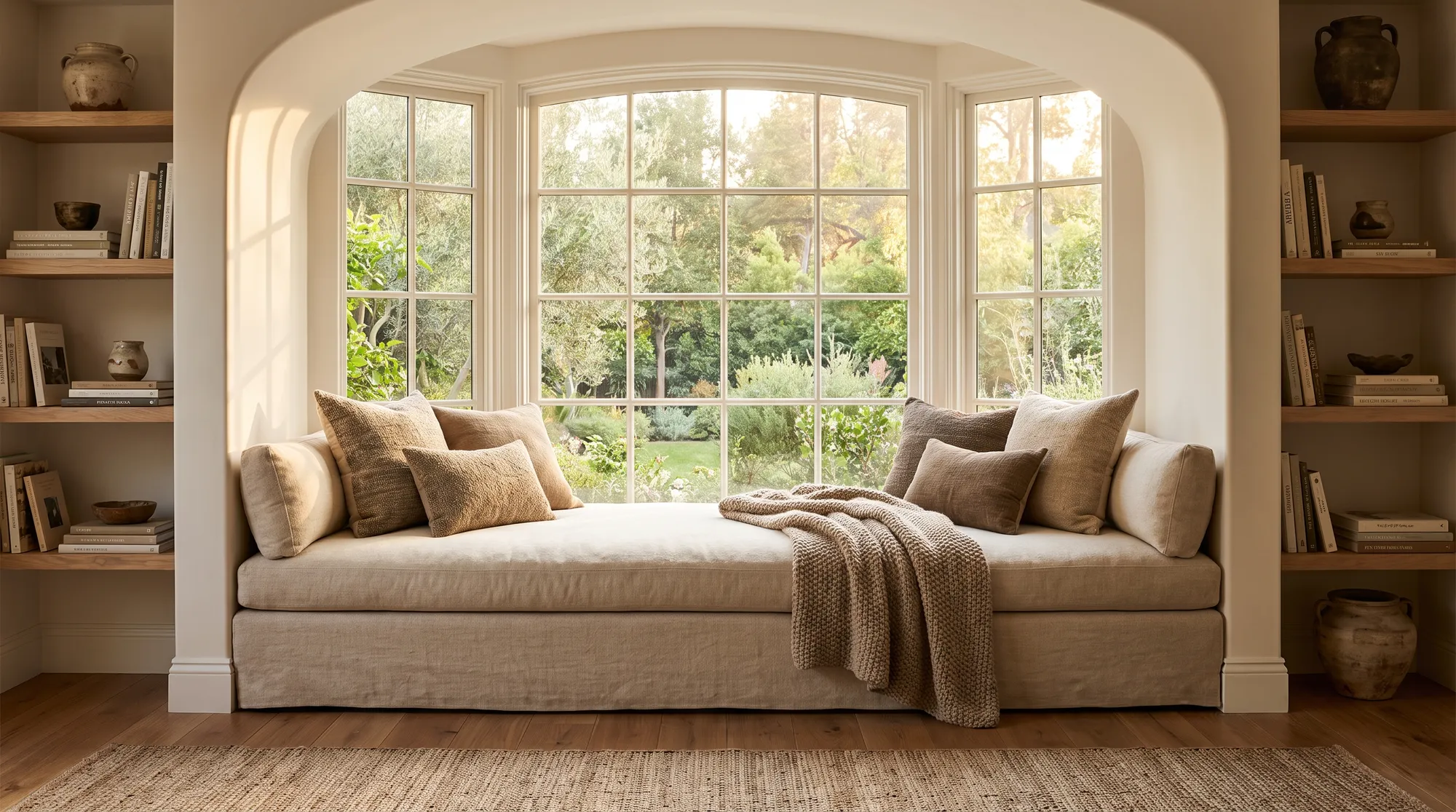
A bay window is the rare renovation that changes how a room feels from across the street and from inside an armchair at the same time. Add a built-in seat and it becomes the spot everyone gravitates to — morning coffee in the light, a child reading above the radiator, a cat asleep in a sunbeam at -20°C. Here is how to design a bay window nook that works through a Quebec winter, what it costs, and why buyers consistently pay for the cachet.
Why Bay Window Nooks Have Such Lasting Appeal
A bay window projects outward from the wall, typically adding 30 to 60 centimetres of depth and wrapping the opening in glass on three sides. That geometry does two things no flat window can: it pulls daylight into the room from multiple angles throughout the day, and it creates a defined alcove that reads as its own small destination within the room. Interior designers call this a « prospect and refuge » spot — a protected perch with a wide view — and humans are simply wired to love sitting in one.
In Quebec housing stock the effect is amplified. Our long winters mean residents spend far more waking hours indoors than the Canadian average, and daylight becomes a premium commodity from November through March. A south- or west-facing bay seat captures low winter sun that a flat window largely misses, turning the coldest months into the nook's best season — provided the build handles the cold correctly, which we cover below.
The nook also solves a practical problem: bay windows are notoriously awkward to furnish around. A sofa floats oddly in front of them; a table blocks the light. A built-in bench embraces the geometry instead of fighting it, adds seating without consuming floor area, and — done with storage — replaces a piece of furniture outright. In Montreal's compact rowhouses, duplexes and Plateau apartments, that reclaimed floor space is worth real money per square foot.
Which Window Configurations Suit a Nook
Not every projecting window makes an equally good seat, so it pays to choose the configuration with the nook in mind. A classic bay window is three units — a large fixed picture window flanked by two angled side units, typically at 30 or 45 degrees. The flat central section gives you a straight bench front and a generous view; the angled flankers wrap light around the sitter. This is the easiest geometry to build a bench into and the most common choice for reading nooks.
A bow window uses four to six identical units in a gentle curve. It projects less per unit of width but spreads light beautifully and suits larger, more formal rooms — a curved-front bench under a bow window is a showpiece, though the curved carpentry costs more. For either style, make the flanking units operable: casement or awning windows on the sides give the nook cross-breeze in summer, which matters when a sunny alcove can otherwise overheat in July.
Glass specification does the heavy lifting for winter comfort. Because a bay projects beyond the insulated wall plane, it runs colder than a flat window in January; specify triple glazing with double low-E coatings and argon fill, meeting ENERGY STAR requirements for Canada's coldest zones, so the seat stays usable at -30°C. Unisson manufactures bay and bow windows in Saint-Laurent with exactly these Quebec winters in mind, in UPVC and hybrid frames that shrug off condensation from a warm body sitting inches from the glass.
- Bay (3 units, 30°-45°): best all-around nook geometry; straight bench, wrapped light.
- Bow (4-6 units): elegant curve for larger rooms; costlier curved bench work.
- Operable flankers: casement or awning sides for summer ventilation of the alcove.
- Triple glazing, low-E, argon: non-negotiable for a seat you will use in February.
Designing the Bench: Dimensions and Storage
Get the dimensions right and the bench feels like furniture; get them wrong and it becomes a shelf for mail. Aim for a seat height of 40 to 46 centimetres (16-18 inches) including the cushion — standard chair height — and a depth of at least 50 centimetres for upright sitting, or 60 to 75 centimetres if you want to curl up sideways with a book. Keep the seat a few centimetres below the window sill so the cushion never presses against the glass or blocks the frame's operation.
Storage underneath is what turns the nook from charming to genuinely functional. You have three options, in ascending order of cost: a lift-top lid on a piano hinge (cheapest, best for blankets and seasonal items, but you must clear the cushions to open it), open cubbies faced with baskets (simple, kid-friendly, always accessible), and drawers on full-extension slides (most expensive, most convenient, and the option that reads as premium millwork to a future buyer). In smaller Montreal homes, drawer storage under a bay seat can absorb an entire linen closet's worth of contents.
Build quality shows in the details. Use 19 mm (3/4-inch) plywood rather than MDF for the carcass — it handles humidity swings near glass far better. Scribe the bench to the angled walls of the bay for tight joints, and paint or stain it to match the room's existing trim so it looks original to the house rather than added. A typical carpenter-built bench with drawers runs $1,500 to $4,000 CAD in the Montreal market depending on storage type and finish; flat-pack hacks using kitchen cabinets can land closer to $600 if you are handy.
The Quebec Detail: Insulating Under the Seat
Here is the mistake that ruins bay window nooks in this climate: skipping the insulation under the seat. Many bay windows — especially on older Montreal homes — project on a cantilevered floor extension whose underside is exposed to outdoor air. If that little floor is poorly insulated, the nook sits on what is effectively a cold diving board all winter. The floor of the bay runs 5 to 10 degrees colder than the room, the bench cavity becomes a cold box, and the beautiful seat goes unused from December to March.
The fix is straightforward during construction. If the bay is cantilevered, the joist cavity beneath it should be dense-packed with cellulose or, better, sprayed with closed-cell polyurethane foam to at least R-25 or higher, with rigid insulation and a sealed soffit closing the underside. If you are building the bench over an existing cold bay floor, line the bench cavity itself: rigid foam board on the floor and against the exterior-facing kick, sealed at the joints, before the carcass goes in. This costs a few hundred dollars and transforms the nook's winter usability.
Mind the heating, too. Many bays have a baseboard heater or radiator on the wall below the window — do not simply box it in. Either relocate the heater to an adjacent wall, or design the bench with a ventilated toe-kick grille and an open back channel so convection continues to wash warm air up across the glass. That rising warm air is also your condensation defence: trapped cold air behind a bench is how you end up with frost in the corners of brand-new triple-glazed windows.
- Insulate cantilevered bay floors to R-25+ with closed-cell foam or dense-packed cellulose.
- Line the bench cavity with sealed rigid foam if the bay floor is cold and inaccessible from below.
- Never enclose a baseboard heater — relocate it or duct airflow through a toe-kick grille.
- Keep an air channel behind the bench so warm air reaches the glass and prevents condensation.
- Air-seal where the bay meets the main wall; gaps here are classic Quebec draft points.
Cushions, Fabrics and Comfort That Lasts
The cushion is where the nook succeeds or fails as a place you actually sit. Use high-resilience foam of at least 2 pounds per cubic foot density, 10 centimetres (4 inches) thick, ideally wrapped in a layer of Dacron batting for a softer edge profile. Cheaper low-density foam feels fine in the store and collapses within a year of daily sitting. Have the cushion cut as a single piece the full width of the bench, or as sections matching the drawer bays below so lifting one section opens one compartment.
Fabric choice should respect the sun. A bay window seat lives in direct light, and ordinary cottons fade visibly within two summers. Choose solution-dyed acrylics or high-rub-count performance weaves (50,000+ double rubs) in fade-resistant colours; these fabrics were developed for marine and outdoor use and are now widely available in interior-friendly textures. Zippered, removable covers are worth insisting on — in a house with kids, pets or coffee, you will wash them.
Layer the textiles for the seasons the way Quebecers layer clothing. A linen or performance-weave base cushion works year-round; add wool throws and chunky knit cushions from October to April, swap to lighter cottons in summer. Because the seat sits against glass, a few larger back cushions along the window also add a welcome thermal and acoustic buffer on the coldest nights.
Lighting: From Daylight Perch to Evening Retreat
Daylight is the nook's whole premise, but in a Quebec December the sun sets before 16 h 15 in Montreal — an unlit nook is a dead zone for half of every winter day. Plan the artificial lighting during the bench design, not after, because the best options need wiring roughed in before the carcass closes up.
The workhorse is a wall-mounted swing-arm reading sconce at each end of the bench, mounted 120 to 140 centimetres above the seat so light falls over the shoulder onto a page. Choose warm lamps around 2700 K with dimming. For ambience, an LED strip tucked under the bench lip or along the window head casing washes the alcove in soft indirect light and makes the bay glow invitingly from the street — worth doing for curb appeal alone. Put the two circuits on separate switches or a smart dimmer at arm's reach from the seat.
Do not forget an outlet. Code aside, a duplex receptacle on the bench face or inside a drawer keeps phone chargers, a laptop, or the heating pad off extension cords. If the nook doubles as a remote-work perch — increasingly common since so many Quebec professionals work hybrid — that outlet is the difference between a reading spot and a favourite office.
What a Bay Window Nook Does for Home Value
Real-estate agents talk about « memory points » — the one or two features visitors mention after touring a house. A window seat in a light-filled bay is reliably one of them. It photographs beautifully in listings, signals custom millwork quality, and lets buyers instantly picture a life in the house. In a market like greater Montreal where many properties in a neighbourhood share near-identical floor plans, that differentiation has concrete value at sale time.
The numbers stack up reasonably. A quality manufactured bay window installed by an RBQ-licensed contractor typically runs $2,500 to $6,000+ CAD depending on size and glazing; the insulated bench with storage adds $1,500 to $4,000. Window replacement projects in Canada consistently return a healthy share of their cost at resale, and the energy math helps too: replacing an old draft-prone flat window with a triple-glazed ENERGY STAR bay improves comfort and may qualify for Rénocliméat support of roughly $150 CAD per opening as part of an energy retrofit.
The unquantifiable return is the one owners cite first, though. In climate terms, a well-built bay nook manufactures the scarcest resource of a northern winter — a warm, bright place to sit in the sun — and does it within your own living room. Few renovations of this size change daily life as much.
Frequently Asked Questions
Can you really sit in a bay window in winter in Quebec?
Yes, if two things are done right: the glazing and the underside. Triple-glazed, low-E, argon-filled units keep the interior glass warm enough to sit beside at -30°C, and insulating the cantilevered floor or bench cavity to R-25+ eliminates the cold-floor effect. Skip either one and the nook will go unused all winter.
How much does a bay window with a built-in seat cost in Montreal?
Budget roughly $4,000 to $10,000 CAD all-in: $2,500-$6,000+ for a quality manufactured bay window professionally installed, and $1,500-$4,000 for a custom insulated bench with storage, cushions and lighting. Handy homeowners can trim the bench cost significantly using cabinet-based DIY approaches.
What is the difference between a bay and a bow window for a nook?
A bay uses three units with a flat centre and angled sides — the easiest shape for a straight bench and the most popular nook choice. A bow curves gently with four to six identical units, suiting larger rooms and offering a dramatic curved seat at a higher carpentry cost. Both work; the bay is the practical default.
Do I need a permit to add a bay window in Quebec?
Usually yes. Replacing a window like-for-like is often exempt, but a bay window changes the building envelope and the façade, which most Quebec municipalities regulate — and boroughs like Plateau-Mont-Royal have strict façade rules. Check with your borough or municipality first, and use an RBQ-licensed contractor for the structural work.
What about the baseboard heater under my window?
Never simply box it inside the bench — it will overheat the cavity and starve the room of heat. Either have an electrician relocate it to an adjacent wall, or design the bench with a ventilated toe-kick grille and rear air channel so warm air still rises across the glass. That airflow also prevents condensation behind the bench.
Does a window seat actually add resale value?
It adds a disproportionate amount of perceived value. Window projects recover a solid share of their cost at resale in Canada, and agents consistently rank window seats among the features buyers remember after visits. Combined with the energy upgrade of modern bay and bow windows, it is one of the better cost-to-charm ratios in renovation.