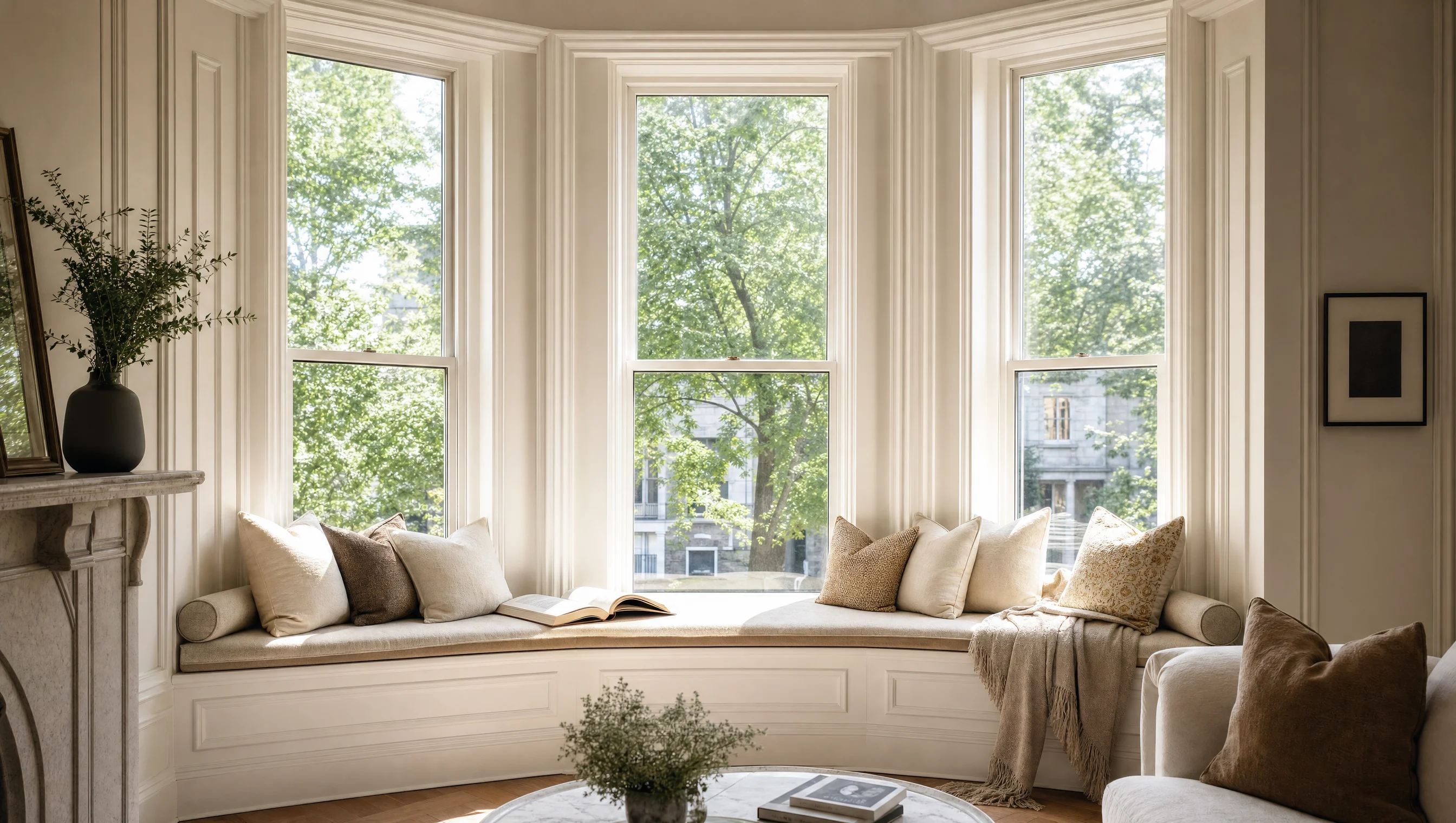
Bay and bow windows turn a flat, ordinary wall into a dramatic projection that floods a room with daylight and adds a sense of space you simply cannot get from a standard flat window. But the two are not interchangeable: the choice between them shapes the architectural feel of your facade, the way light enters, the structural depth required, and the final price. This guide breaks down every difference so you can choose with confidence for your Montreal home.
What is the Difference Between Bay and Bow Windows?
A bay window combines three sections set at sharp angles — typically a large picture window in the centre flanked by two operable side windows angled at 30 to 45 degrees. The result is a bold, faceted projection that pushes a defined nook out from the wall, creating a clear pocket of space inside the room.
A bow window, by contrast, curves outward in a gentle arc using four to six smaller window units joined at softer angles, usually around 10 to 15 degrees each. Because the individual panels are narrower and more numerous, the overall effect is a smooth, rounded sweep rather than the angular bump of a bay.
Both are “projection” or “compound” windows because they extend beyond the plane of the wall, and both require a properly built and insulated head and seat box above and below the glass. The geometric difference — angular versus curved, fewer larger panels versus more smaller ones — is what drives the differences in light, cost, and architectural fit that follow.
Style and Architectural Match
The right choice often comes down to the era and character of your home. Bay windows, with their crisp angles and larger central pane, suit both modern builds with clean lines and many traditional homes. They make a strong, confident statement on a flat suburban facade in Laval or on the South Shore and pair naturally with contemporary trim.
Bow windows, with their flowing curve, are a classic match for Victorian, Greystone, and heritage homes — exactly the housing stock that defines streets in Outremont, Westmount, and the Plateau. The gentle arc echoes the rounded turrets and bay fronts of nineteenth-century architecture and looks at home on a brick or stone facade.
Beyond era, think about the view and the room. A bay frames a single dominant view through its large centre pane, ideal for looking onto a garden or a tree-lined street. A bow spreads the view across several panels for a wider, panoramic sweep, which works beautifully on a corner room or anywhere you want to capture a broad outlook.
Energy and Ventilation Performance
Both styles ventilate well, but in slightly different ways. A bay window usually has two operable side units — often casements — that throw open at an angle to scoop cross-breezes into the room. A bow typically includes one or two operating units, frequently at each end, with the remaining panels fixed, so you balance airflow against the larger fixed glass area.
In Quebec’s climate, the energy story of a projection window lives in the details below the glass. The seat box beneath the window and the head box above it must be insulated to a high standard, because an uninsulated cavity becomes a cold sink that drafts onto your feet and can frost over. Proper flashing and a continuous air barrier are non-negotiable to keep wind-driven rain and meltwater out of the projection.
Specify the glass for our winters and both styles perform well. Triple-pane Low-E glass with argon fill and warm-edge spacers keeps the interior surface warm and condensation at bay, even on a faceted bay where corners are naturally the coldest points. A well-built, well-insulated projection performs as comfortably as the flat wall it replaced.
- Both can be specified with triple-pane Low-E glass and argon fill
- Insulated seat and head boxes are essential to prevent winter drafts
- Properly flashed projections shed wind-driven rain and meltwater
- Bay: two operable sides for strong cross-ventilation
- Bow: operating units typically at each end with fixed panels between
Interior Space and Everyday Living
One of the biggest reasons homeowners choose a projection window is the usable space it creates inside. A bay window’s angular pocket produces a deep, defined ledge — often 12 to 18 inches (30 to 45 cm) — that is perfect for a built-in window seat with storage underneath, a reading nook, or a generous display shelf for plants and dishes.
A bow window’s curve creates a softer, more sweeping ledge that follows the arc of the glass. It is slightly shallower at any single point but spreads across a wider span, which suits a row of plants, a curved bench, or simply a bright, open corner that makes a modest room feel considerably larger.
Both styles dramatically increase natural light because glass wraps around three or more directions instead of facing straight out. In a north-facing Montreal living room that would otherwise feel dim through the long winter, that extra side glazing pulls in morning and afternoon light that a flat window would miss entirely.
Cost Comparison in Quebec
A bay window installation typically runs $4,500 to $9,000 in Quebec, depending on size, the number of operable units, the glazing package, and the finish. The price reflects not just the window itself but the carpentry of the seat and head boxes, the flashing, and often interior trim work to finish the new nook.
Bow windows usually cost 15% to 25% more than a comparable bay because they use more individual window units and require curved framing that takes more labour to build and install correctly. The additional panels also mean more sealed glass edges, each of which must be flashed and finished, adding to both material and labour.
Whichever you choose, the bulk of the cost beyond the window is structural and finishing work, so a detailed, itemized quote matters. Larger projections may need cable supports or knee brackets to carry the weight, and any quote should spell out the support method, the insulation of the boxes, and the warranty on the glass seals.
Structural Support and Installation
Because a projection window carries its own weight out beyond the wall — plus the weight of anyone who sits on the ledge — larger bay and bow units need engineered support. This usually takes the form of steel cable supports anchored above and tied into the framing, or knee brackets beneath the seat box that transfer the load back to the wall.
Installation also demands meticulous weatherproofing for our climate. The roof of the projection (the head) must be sloped and flashed to shed rain and snowmelt, the seat must be insulated and sealed against air leakage, and a continuous water-resistive barrier must wrap the whole assembly. Cutting corners here is the single most common cause of leaks and cold spots in poorly built projections.
This is firmly professional territory. A qualified installer holding a valid RBQ licence will assess whether your wall can carry the projection, design the support, build and insulate the boxes to code, and warranty the result — protections that a do-it-yourself approach simply cannot offer.
See Live Examples and Next Steps
The easiest way to decide is to stand inside a real projection and feel the light and space for yourself. Explore our bay and bow windows page for technical specifications, glazing options, and finish choices, and see how each style transforms a room.
When you are ready, request a free estimation and our team will assess your wall, recommend the right style for your home’s architecture and orientation, design the support and insulation, and provide a fixed-price written quote. We manufacture locally in Saint-Laurent and back every installation with a long-term warranty.
Frequently Asked Questions
Do bay windows need extra support?
Yes. Larger bay units need engineered support such as steel cable supports anchored above or knee brackets beneath the seat box to carry the projection’s weight. A qualified installer assesses this and includes the proper support method in the quote.
Are bow windows colder in winter?
Not when they are built correctly. A properly insulated bow window with triple-pane Low-E glass, sealed and insulated seat and head boxes, and continuous flashing performs as well as a standard wall unit in Quebec winters. Cold spots only appear when the boxes are left uninsulated or the projection is poorly flashed.
Can I add a window seat to a bay or bow window?
Yes. The projection naturally creates a 12 to 18 inch (30 to 45 cm) deep ledge that is ideal for a built-in bench, often with storage underneath. A bay gives a deeper, more defined seat, while a bow offers a wider, gently curved ledge.
Which is more expensive, a bay or a bow window?
Bow windows generally cost 15% to 25% more than a comparable bay because they use more individual window units and require curved framing that takes more labour. A bay installation typically runs $4,500 to $9,000 in Quebec, with bows landing above that range.
Which style suits a heritage Montreal home?
Bow windows, with their gentle curve, are the classic match for Victorian, Greystone, and heritage homes common in Outremont, Westmount, and the Plateau. Bays, with their crisp angles, suit modern builds and many traditional suburban facades in Laval and on the South Shore.
Do bay and bow windows qualify for rebates?
Yes, the window units themselves qualify when ENERGY STAR certified for Climate Zone D, so Rénoclimat and the federal Canada Greener Homes program can apply. Confirm the certification in writing and ensure your installer holds a valid RBQ licence, since this is often tied to rebate eligibility.