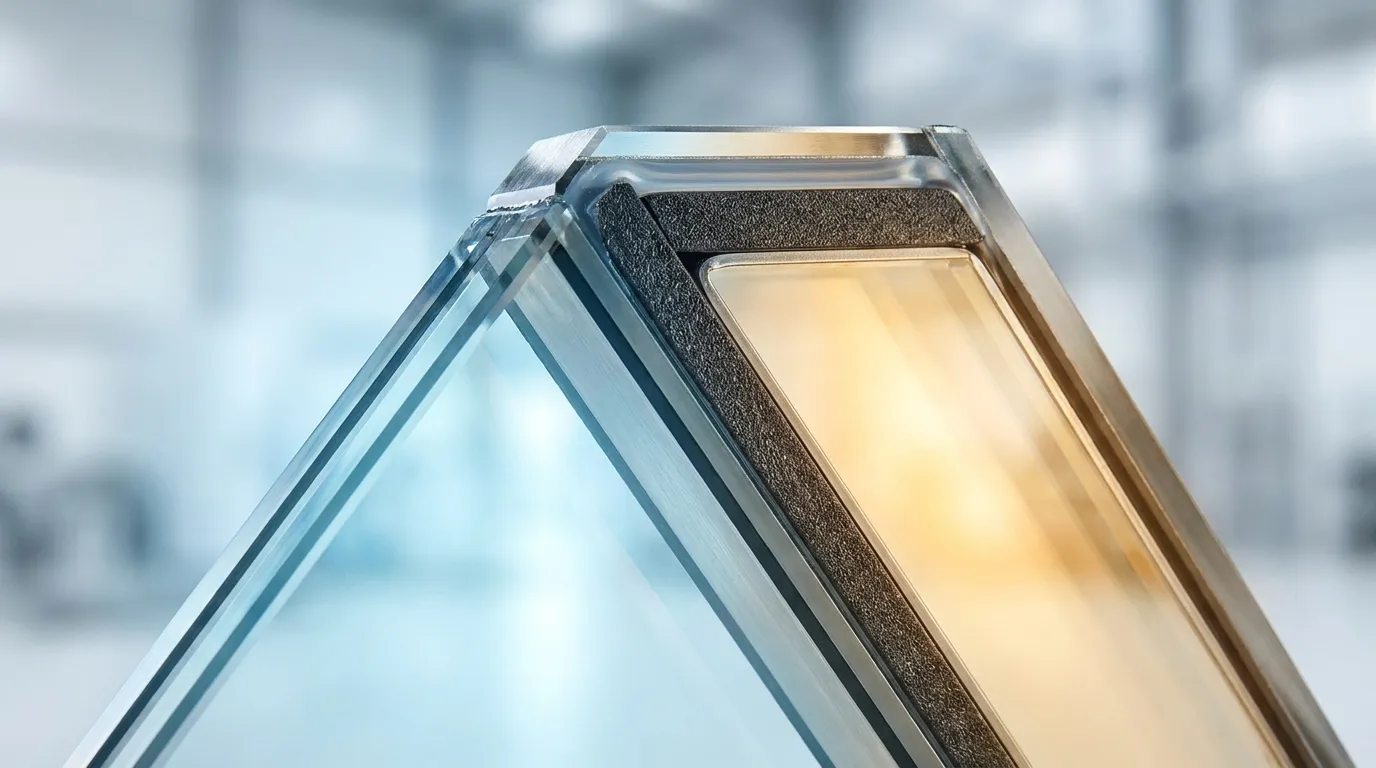
Nearly every window quote in Quebec now includes two small words, argon fill, and most homeowners have no idea whether they are paying for physics or for marketing. The short answer: argon is real, measurable, and one of the cheapest efficiency upgrades in the entire window. The long answer, including how much it helps, whether it leaks out, and when krypton makes sense instead, is what this article is for.
What argon actually does between the panes
Every modern window is built around an insulated glass unit: two or three panes sealed around a spacer, with a gas-filled cavity between them. That cavity is where a huge share of the window's insulating work happens, and the physics is simple: heat crossing the cavity must conduct through the gas and ride its convection currents. The less conductive and more sluggish the gas, the less heat gets across.
Argon is about 34 percent denser than air and has roughly one-third lower thermal conductivity. Fill the cavity with argon instead of dry air and you slow conduction directly, and because the heavier gas circulates more lazily, you also weaken the convection loops that ferry heat from the warm pane to the cold one. It is the same principle as swapping a thin windbreaker for a down parka: same thickness, better still-air performance.
Argon is also a genuinely boring gas in the best way: inert, colourless, odourless, non-toxic, and abundant, it makes up almost 1 percent of the atmosphere and is captured as a by-product of industrial oxygen production. That abundance is exactly why the upgrade is cheap, and why there is no health or environmental concern if a sealed unit ever breaks.
The numbers: how much argon improves U-factor
The U-factor measures how fast heat escapes through the whole window, in W/m2K here in Canada, and lower is better. Moving from an air fill to a 90 percent argon fill in a typical double-glazed low-E unit improves the centre-of-glass U-factor by roughly 0.2 to 0.3 W/m2K, which translates to a whole-window improvement in the range of 5 to 10 percent. That may sound modest, but it is the difference that helps push a good double-glazed window under the ENERGY STAR Zone D threshold of 1.4 W/m2K required for Montreal and southern Quebec.
Argon punches far above its weight because of how it interacts with the low-E coating. The coating handles radiant heat, the argon handles conduction and convection, and together they attack all three transfer mechanisms; an argon fill without low-E, or low-E without argon, leaves one channel wide open. This is why reputable Quebec manufacturers treat low-E plus argon as a single package, and why comparing quotes requires checking that both are present in every unit, not just the showroom sample.
There is a comfort dividend the U-factor number understates. A better-insulated cavity keeps the interior pane warmer on a -25 C night, which means less cold radiating onto your skin near the window, less convective draft rolling off the glass, and a higher resistance to condensation and frost forming at the glass edge. Homeowners consistently notice this before they notice anything on a heating bill.
- Centre-of-glass gain: roughly 0.2 to 0.3 W/m2K over an air fill.
- Whole-window gain: about 5 to 10 percent lower U-factor.
- Zone D target: 1.4 W/m2K or better for Montreal; argon helps get there.
- Felt benefit: warmer interior glass, fewer drafts, less edge condensation.
Argon vs krypton: when the expensive gas earns its keep
Krypton is argon's rarer, heavier cousin: denser still, less conductive still, and dramatically more expensive, because it is about 400 times scarcer in the atmosphere. In the right cavity it outperforms argon meaningfully. The catch is the phrase in the right cavity: krypton's optimum performance comes in narrow gaps of roughly 6 to 9 mm, while argon peaks in the 12 to 16 mm gaps that standard double-glazed units already use.
That geometry is why krypton's natural home is triple glazing. A triple-glazed unit squeezed into a frame of normal thickness must use two narrow cavities, exactly where argon underperforms and krypton shines. In practice, Quebec manufacturers offer argon-filled triples as the standard and krypton or argon-krypton blends as a premium for maximum performance or where a slim triple unit must fit a narrow frame profile. Our guide to triple-glazed windows covers when that whole upgrade path makes sense for a Quebec home.
For a standard double-glazed replacement window, the verdict is easy: take argon, skip krypton. The krypton premium can run $50 to $150 or more per window for a gain your heating bill will struggle to detect in a wide cavity, while argon delivers most of the available benefit at a fraction of the price.
Does the argon leak out over time?
Yes, slowly, and far more slowly than the folklore suggests. A properly manufactured sealed unit loses argon by diffusion through its edge seals at roughly 1 percent per year or less, a rate confirmed by both laboratory aging tests and industry certification standards, which typically require at least 80 percent retention after 20 years. At 1 percent per year, a unit that starts at 90 percent argon still holds most of its fill after two decades, and the performance penalty at that point is a small fraction of the original argon benefit.
The real risk is not slow diffusion but seal failure. If an edge seal cracks, from thermal stress, poor manufacturing, or improper installation that leaves the unit sitting in water, the argon escapes quickly and humid air takes its place, which is precisely when you see fog or condensation between the panes. A fogged unit has lost its argon, its dry air, and its dignity all at once, and the fix is replacing the sealed unit, which is routine and much cheaper than replacing the window.
Your protection is boring diligence: buy units from a manufacturer certified to Canadian standards, confirm the warranty covers seal failure for 10 to 20 years, and make sure installation follows the drainage and shimming practices that keep unit edges dry. Quebec's freeze-thaw cycling is a demanding test bench, and warranty terms are where manufacturers reveal how confident they are.
What argon costs, and what it gives back
Here is the pleasant surprise of this whole topic: argon is nearly free. The gas itself costs the manufacturer pennies per unit, and the fill adds roughly $30 to $60 per window at retail; many Quebec manufacturers, Unisson included, simply build low-E argon glazing as their standard specification rather than an option. On a whole-home project of 12 windows, you might be looking at a few hundred dollars total for the argon component, buried inside the glazing package.
Payback arithmetic at that price is almost unfair. A 5 to 10 percent whole-window efficiency gain on windows that account for a quarter of a typical home's heat loss yields modest but real annual savings, and at Quebec electricity rates the argon premium typically pays for itself within a handful of heating seasons, then keeps paying for decades. Very few building upgrades of any kind have a better ratio of cost to permanent benefit.
Argon also does quiet work for your grant eligibility. Programs like Rénoclimat, which pays around $150 per replaced opening, and the broader federal efficiency programs all key off ENERGY STAR certification and U-factor thresholds, and the argon fill is part of how affordable windows hit those numbers. Skipping argon to save $40 a window can literally cost you the $150 subsidy on that same opening.
The verdict for Quebec homes
In a climate with 4,500-plus heating degree days, where January nights sit at -20 C and windows are the thermal weak point of every wall they occupy, argon fill is not a gimmick and not a luxury; it is the baseline. It is real physics, delivering a measurable 5 to 10 percent whole-window gain, for a cost so small that refusing it is a false economy. Any new window quoted for a Quebec home should include low-E glass with argon fill as a matter of course, and any quote that omits it deserves a pointed question.
Where judgment enters is above that baseline. Double-glazed low-E argon is the sensible floor; triple glazing with argon is the comfort-and-efficiency upgrade that makes particular sense for bedrooms, north faces, noisy streets, and anyone planning to stay in the house long-term; krypton belongs in narrow-cavity triples and specialty applications. Match the glazing to the room and the budget, and let argon quietly do its work in all of them.
One final tip when you shop: ask for the whole-window U-factor on the NRCan or ENERGY STAR label, not the centre-of-glass number from a brochure, and confirm Zone D certification. The label bakes in the frame, the spacer, the low-E, and the argon together, and it is the single most honest number in the window industry.
Frequently Asked Questions
How much difference does argon gas really make?
In a typical double-glazed low-E window, argon improves the centre-of-glass U-factor by about 0.2 to 0.3 W/m2K, or roughly 5 to 10 percent for the whole window. It also keeps the interior pane warmer on cold nights, which means fewer drafts and less condensation, a benefit Quebec homeowners feel immediately.
Does argon gas leak out of windows over time?
Slowly, yes: a well-made sealed unit loses roughly 1 percent of its argon per year through the edge seals, so it retains most of its fill after 20 years. Fast loss only happens when a seal fails outright, which announces itself as fog between the panes and is covered by any decent 10-to-20-year warranty.
Is krypton worth the extra cost over argon?
Only in narrow cavities. Krypton outperforms argon in gaps of about 6 to 9 mm, which is why it belongs in slim triple-glazed units, but in the 12 to 16 mm cavity of a standard double-glazed window it adds $50 to $150 per window for a gain you will not feel. For standard windows, argon is the smart money.
Can I tell if my windows actually have argon in them?
Not by looking, since argon is colourless and invisible. Check the sealed-unit label or spacer stamp, the manufacturer's order documentation, or the ENERGY STAR listing for the model; professionals can also test non-destructively with a spark or gas-analysis device. Fog between panes is the one visible sign the gas is gone.
Do argon windows qualify for grants in Quebec?
Argon itself is not the criterion, but it helps windows meet the ENERGY STAR Zone D U-factor threshold of 1.4 W/m2K that programs key off. Rénoclimat pays around $150 per eligible replaced opening, so skipping a $40 argon fill can cost you a $150 subsidy on the same window.
Is argon gas safe if a window breaks?
Completely. Argon is an inert, non-toxic, non-flammable gas that already makes up almost 1 percent of the air you are breathing right now. If a sealed unit breaks, the small volume of argon disperses instantly and harmlessly; the only loss is the window's insulating performance.